



Written by Rick Kovac, COO of Golden Lighting
The takeaway: A color glass chandelier can give a room a genuine focal point, but the color only works when it's sized to the furniture, cleared correctly for the ceiling, and backed up by task or accent lighting where the tinted glass can't carry the load on its own.
Key takeaways:
- Choose the glass color after reviewing the room's permanent materials — flooring, countertops, cabinetry, upholstery — so the chandelier connects them rather than competing with them.
- Size from the table first (half to two-thirds of the table's width), then check the room-formula diameter and hanging clearance as secondary references.
- Tinted and smoked glass reduces usable light output, so plan for layered task or accent lighting rather than relying on the chandelier alone.
- Keep at least 7 feet of clearance from the floor to the fixture bottom in walking areas — that's the hard minimum, with 7.5 feet preferred where the ceiling allows it.
A dark, echoing entryway or a dining room that feels flat can make an entire home seem unfinished. More paint and heavier furniture rarely solve the problem. A well-chosen color glass chandelier can add visual structure, warmth, and a clear focal point while still functioning as a practical light source.
The right fixture does more than fill ceiling space. Its glass color influences the room's mood, its transparency affects usable brightness, and its proportions determine whether the installation feels composed or intrusive. For homeowners and designers, the strongest choice balances appearance, engineering, maintenance, and long-term flexibility.
Why a Color Glass Chandelier Transforms a Room
A cavernous foyer often needs architectural weight. A sterile dining room may need a warmer visual center. Colored glass addresses both conditions by giving the eye something substantial to read, even when the fixture is switched off.
A clear chandelier reflects and distributes light with a relatively neutral presence. Amber, rose, smoky gray, blue, or jewel-toned glass introduces another layer. The fixture becomes part of the room's palette, not merely an object attached to the ceiling.
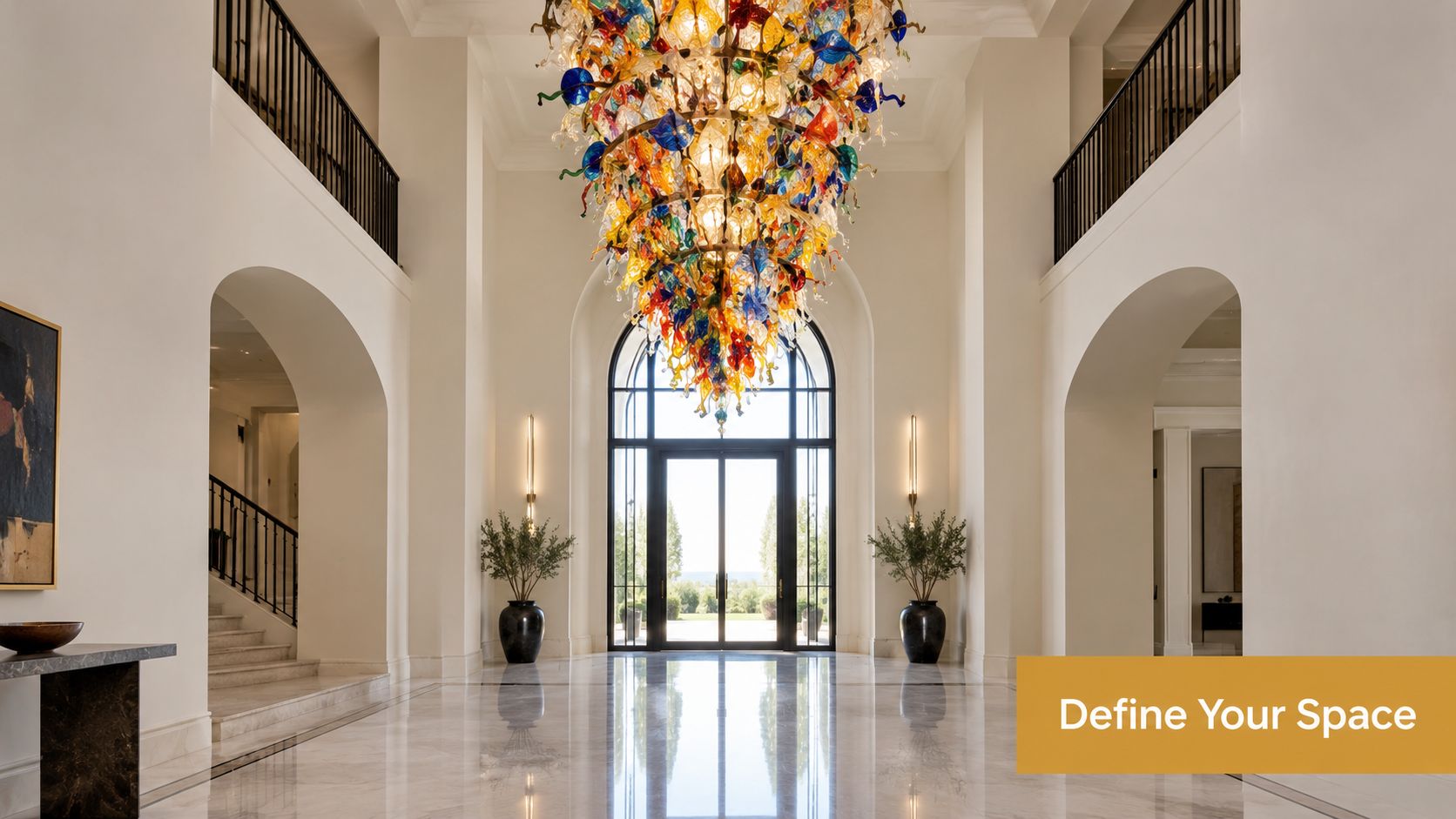
Color creates a visual anchor
A sculptural glass arrangement can soften a large open plan, define a dining zone, or make a narrow entryway feel deliberately designed. The effect works because the chandelier combines vertical scale with color. It draws attention upward while connecting the ceiling to furniture, wall finishes, artwork, and flooring.
Current design coverage points toward bold color, sculptural silhouettes, and tinted or jewel-toned glass as a projected 2026 statement direction (chandelier trend coverage from Residence Supply). That direction gives creative homeowners more freedom than the familiar clear-glass default, but trend appeal shouldn't replace practical evaluation, and it's worth remembering that a retailer's own trend guide reflects what it stocks as much as neutral design research.
A color glass chandelier earns its place when the color supports the room rather than competing with every other finish. In a quiet interior, a saturated fixture can provide the needed focal point. In a patterned room, softer tinting or a more open glass arrangement usually creates better balance.
Practical rule: Choose the glass color after reviewing the room's permanent elements, including flooring, countertops, cabinetry, and upholstery. The chandelier should connect those materials, not introduce an unrelated accent.
Style value needs functional value
Colored glass can contribute to perceived warmth and personality, but it doesn't automatically provide sufficient illumination. The fixture may become a decorative anchor while another layer, such as recessed lighting, sconces, or pendants, handles work surfaces and circulation paths.
The historical foundation is substantial. A first glass chandelier may have been made in 1673 in Orléans, France, while molded glass elements were already used in chandeliers by the end of the seventeenth century. The form was described as fully developed only after 1740, and early colored-glass formulas appeared in 1612 in Antonio Neri's L'Arte Vetraria, which was translated into English in 1662 (history of chandeliers).
That history matters because colored glass isn't a passing novelty. It represents a long relationship between craft, refraction, color, and architectural display. The modern buying decision is more specific: determine whether the chosen glass provides the right atmosphere without sacrificing the room's everyday usability.
Understanding Glass Composition and Finish Options
Not all colored glass behaves the same way. The first distinction is between color integrated into the glass itself and color applied to the surface after the glass has been formed.
Mineral-infused glass receives its color through minerals added during melting. The hue becomes part of the glass structure, so a chip doesn't reveal a neutral material beneath a painted exterior. Surface-coated glass uses paint, foil, or another treatment on the outside. It can produce a vivid finish, but the exterior layer needs more careful handling.
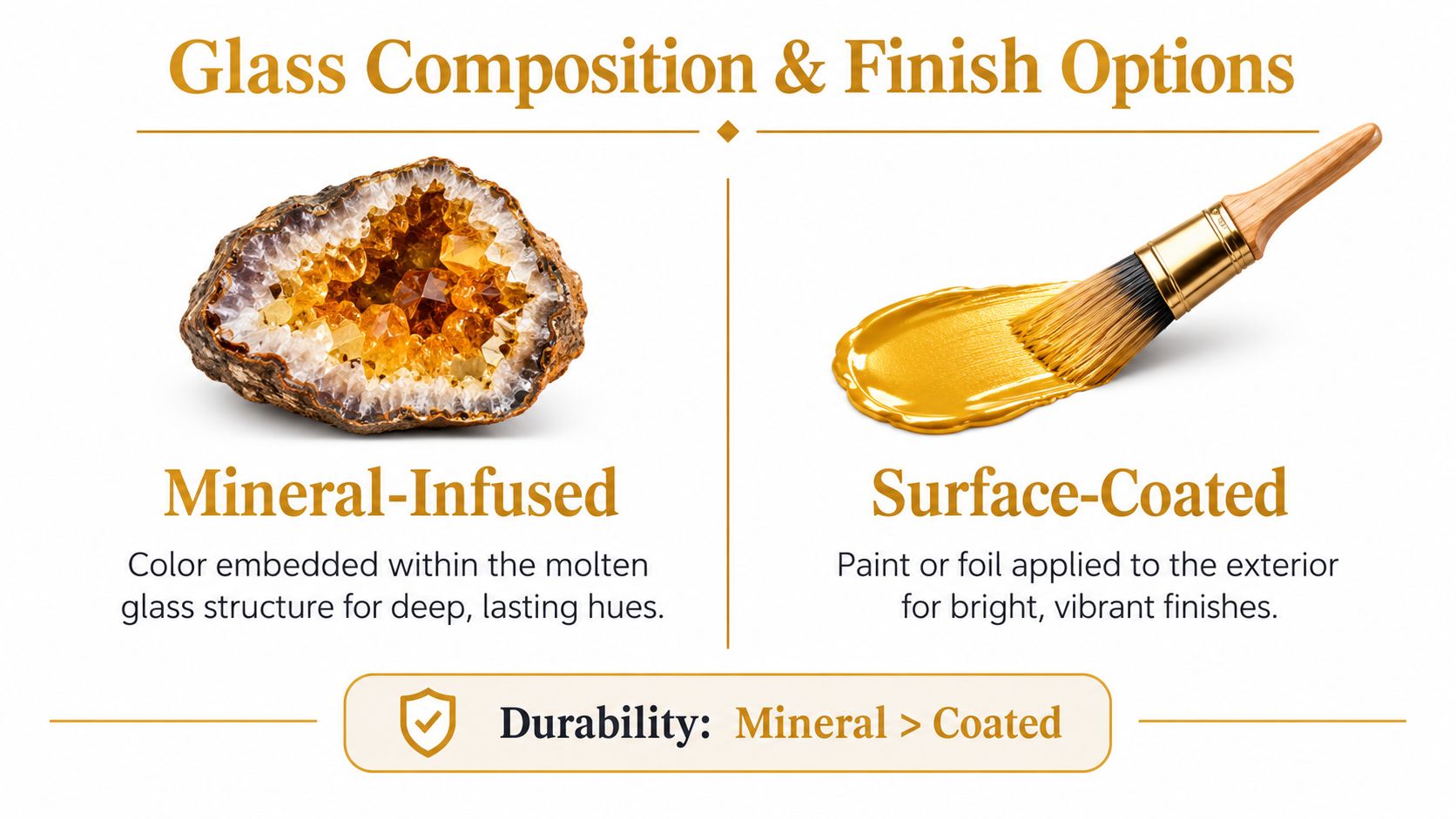
Material affects appearance and serviceability
Glassmakers developed colored-glass techniques long before electric decorative lighting. Modern fixtures still depend on the same basic relationship between formulation, thickness, translucency, and light transmission.
Visible-light transmission can range from opaque to semi-translucent depending on color concentration. A pale tint may preserve a brighter, more open effect, while dense amber, gray, or saturated glass can create a deeper mood and a more enclosed visual field. Some high-end chandelier construction uses borosilicate glass for its added resistance to rapid temperature changes near the bulb, though that property alone doesn't make every fixture using it indestructible — weight, mounting, cleaning, bulb heat, and handling still affect the installation's service life.
A practical evaluation should include:
- Color depth: Ask whether the glass is lightly tinted, strongly saturated, opaque, or translucent.
- Optical quality: Look for clarity, refraction, internal variation, and how the glass behaves when illuminated.
- Construction method: Confirm whether the color is integrated into the glass or applied as a surface finish.
- Piece replacement: Find out whether individual elements can be reordered if a shade is damaged.
- Visual density: Compare the amount of glass with the open space between pieces, not just the listed diameter.
Finish coordination gives the fixture flexibility
Colored glass works best when the surrounding metal finish supports it. Warm amber often sits naturally with brass or aged metal, while smoky glass can sharpen a darker contemporary palette. Blue, green, or rose glass may need quieter hardware so the fixture remains intentional rather than overly decorative.
YEP by Golden allows creative homeowners to mix and match glass shades with hardware finishes, making it possible to personalize the relationship between color, frame, and room finishes. That approach is useful when a standard chandelier feels close to the right solution but doesn't quite coordinate with existing cabinetry or furniture.
The key question is not just whether the glass looks attractive in a product photograph. It's whether the material will continue to look appropriate when viewed in daylight, under its installed bulbs, and from below. A showroom sample or installed image can reveal far more than a front-facing catalog image.
How to Calculate the Perfect Chandelier Size
A chandelier can be beautifully made and still look wrong if its proportions don't suit the room. The most reliable starting point is a simple sizing formula that converts room dimensions into a fixture diameter — treated as a minimum starting size, not a final answer.
Add the room's length and width in feet. Treat that sum as the chandelier's diameter in inches, as a minimum starting size. For example, a room measuring 12 by 14 feet points to a 26-inch chandelier as a minimum starting diameter (Kichler's chandelier planning and selecting guide).
Start with diameter, then judge visual mass — and let the table govern when it disagrees
The room-dimension formula establishes a useful baseline, not an automatic final answer. When it disagrees with the table-width formula below, the table governs — the room formula is a starting point, not the deciding number. A dense color glass chandelier may also appear heavier than an open fixture with the same diameter because overlapping petals, discs, or tubes create a stronger continuous shape.
A quiet room can often support a more visually assertive arrangement. A smaller room with patterned wallpaper, prominent art, or substantial furniture may need more breathing space.
Use this sequence:
- Measure the room: Record the length and width in feet.
- Add the dimensions: Convert the sum into the starting diameter in inches.
- Inspect the glass density: Determine whether the fixture reads as open, layered, compact, or sculptural.
- Check the furniture relationship: Make sure the chandelier aligns with the table, island, or central circulation area, and let the table width set the final size.
- Review the fixture from below: Look for exposed sockets, wiring, structural rings, and visible gaps.
Match height to the ceiling and table
As a general guide, fixture body height should track ceiling height at roughly 2.5 to 3 inches of fixture height for every foot of room height. An 8-foot ceiling suggests a fixture body about 20 to 24 inches tall under that guide.
Clearance determines where the fixture can safely hang:
- Over an open floor or walking area, keep at least 7 feet of clearance from the floor to the fixture's lowest point — that's the hard minimum for head clearance, with 7.5 feet preferred where the ceiling height allows it.
- Over a dining table or kitchen island, the fixture usually sits 30 to 36 inches above the tabletop.
The table itself provides another scale reference. The house standard places chandelier width at roughly one-half to two-thirds of the table's width, which is the majority guidance across sizing sources — treat a wider fixture, up to about three-quarters of the table width, as an occasional variant rather than the default.
For a full planning reference, use Golden Lighting's guide to sizing and placing a light fixture.
Managing Light Output and Bulb Selection
Colored glass doesn't transmit light in the same way as clear glass. Pigments and surface treatments absorb or scatter part of the emitted light, so a fixture that looks bright in a showroom may provide less usable illumination once installed in a dining room, foyer, or hospitality space. The darker the amber, gray, or saturated hue, the more carefully the lamping plan needs to be evaluated.
Separate atmosphere from task illumination
A dense color glass chandelier often works better as a mood-setting layer than as the only source of general light. That isn't a failure. It just means the fixture needs support from other sources when people must prepare food, read menus, clean surfaces, or move safely through the room.
Evaluate both:
- Total lumen output: Consider the combined light produced by the fixture's bulbs.
- Glass density: Account for how much of that light the material absorbs or scatters.
- Room function: A dining room, foyer, and kitchen island place different demands on the fixture.
- Layered lighting: Add recessed, wall-mounted, under-cabinet, or nearby pendant lighting when the chandelier is primarily decorative.
- Dimming: Use compatible dimming so the room can shift from practical brightness to evening atmosphere.
Warm-white LEDs pair well with dense colored glass when the intended result is intimate and welcoming. Dimming gives the homeowner control over the visual balance, particularly when the fixture's hue becomes more prominent after dark.
Lighting decision: If the glass is the reason for the purchase, the bulbs should reveal its color without making the room feel dim. Upsize the lamping plan where needed, then use dimming to reduce output when the room shifts from task use to entertaining.
Bulb shape and visibility also affect the final design. A highly visible lamp can become part of the composition, while a bulky or overly bright source may compete with the glass. Review Golden Lighting's guide to choosing light bulbs before finalizing the specification.
Styling Your Space with Golden Lighting Collections
Color glass works across several design languages, but the surrounding silhouette determines whether the result feels classic, casual, or highly sculptural. The right styling decision starts with the room's existing level of ornament.
A traditional or transitional home usually benefits from restrained tinting, familiar proportions, and a metal finish that relates to door hardware, cabinetry, or plumbing fixtures. A softly colored glass shade can add warmth without changing the room's entire identity.
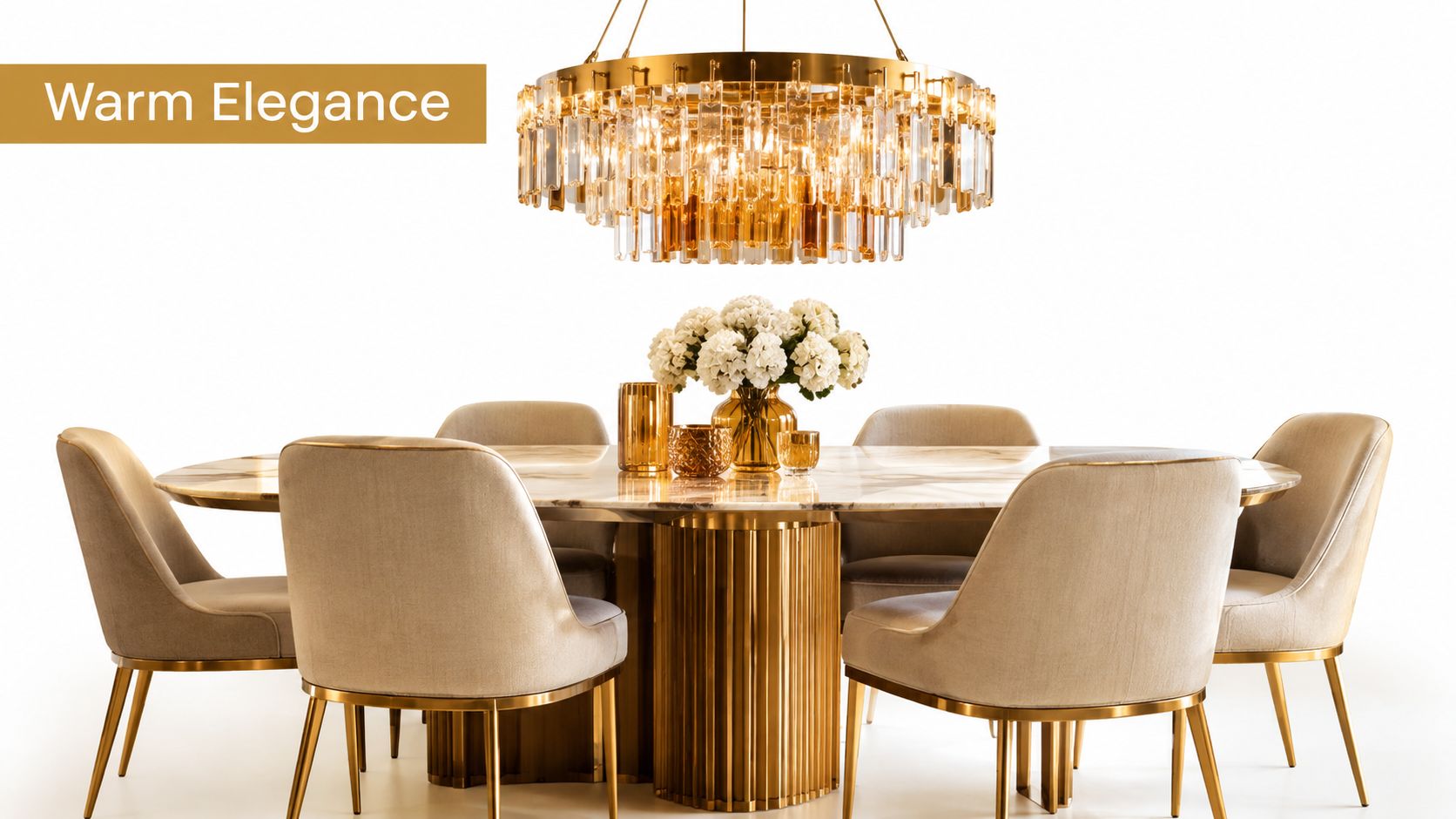
Choose the collection according to the room's personality
The timeless Golden line includes fixtures with glass shade options such as hammered water glass and clear glass. The Ciara 9-light chandelier and Calla 6-light chandelier offer examples of how textured or transparent glass can provide interest without requiring a highly saturated color palette.
For a more personalized scheme, YEP by Golden supports mix-and-match decisions involving shades, glass, and finishes. That flexibility suits a creative homeowner who wants modern brass kitchen lighting, coordinated pendants, or a repeated finish across adjacent spaces without making every fixture identical.
Professionals specifying refined residential interiors may prefer the sculptural, showroom-forward direction of Ziva by Golden. Those pieces call for more deliberate placement, quieter surrounding finishes, and careful review of sightlines because the fixture itself carries greater visual authority.
Build a connected lighting plan
A color glass chandelier shouldn't exist as an isolated decorative gesture. In an open-plan home, related pendants or sconces can repeat its finish while allowing each fixture to serve a different purpose.
A useful room-by-room approach looks like this:
- Entryway: Use a sculptural form to establish the home's palette, then preserve clear circulation below it.
- Dining room: Align the fixture with the table, not merely with the center of the ceiling.
- Kitchen: Let the chandelier provide character while task lighting handles counters and preparation areas.
- Bedroom: Select a lighter, less visually dense glass arrangement to avoid making the ceiling feel crowded.
- Outdoor transition: Coordinate the indoor metal finish with appropriate exterior lighting rather than trying to force interior glass into an unsuitable environment.
For ideas on combining warm metal and transparent or tinted elements, explore gold and glass pendant lighting. The strongest rooms repeat a material or finish with restraint, creating continuity without turning the entire floor plan into a matching set.
Maintenance and Long-Term Care Strategies
Colored glass deserves a maintenance plan before installation, especially when the chandelier contains many individual elements. A layered fixture can collect dust along upper edges, between overlapping pieces, and around the frame. Access becomes more difficult when the chandelier hangs over a stairwell or in a tall foyer.
Mineral-infused color is integrated during melting, so a chipped element can't be repainted to restore the original result (a specialist colored-glass FAQ). Surface-coated glass has a different vulnerability, because aggressive cleaning can affect the exterior treatment.
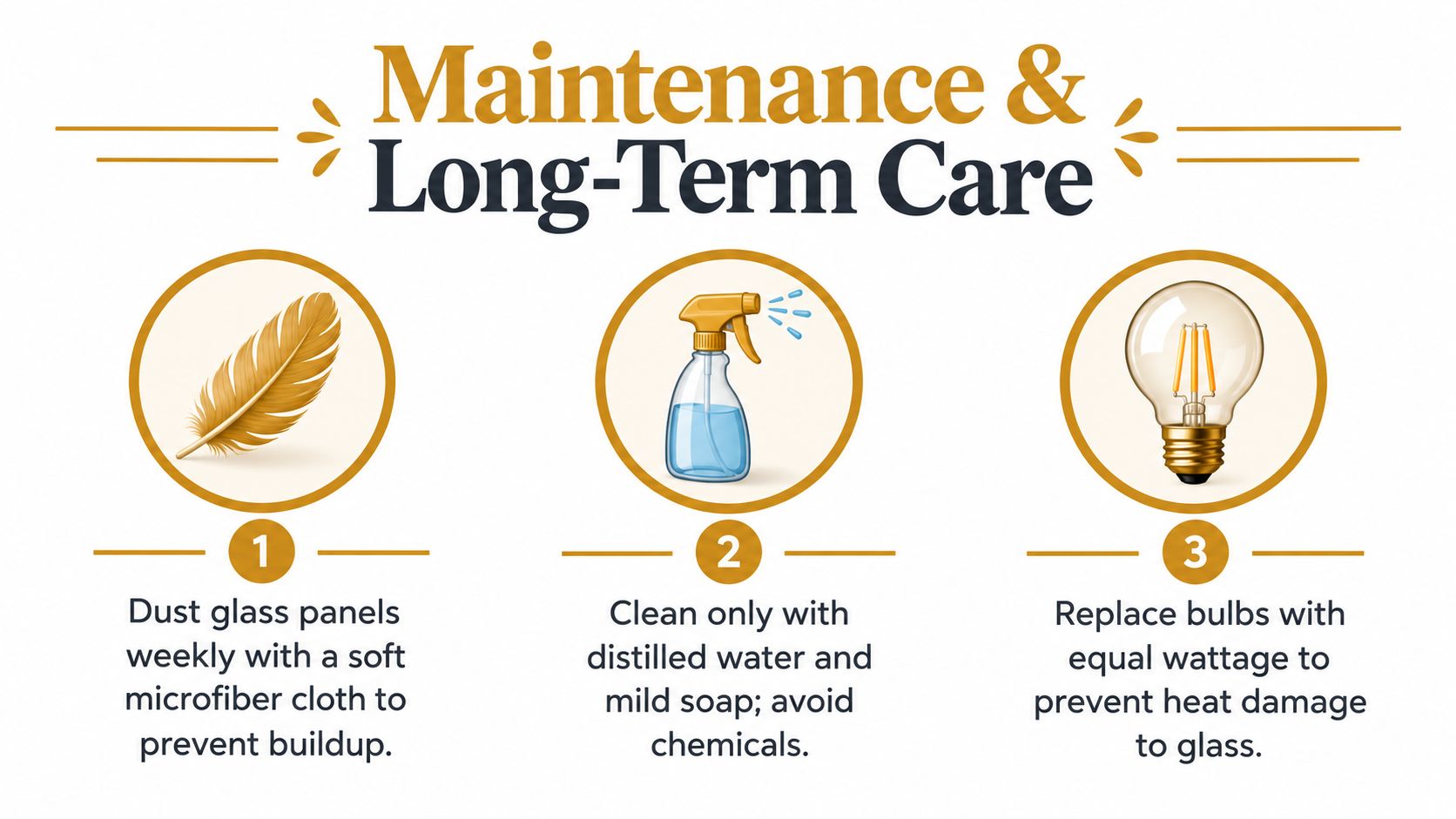
Establish a simple cleaning routine
Dust should be removed gently with a soft microfiber cloth. Harsh pressure can stress thin glass, loosen fittings, or move a decorative element out of alignment.
Use this care sequence:
- Switch off the fixture: Allow bulbs and glass to cool before handling any component.
- Dry dust first: Lift loose particles with a soft cloth or feather duster rather than grinding them into the surface.
- Clean selectively: Use distilled water and mild soap when the manufacturer permits it, applying the solution to the cloth rather than flooding the fixture.
- Dry completely: Remove moisture from glass, sockets, and hardware before restoring power.
- Protect the finish: Avoid abrasive pads, strong chemicals, and unapproved polishing products.
Bulb replacement also matters. Use bulbs with equal wattage to the approved specification, and don't increase heat to compensate for tinted glass. If the room needs more usable light, the safer solution may be additional layered lighting or a fixture designed for a higher compatible output.
Plan for damage before it happens
Ask the supplier whether individual glass pieces can be reordered, whether spare elements are available, and whether replacement parts are identified by position or number. Hand-finished glass may show small variations between production batches, so a replacement can be functional without being a perfect visual match.
Property managers and hospitality specifiers should be especially selective. A dense, highly layered fixture may create strong visual impact, but it also introduces more surfaces to clean and more individual pieces to protect. A design with fewer, more accessible components can offer better serviceability in a rental or high-traffic setting.
Service question: Before purchase, request the replacement-glass policy, approved cleaning method, fixture weight, mounting requirements, and bulb specifications in writing. Those details matter more after installation than they do in a styled photograph.
A color glass chandelier is a sound choice when its color, scale, light output, and maintenance demands fit the room's real use. Review the collection, compare glass samples under daylight and electric light, and speak with a Golden Lighting showroom or design professional before ordering. Find the fixture that fits the space, then take the next step by shopping the chandelier collection or locating a showroom for an in-person material review.
— seen a lot of light fixtures in 80+ countries. Still learning what actually works in a home.











Share:
Kitchen Lighting Ideas That Actually Work