



Written by Rick Kovac, COO of Golden Lighting
The takeaway: In an entry with an 8- or 9-foot ceiling, a semi-flush mount is usually the right fixture, as long as you size it by the clearance it leaves, not by the photo, and pick a shaded or diffused bottom so guests don't walk in looking at a bare bulb.
Key takeaways:
- Keep at least 7 feet from the floor to the bottom of any fixture people walk under, and aim for 7½ feet where the ceiling allows. On an 8-foot ceiling, that caps the whole fixture at about 12 inches tall.
- Semi-flush mounts belong under standard 8–9 foot ceilings. In a double-height foyer they read lost, so choose a chandelier or pendant instead.
- Start with the room formula: room length plus width in feet gives a starting diameter in inches.
- Entry fixtures sit above eye level, so choose a shade or diffuser that hides the bulb from below, use warm 2700K–3000K light, and put the fixture on a dimmer.
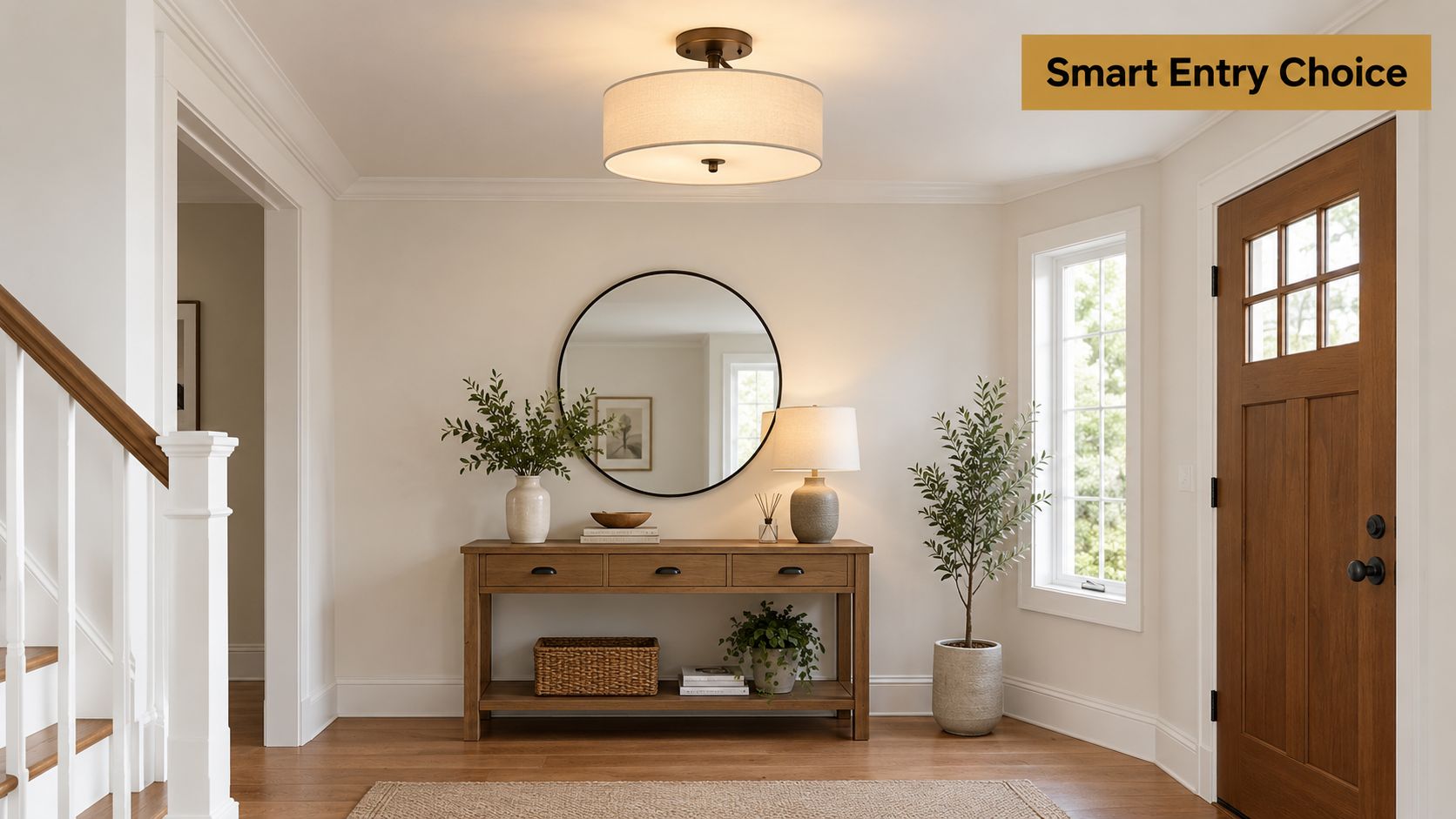
A cramped foyer usually goes wrong in one of two ways. A chandelier hangs into the walking path and competes with the door, or a flat ceiling disk lights the space evenly but leaves it feeling unfinished. A well-chosen semi-flush mount avoids both: it adds shape and presence overhead while keeping the path to the door clear.
Why a Semi-Flush Mount Suits Most Entries
A semi-flush mount hangs a short distance below the ceiling on a stem or canopy, between a flush mount that hugs the ceiling and a pendant that drops on a cord or chain. That gap is the point. It gives the fixture enough body to read as a design choice, and on many models it lets light spill onto the ceiling as well as down, so the entry doesn't feel like a single bright spot.
Our design team's rule is that flush and semi-flush fixtures exist because ceilings are low. Under a standard 8- or 9-foot ceiling they look right at home. Under a double-height or vaulted foyer, a ceiling-hugging fixture looks lost. That space calls for a chandelier or pendant scaled to the volume instead.
In an entry, clearance is part of the design. A fixture that looks beautiful but makes a tall guest duck is the wrong fixture.
Semi-flush vs. flush mount vs. pendant
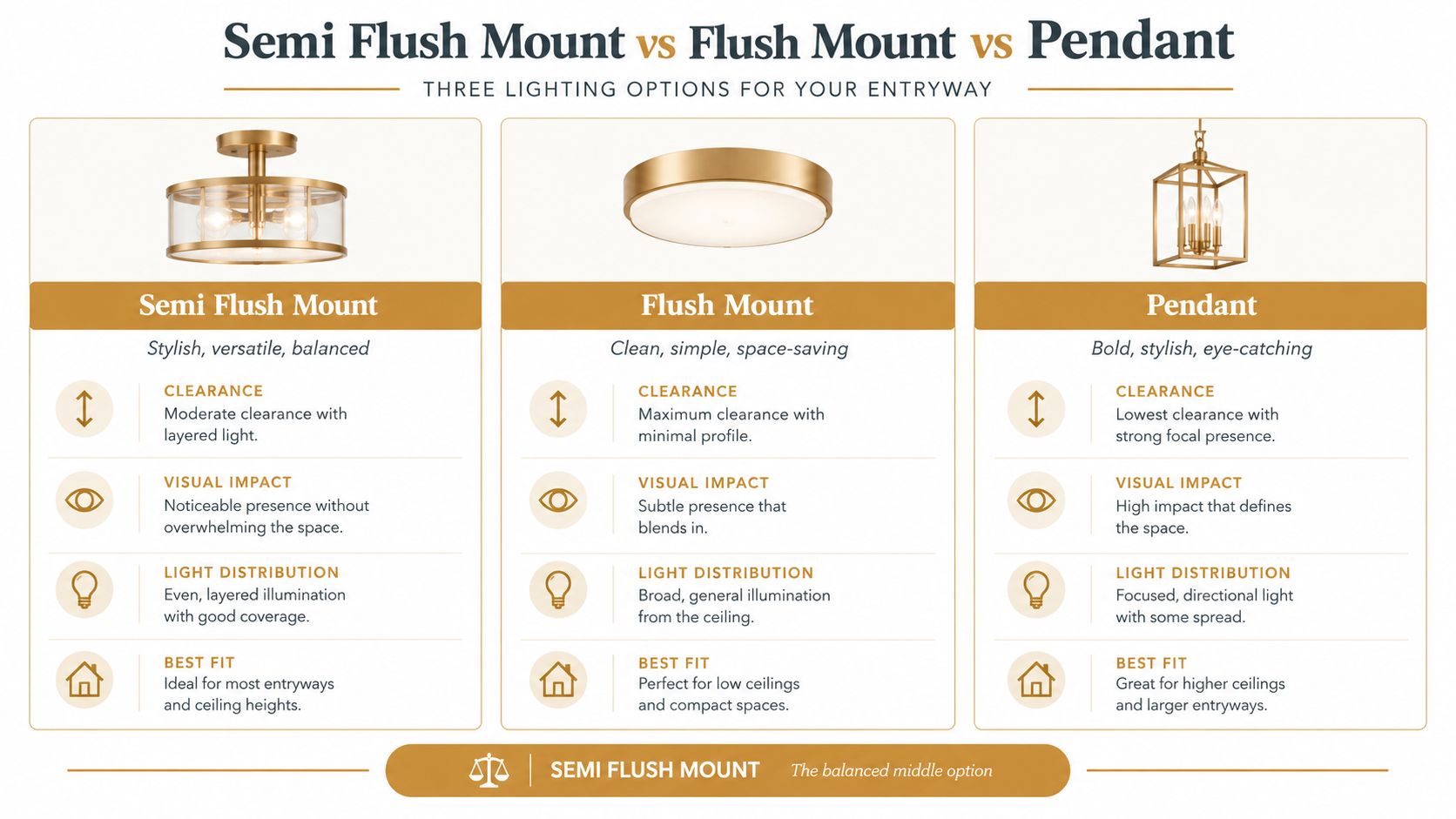
| Fixture | Best entry condition | Trade-off |
|---|---|---|
| Flush mount | Low ceilings, tight halls, a door that swings close to the fixture | Maximum headroom, least decorative presence |
| Semi-flush mount | Most 8–9 ft foyers and entry halls | Balances presence and clearance; check its full height |
| Pendant or chandelier | Taller or double-height foyers | Strongest focal point, but needs the ceiling height to stay clear of heads |
If you're still deciding between styles, our explainer on what semi-flush mount lighting is and where to use it covers the category in more depth.
How to Measure Your Entry Before You Shop
- Measure floor to ceiling. Use the finished floor and the finished ceiling, not the plans.
- Find your maximum fixture height. Subtract 84 inches (7 feet) from the ceiling height. That's the most the fixture can measure from canopy to lowest point and still clear a walkway: about 12 inches under an 8-foot ceiling and about 24 inches under a 9-foot ceiling. If the ceiling allows it, leave 90 inches (7½ feet) instead.
- Find a starting width. Add the entry's length and width in feet; the total is a starting fixture diameter in inches. A 10 × 12 ft entry gives about 22 inches. Treat it as a minimum starting size, not a final answer.
- Adjust for visual weight. An open, airy frame can go a size up; a dense or ornate one can go a size down.
- Check the door and sightlines. Open the front door fully and make sure nothing (the door, a storm door, a tall coat) comes near the fixture. Then look in from the threshold and out from the stairs or hallway.
- Center it on the architecture. Line the fixture up with the door, the hall, or the space between door and stair so it reads as part of the house, not an afterthought.
For worked examples of the room formula, see our fixture sizing and placement reference and The Golden Scale Method.
Long entry halls
A long entry hall works more like a hallway than a foyer. Our design team lights narrow runs with a series of evenly spaced flush or semi-flush fixtures along the centerline, rather than one fixture expected to reach both ends. Lit walls matter here too. ANSI/IES residential guidance treats hallways as pass-through spaces and favors light on the walls and art between doors over a bright pool on the floor.
Glare, Bulbs, and Dimming
An entry fixture sits above eye level, which changes how you choose it. Under ANSI/IES residential lighting guidance (RP-11-26), fixtures mounted above eye level in entries, foyers, halls, and stairways should be shielded at the bottom so people walking underneath aren't looking into a bare bulb. If the fixture can be seen from a stair landing above, shield the top as well. In practice, that means a fabric drum, frosted or opal glass, or a closed bottom diffuser. Clear glass with an exposed bulb works best where nobody passes directly beneath.
- Color: Warm white in the 2700K–3000K range is the standard for living spaces, and it makes an entry feel welcoming rather than clinical.
- Color quality: Every Golden Lighting LED is rated 90 CRI or higher, above the 80-CRI industry minimum and in the band reserved for color-critical spaces.
- Dimming: Put the entry on a dimmer so it can be bright for keys and coats in the evening and softer late at night. Use a dimmer the fixture or bulb maker lists as compatible. Standard LEDs hold their color as they dim; they won't drift warmer unless they're labeled dim-to-warm.
- Bulb fit: Check the fixture's socket type and maximum wattage before you buy bulbs. Our bulb selection tips walk through the details.
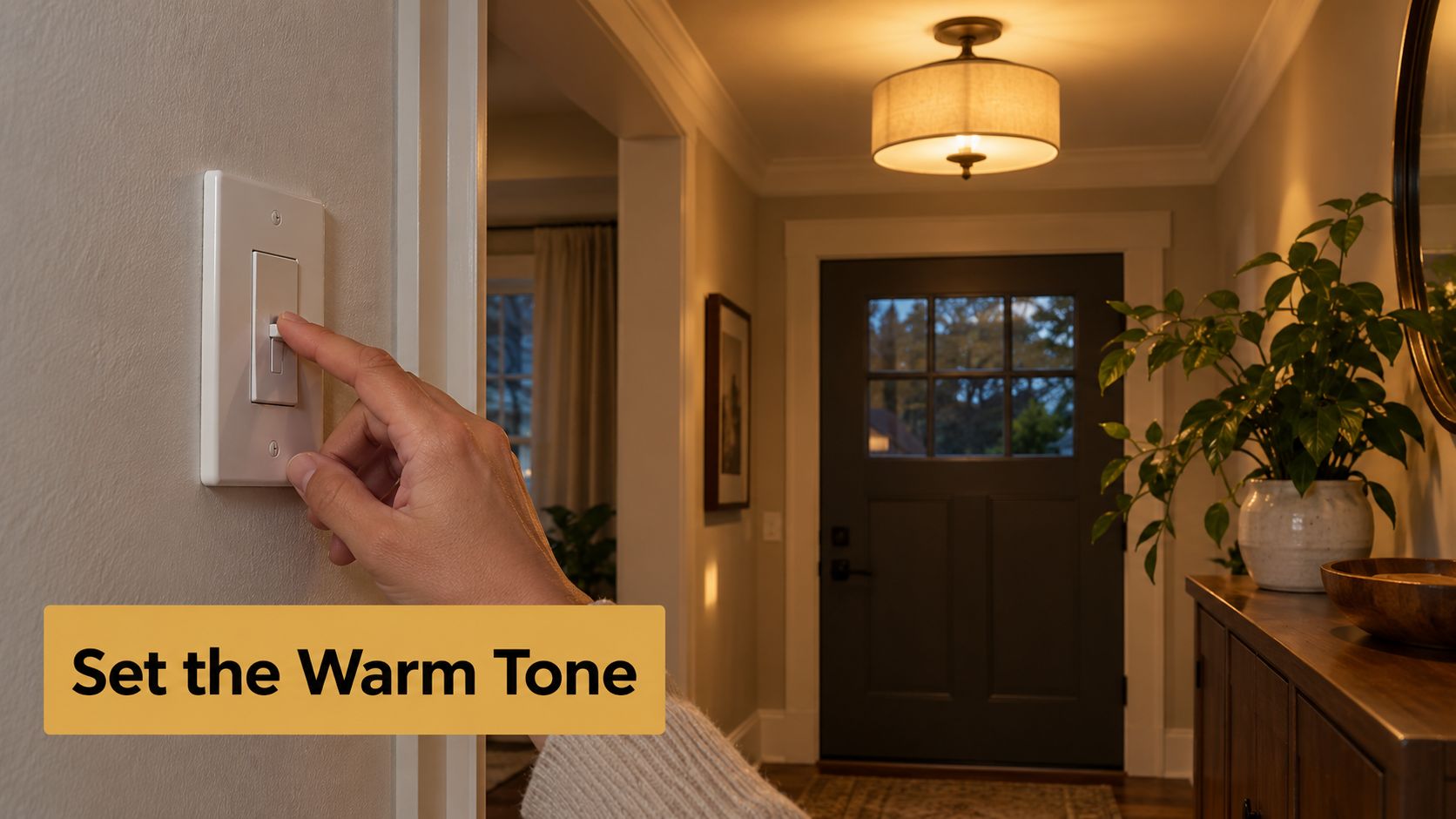
Don't ask the ceiling fixture to do everything. A lamp or a pair of sconces at the console adds a lower, warmer layer, and lighting a wall or a piece of art makes the entry feel larger than another bright spot overhead would.
Installation and Safety Basics
- Turn off the breaker and test. A wall switch alone isn't a safe shutoff. Confirm the circuit is dead with a voltage tester before touching wires.
- Check the ceiling box. Under the National Electrical Code (NEC 314.27), ceiling outlet boxes must support at least 50 lb. A fixture heavier than that needs independent support or a box listed and marked for the greater weight. The box should be secure, with no rocking.
- Connect the ground. Identify the grounding conductor and make every connection secure inside the box. Our guide to ground wire connections covers this step.
- Measure the installed height. Before final tightening, measure from the floor to the fixture's lowest point and confirm it clears 7 feet.
- Call an electrician when in doubt. If you can't identify the breaker, the wiring is unfamiliar, or the box needs structural work, use a licensed electrician.
Styling the Entry
Let the fixture relate to the entry, not just the ceiling. A round semi-flush echoes a round mirror. A linear one can reinforce a narrow console or a paneled door. Repeat the fixture's finish on at least one other surface, such as door hardware, a mirror frame, or a console's metal legs, so it reads as chosen rather than accidental. Small entries usually look best with an airy frame or a lighter finish; a larger foyer can carry a deeper silhouette, provided it still clears the path.
For more ideas by entry size, see small entryway lighting ideas and large entryway lighting.
Shop this guide
- Aenon 6-light Semi-Flush Mount in Matte Black — about 27¾ inches wide and under 9 inches tall, so it works under an 8-foot ceiling in a larger entry.
- Ellie 4-light Semi-Flush Mount in Modern Brushed Gold — 19 inches wide and about 13¼ inches tall; a fit for 9-foot entry ceilings.
- Duncan 3-light Semi-Flush Mount in Matte Black and Matte White shade — a linear form with shaded lights for a long entry hall.
Choose the fixture that fits the ceiling, clears the door, and keeps the bulb out of sight. Browse the full semi-flush collection or find a Golden Lighting retailer to see finishes and scale in person.
— seen a lot of light fixtures in 80+ countries. Still learning what actually works in a home.











Share:
Farmhouse Style Light Fixtures: Size and Style Guide