


Written by Rick Kovac, COO of Golden Lighting
The takeaway: An antique brass chandelier is a finish choice as much as a lighting choice. Size it to the room and the table, hang it 30 to 36 inches above the tabletop, light it with warm 2700K–3000K bulbs, and treat its patina as part of the design, not dirt to polish off.
Key takeaways:
- "Antique brass" is a finish: a darker, softened brass tone. A lacquered (clear-coated) finish stays as it is; unlacquered brass keeps changing as it ages.
- Start with the room: length plus width in feet gives a starting diameter in inches. Over a table, the chandelier should be one-half to two-thirds of the table's width.
- Hang the bottom 30 to 36 inches above the table, and at least 7 feet above the floor anywhere people walk underneath.
- Dust it, wipe it with a barely damp cloth, and skip abrasive polish. Green, powdery spots are a warning sign, not character.
Antique brass has a particular warmth. It's darker and softer than polished brass, it doesn't shout, and under warm light it glows like something that has been in the family for decades. That's exactly why it works over a dining table, in a foyer or above a living room seating group.
It also means the details matter. The wrong size, a cool bulb or an aggressive polish can turn a warm, quiet finish into something that looks either lost, flat or brand new in the wrong way. Here's how to get each part right.

Styled scene: the Waverly 5-light Chandelier in Aged Brass, 25 inches wide, centered over the table. The black shades hide the bulbs and let the brass read warm.
What "antique brass" really means
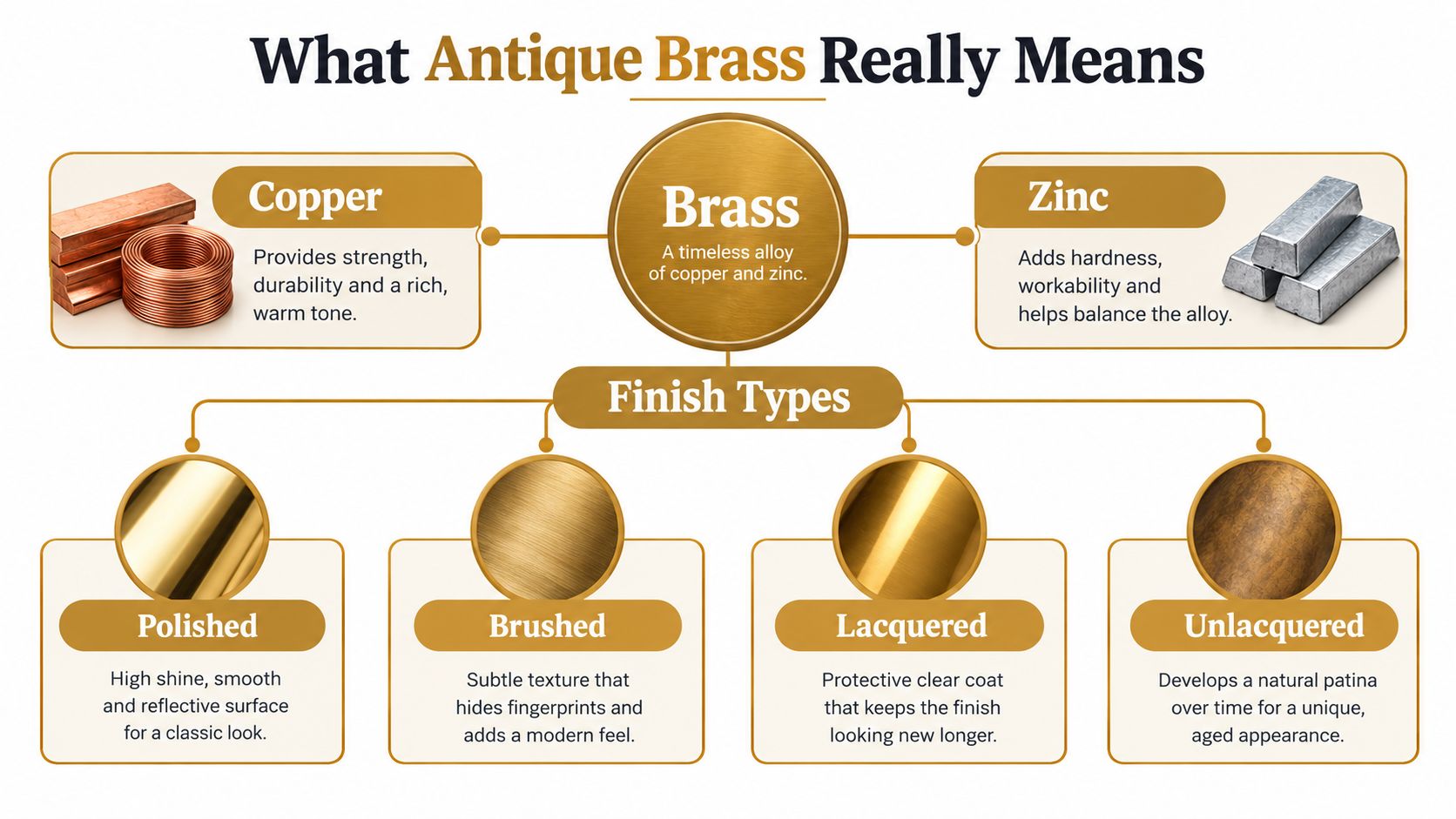
Brass is an alloy of copper and zinc. "Antique brass" describes how its surface is finished: a darker, softened, slightly uneven tone that suggests age. Makers use overlapping names for neighboring looks, so judge the color, not the label.
| Finish name | How it usually looks | Good to know |
|---|---|---|
| Antique or aged brass | Darker, low-luster, softly varied | Golden calls this look Aged Brass: a low-luster, satin sheen |
| Brushed brass | Lighter, with a fine directional grain | Hides fingerprints; reads more modern |
| Polished brass | Bright and mirror-like | Shows every fingerprint; the most formal |
| Champagne bronze or champagne brass | Pale, muted gold | A softer option when antique brass feels too dark |
The other question is whether the finish is sealed. A lacquered (clear-coated) finish stays as it is and only needs dusting. An unlacquered finish keeps darkening with handling, humidity and air, which is part of its appeal and part of its upkeep. If a product page doesn't say, ask before you buy. For more on how metal finishes hold up, see our comparison of powder-coat and plated finishes.
How big should it be?
- Start with the room. Add the room's length and width in feet and read the total as inches. A 12 × 10 ft room starts at about 22 inches.
- Check the table. Over a dining table, the chandelier should be one-half to two-thirds of the table's width. A 42-inch-wide table takes about 21 to 28 inches. When the room and the table disagree, the table wins.
- Check the ceiling. Allow about 2.5 to 3 inches of fixture height for every foot of ceiling height, so roughly 20 to 24 inches tall under an 8-foot ceiling.
- Adjust for visual weight. An open frame with slim arms can go a size up. A dense or heavily shaded design should come down a size.
For the full method with worked examples, see What Size Chandelier Do I Need? and our white paper, The Golden Scale Method, or run your numbers through the Chandelier Size Calculator.
How high to hang it
- Over a table: 30 to 36 inches from the tabletop to the bottom of the chandelier, whatever the ceiling height. A taller ceiling means a longer chain or rod, not a higher chandelier.
- Where people walk underneath, in a foyer or a living room: at least 7 feet from the floor to the lowest point.
- Low ceilings: if a hanging fixture can't keep 7 feet of clearance, a wide semi-flush in the same finish is the better answer.
Our rule: antique brass is meant to look like it has always been there. Size and hang it so it looks settled, not squeezed in.
Get the light right
Antique brass looks its best in warm light. Cool bulbs flatten it and make the finish look grey and dull.
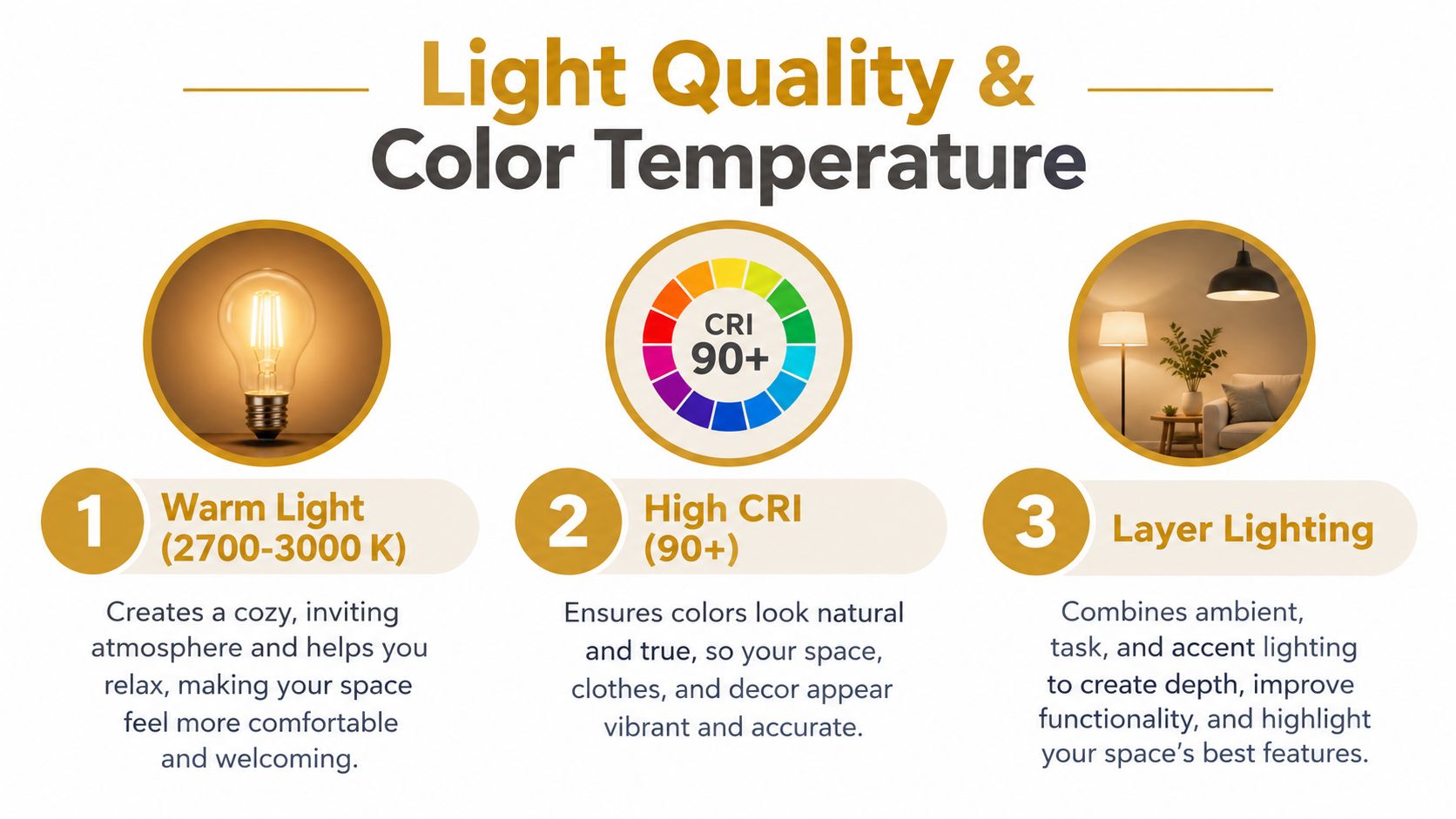
- Color temperature: 2700K–3000K for dining rooms, living rooms and foyers.
- Color rendering: CRI 90 or higher, so wood, food and skin look natural. Here's what CRI means.
- Dimming: put the chandelier on a dimmer and use bulbs that are rated for it. Our guide to dimmers for LED lights explains what to check.
- Glare: shades, frosted glass or small dimmed candle bulbs keep it comfortable at the table. A bright, bare bulb at seated eye level is glare.
- Layers: a chandelier rarely lights a room alone. Add sconces, lamps or task light around it so it doesn't have to be turned up full.
For bulb shapes and brightness, see our guide to choosing light bulbs.
A true antique, or a new fixture with an antique finish?
A genuine vintage chandelier can be beautiful, but it was wired for another era. Before one goes up, have a qualified electrician or lighting restorer check the sockets, the wiring insulation, the grounding and the canopy and chain, and rewire it if needed. A new fixture with an antique-brass finish gives you the look with current, listed components and replacement parts you can still buy. For most homes, that's the simpler choice.
Weight and installation
- Check the weight on the product page before you order. Every Golden Lighting product page lists it.
- Check the ceiling box. Under the National Electrical Code (NEC 314.27), a ceiling box must support at least 50 pounds; a fixture over 50 pounds needs support independent of the box, or a box listed for the heavier weight.
- Turn off the breaker, not just the switch, and test before touching any wires.
- Call a licensed electrician for a heavy fixture, an older home, a new box or anything you're unsure of.
Our step-by-step guide to hanging a chandelier walks through the rest.
Patina and care
- Turn it off and let it cool before cleaning.
- Dust with a soft, dry cloth, supporting each arm as you go.
- Wipe with a cloth barely dampened with water, then dry it. Avoid sprays that drip into sockets.
- Skip abrasive polish and harsh cleaners. They can strip a lacquer coat or leave bright, uneven spots on an aged finish.
- Look it over once a year. An even, soft darkening is the finish aging as intended. Green or powdery spots, flaking lacquer or sharp dark patches point to moisture or chemical exposure and are worth having looked at.
Care rule: don't polish an aged finish unless you actually want it bright again. The patina is the point.
How to style it
- Warm woods make antique brass feel settled, from a walnut table to oak floors.
- Soft whites and creams let the brass stand out without feeling heavy.
- Black in shades, hardware or frames gives it a sharper, more current edge.
- Repeat the brass at least once elsewhere in the room, such as cabinet pulls, a mirror frame or a lamp base, so it reads as a plan.
Mixing metals works when it's deliberate. Our guide to coordinating lighting, hardware and furniture metals explains how. If antique brass feels too dark, compare brushed gold, champagne bronze or antique bronze.
Shop this guide
- Waverly 5-light Chandelier in Aged Brass: 25 inches wide, with black fabric shades. Right for a table about 38 to 50 inches wide.
- Orwell 6-light Chandelier in Aged Brass: 29 inches wide, with matching aged brass shades. Right for a table about 44 to 58 inches wide.
- Orwell 6-light Chandelier in Aged Brass and Clear Glass: the same frame with a lighter look.
- Orwell 6-light Chandelier in Brushed Champagne Brass and Aged Brass shade: a paler frame with aged brass accents.
Measure the room and the table, keep the light warm, and let the finish age. Browse chandeliers, or find a Golden Lighting retailer to see the finish in person.
— seen a lot of light fixtures in 80+ countries. Still learning what actually works in a home.

Share:
Outdoor Chandeliers for Patios and Porches: How to Choose One