



Written by Rick Kovac, COO of Golden Lighting
The takeaway: The best bathroom sconces come in a pair flanking the mirror at about face height, carry the right damp or wet rating for where they're mounted, and use diffused, warm, high-CRI light. Choose the finish only after those three are settled.
Key takeaways:
- Flank the mirror with a pair of single-light sconces, centered at about 60 inches above the floor and adjusted to the user's eye level. A light above the mirror alone casts shadows down the face.
- The National Electrical Code sets the zone around a tub or shower. Within 3 feet horizontally and 8 feet up from the rim or threshold, no hanging fixtures are allowed; fixtures there must be damp-rated, and wet-rated where shower spray can reach.
- For vanity light, ANSI/IES guidance calls for CRI 90 or higher and a warm, flattering 2500K–3000K, with diffused shades and no open light aimed at the mirror.
- A powder room can run on sconces alone; a full primary bath usually needs an overhead layer and safe light at the tub and shower too.
A single ceiling light over the sink can make a morning routine harder than it needs to be. It lights the top of your head and leaves shadows under the eyes, nose, and chin. A pair of sconces at the mirror fixes that, and they also give the bathroom a softer evening setting and a more finished look. The right pair starts with placement and ratings, then moves to light quality and style.
Decide the Sconce's Job First
A bathroom sconce does one of two jobs, and the job decides everything else.
- Task light at the mirror. Mounted beside the mirror near eye level, sconces send light across the face for shaving, skincare, and makeup. This is grooming light, and it needs a diffused shade, enough output, and good color.
- Ambient or accent light elsewhere. A sconce beside a freestanding tub, in an alcove, or in a water closet washes the wall and sets the mood. It isn't expected to light a face, so it can be softer and more decorative.
If the bathroom needs both bright grooming light and a relaxed evening mood, don't force one fixture to do both. Add a dimmer and a second layer instead.
Placement and Mounting Height
The mirror is the anchor. NKBA's planning guidelines name sconces beside the mirror as the preferred arrangement, with side-of-mirror fixtures centered at about 60 inches above the finished floor, adjusted to the eye level of the person using it. The IES consumer guidance makes the same point from the other direction: lights placed vertically on both sides of the face, centered at eye level, avoid the shadows an above-mirror light creates.
- Mark the mirror edges and the user's eye level at the basin.
- Place one single-light sconce on each side of the mirror, centered near eye level, so light reaches both cheeks and the jawline. Our design team never puts a lone single-light sconce above a mirror. If you want light above, use a multi-light bar.
- Keep the pair close to the face. On a wide vanity wall, don't push the sconces out to the far edges; keep them near the mirror the person actually uses.
- Give each person their own pair at a double vanity. A single fixture centered between two sinks leaves both users lit from above and the side.
- Resolve conflicts before the walls close. A window, stud, medicine cabinet, or existing box can force a change. Move the electrical rough-in, or choose a mirror and sconce combination that works with the constraint.
Our bathroom sconce placement guide and small bathroom sconce guide go deeper on layouts, and our vanity light height guide covers above-mirror bars.
Light the face from the sides, not the top of the head. That one decision does more for a bathroom mirror than any bulb upgrade.
The Rating Decision Comes Before the Finish
Many bathroom lighting mistakes start when the finish is chosen before the location is checked. Reverse the order.
The National Electrical Code (NEC 410.10(D)) defines a zone around every tub and shower: 3 feet horizontally and 8 feet vertically from the top of the tub rim or shower threshold. Inside that zone, no cord-, chain-, or cable-hung fixtures, pendants, track lighting, or ceiling fans are allowed. Fixtures in the tub or shower footprint up to 8 feet must be marked for damp locations, and where they're subject to shower spray, for wet locations.
- In the shower or where spray reaches: a wet-location fixture.
- Elsewhere inside the tub/shower zone: at least damp-location.
- At the vanity, outside the zone: a damp-rated sconce is the sound choice in a steamy bathroom.
Look for the location rating on the product listing or spec sheet. A UL or ETL mark means the fixture was tested to the applicable safety standard. It doesn't make every fixture suitable for every spot in the room, so the listed location has to match the installation. Our explainers on damp vs. wet ratings and UL vs. ETL explain what each one actually tests. Have your electrician confirm how local code applies.
Light Quality: Color, CRI, and Diffusion
ANSI/IES residential lighting guidance (RP-11-26) is specific about vanity light:
- Direction: light should fall on the face, neck, and hair, not down on the top of the head.
- Color rendering: CRI 90 or higher, so skin tones and makeup read accurately. Every Golden Lighting LED is rated 90 CRI or higher.
- Color temperature: a flattering warm range of about 2500K–3000K.
- Glare: diffused, lensed, or shaded sources, with no open light aimed toward the mirror.
- Surfaces: light-colored walls and counters around the mirror bounce light back onto the face.
- Dimming: recommended, so the same sconces can serve a bright morning and a quiet evening bath.
That's why opal, frosted, or fabric-shaded sconces outperform clear glass and bare bulbs at the mirror. For more on reading color specs, see our guide to color rendering index.
On dimmers, the safe rule is simple: confirm the sconce or bulb is dimmable, then use a dimmer the manufacturer lists as compatible. Don't assume the switch already in the wall will work smoothly with LEDs. Our guide to dimming LED lights covers the details.
When Sconces Are Enough and When You Need More
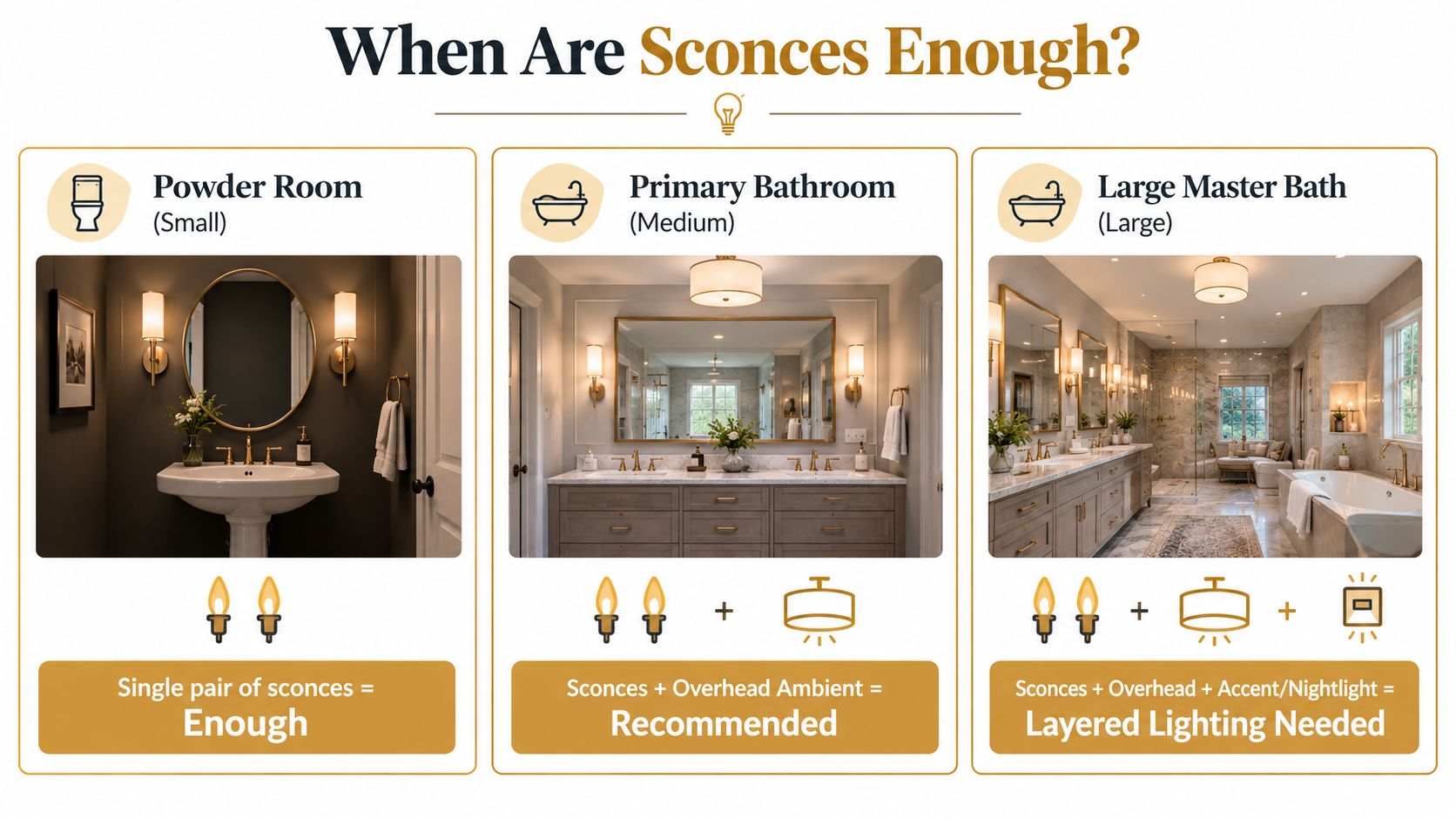
Powder room. ANSI/IES guidance exempts powder rooms (no tub or shower, guest use) from full grooming light levels. A pair of diffused sconces on a dimmer can carry the whole room, and it can be moody on purpose.
Primary bathroom. Sconces handle the mirror, but the room needs an overhead layer so it's usable away from the basin. Lighting standards are consistent on this: no single fixture lights an entire room.
Large or dark-finished bath. Add a third layer, such as accent light at the tub or a low nightlight, and plan safe light anywhere there's water or a step. Winchip's Fundamentals of Lighting makes the point that bath lighting should be judged from both seated and standing positions. Dark tile and cabinetry absorb light, so a dark bathroom needs more of it than a white one.
Style Pairings That Look Intentional
| Bathroom style | Sconce silhouette | Finish ideas |
|---|---|---|
| Modern | Slim cylinder or vertical form with opal or fluted glass | Brushed brass, matte black |
| Mid-century | Opal globe on a simple arm | Aged brass, champagne bronze |
| Minimalist | Simple cylinder or square shade | Matte black, white |
| Transitional | Bell or half-shade with diffused glass | Polished nickel, chrome, champagne bronze |
A finish should appear on at least two surfaces, such as the sconces and the faucet, or the sconces and the cabinet pulls, so the room reads as planned. Matching the fixture to the hardware's color family (brass, black, nickel) is the classic default. Mixing metals deliberately is a current trend, and it works when the mix is clearly intentional.
Shop this guide
- Dixon 1-light Wall Sconce in Aged Brass and Opal Glass — an opal globe for soft, diffused face light; damp-location rated.
- Dorinda 1-Light Wall Sconce in Brushed Champagne Bronze with Opal Glass — a scalloped opal shade in a warm champagne finish; damp-location rated.
Measure the vanity, identify the moisture zone, and list the layers the room needs before you browse finishes. Explore the bathroom lighting collection or find a Golden Lighting retailer, and bring the fixture and dimmer details to your electrician before the walls close.
— seen a lot of light fixtures in 80+ countries. Still learning what actually works in a home.











Share:
Antique Brass Chandeliers: How to Choose, Size and Care for One
Low Profile Chandeliers for Low Ceilings: Clearance, Sizing, and Style