



Written by Rick Kovac, COO of Golden Lighting
The takeaway: The gold finish sets a vanity light's character, but the light source decides whether it works — choose function at the mirror first, proportions second, and the finish last.
Key takeaways:
- Flanking the mirror with a pair of sconces gives the most even face light; NKBA guidance centers them at about 60 inches above the floor, adjusted to eye level.
- An above-mirror bar for standing users sits about 78–84 inches above the floor with at least 6 inches to the ceiling, and should never be wider than the mirror.
- For grooming, choose CRI 90 or higher and a warm 2700K–3000K source, with frosted or opal glass where the bulb sits in your line of sight.
- Brushed and satin gold hide fingerprints and glare better than polished gold, which needs a room with enough structure to carry it.
A bathroom can have beautiful tile, a generous mirror, and expensive hardware and still fail during the morning routine. Your face looks shadowed, makeup colors shift, and a polished renovation feels strangely flat. The usual advice is to choose gold bathroom vanity lights for warmth and style, then worry about the bulb later. That order is backwards. The gold finish sets the visual character, but the light source determines whether the fixture works.
The right decision combines a finish that will age well, a size that respects the mirror, and a high-quality light source for grooming. Here's how to choose, place, and specify one.
The Enduring Appeal of Gold in Bathroom Design
Gold isn't automatically timeless, and it isn't automatically dated. The result depends on the treatment, the silhouette, and whether the fixture does its daily job. A heavily ornate polished fixture can overpower a compact powder room, while a slim brushed-gold bar adds warmth to a restrained contemporary bathroom without dominating it.
Vanity lighting is where homeowners notice performance most directly. A ceiling fixture fills a room, but a vanity light sits beside the mirror, close to the face, and in daily view. Its finish affects reflections, contrast, and how the bathroom relates to faucets, cabinet pulls, mirror frames, and tile.
Design principle: Gold works best when the finish supports the room's architecture and the light source supports the person using the mirror.
Warm metals connect naturally with stone, timber, cream paint, handmade tile, and darker accents. The combination feels grounded when the fixture has a controlled profile — so gold bathroom vanity lights are a sound choice when the sheen suits the room, the proportions are disciplined, and the specification puts accurate light ahead of decorative impact.
Choosing the Right Gold Finish for Your Space
Not every gold finish creates the same room. Polished gold reflects the most light and catches the eye immediately. Brushed brass softens the metal with visible grain, and satin gold sits between the two, offering warmth without mirror-like glare.
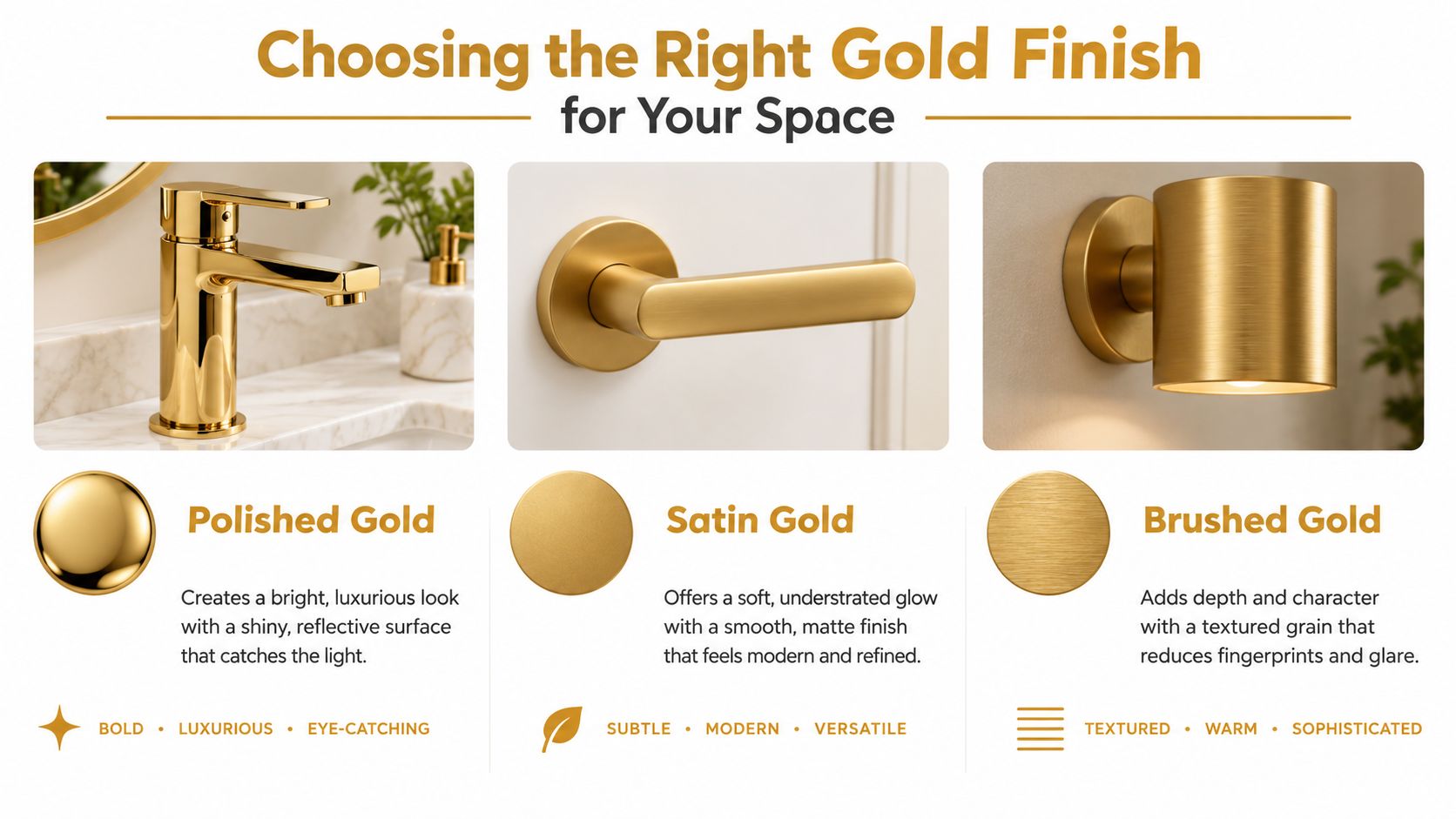
Polished gold for traditional impact
Polished gold suits bathrooms that already have formal or decorative details: sculptural mirrors, strongly veined marble, crystal accents, and classic millwork. The finish picks up surrounding colors, so it needs a deliberate setting rather than a collection of competing focal points. Its weakness is practical — fingerprints and water spots show readily near a busy sink, and in a small bathroom with strong direct light it can throw distracting highlights.
Brushed brass for everyday versatility
Brushed brass is the most forgiving choice for family bathrooms. Its directional texture breaks up fingerprints and gives the fixture a quieter presence. It pairs especially well with modern and transitional rooms, where a slim bar or simple sconce needs warmth without ornamental weight.
Satin gold for a calm, tailored look
Satin gold has a soft, matte character that works well in spa-inspired bathrooms beside pale stone, fluted cabinetry, frosted glass, and warm neutral walls. Finish names aren't standardized, so a sample is more reliable than a label. Our champagne bronze finish guide helps compare neighboring warm-metal finishes before you commit to a full hardware package.
Mixing metals without visual noise
Matching your vanity light to faucets and pulls is the classic default, and deliberate mixed metals is a current trend. Either works if you follow a few rules:
- Choose contrast: Pair warm gold with matte black, aged bronze, or a cooler brushed metal rather than a near-match that looks accidental.
- Repeat the relationship: If gold appears at the vanity, echo it in a mirror frame, cabinet pull, or small accessory.
- Control the hierarchy: Let one finish lead and use the second as support.
- Inspect samples: Warm metals change noticeably under different bulbs and beside different tile colors.
Sizing and Placement Rules for Vanity Lighting
A gold fixture can look expensive on a showroom wall and still look wrong above a home mirror. Proportion and placement come first.
Side sconces: the best face light
Lighting standards and design references agree: the best grooming light comes from both sides of the face. The Illuminating Engineering Society's consumer guidance recommends placing lights vertically on both sides of the mirror at eye level, noting that a light above the mirror alone casts shadows on the face. Use single-light sconces in pairs flanking the mirror — never one lone sconce above it.
For height, NKBA (National Kitchen & Bath Association) guidance centers side-of-mirror fixtures at about 60 inches above the floor, adjusted to the eye level of the people using the mirror. The goal is to keep the source from sitting so high that it carves shadows under the eyes and chin, or so low that it shines straight into them.
Above-mirror bars
Where a bar above the mirror is the better fit — a wide mirror, or no wall space beside it — use a multi-light bar with lensed or diffused shades. NKBA places an above-mirror bar for a standing user at about 78–84 inches above the floor, with at least 6 inches between the top of the fixture and the ceiling; for a seated user, about 52–66 inches.
For width, our design team's guidance is to keep the bar slightly narrower than the mirror and never wider. Let the mirror and the vanity cabinet anchor the proportion rather than a fixed formula.
A practical measuring sequence
- Measure the mirror. Note its width, height, and the height of its center above the floor.
- Choose the arrangement. A flanking pair if there's wall space beside the mirror; a bar above it if there isn't.
- Mark the centerline. Center an above-mirror bar on the mirror, not on an adjacent wall or cabinet edge.
- Check clearances. Account for medicine-cabinet doors, the fixture's projection, and ceiling clearance before drilling.
- Confirm the box and rating. The electrical box must sit in the right position and support the fixture, and the fixture must be damp-location rated for a bathroom.
For a contractor-ready walkthrough, see our standard vanity light height guide. Confirm electrical requirements with a qualified installer — and note that within the tub and shower zone, the National Electrical Code prohibits hanging fixtures and requires damp- or wet-rated luminaires.
The Technical Side of Grooming Light and Color Accuracy
A gold finish makes a bathroom feel warmer, but it can't correct poor color rendering. The bulb or integrated LED decides whether skin tone, makeup, and fabric colors look right in the mirror.
CRI determines what the eye sees
Color Rendering Index (CRI) measures how accurately a light source shows color. The ANSI/IES residential lighting standard calls for a CRI of 90 or higher at the vanity. That's above the 80-CRI industry minimum and in the band reserved for color-critical spaces — and every Golden Lighting LED is already there. A low-CRI source can make a room look bright while still making makeup selection difficult; the problem isn't the amount of light, it's the spectrum.
Warm white is not the same as dim
The same standard puts flattering vanity light at about 2500K–3000K. In practice, a 2700K–3000K LED is the sweet spot: warm enough to flatter skin and sit comfortably beside brass, wood, cream tile, and natural stone, without the blue-green cast of cooler light. Match the vanity to the bathroom's other lighting, especially if it opens to a dressing area or bedroom, so the color doesn't jump from warm to cool between spaces.
Glare, diffusion, and dimming
A clear glass shade exposes the bulb and creates crisp sparkle, but it can feel harsh if the bulb sits at eye level. Frosted or opal glass diffuses the source and makes a compact bathroom more comfortable, particularly when the mirror and tile already reflect light. Whatever the shade, light should fall on the face — never aimed directly at the mirror.
Dimming adds control for different routines: full brightness for grooming, a low warm setting for a late-night visit. Our guide to lighting for makeup — color temperature, CRI, and brightness explains how to read a spec sheet for these details.
Styling Gold Vanity Lights with Golden Lighting Collections
A finish becomes convincing when it connects several elements without looking forced. Brushed gold hardware, a warm mirror frame, and a restrained light silhouette create continuity. The same finish paired with ornate glass and busy tile can become visually noisy.
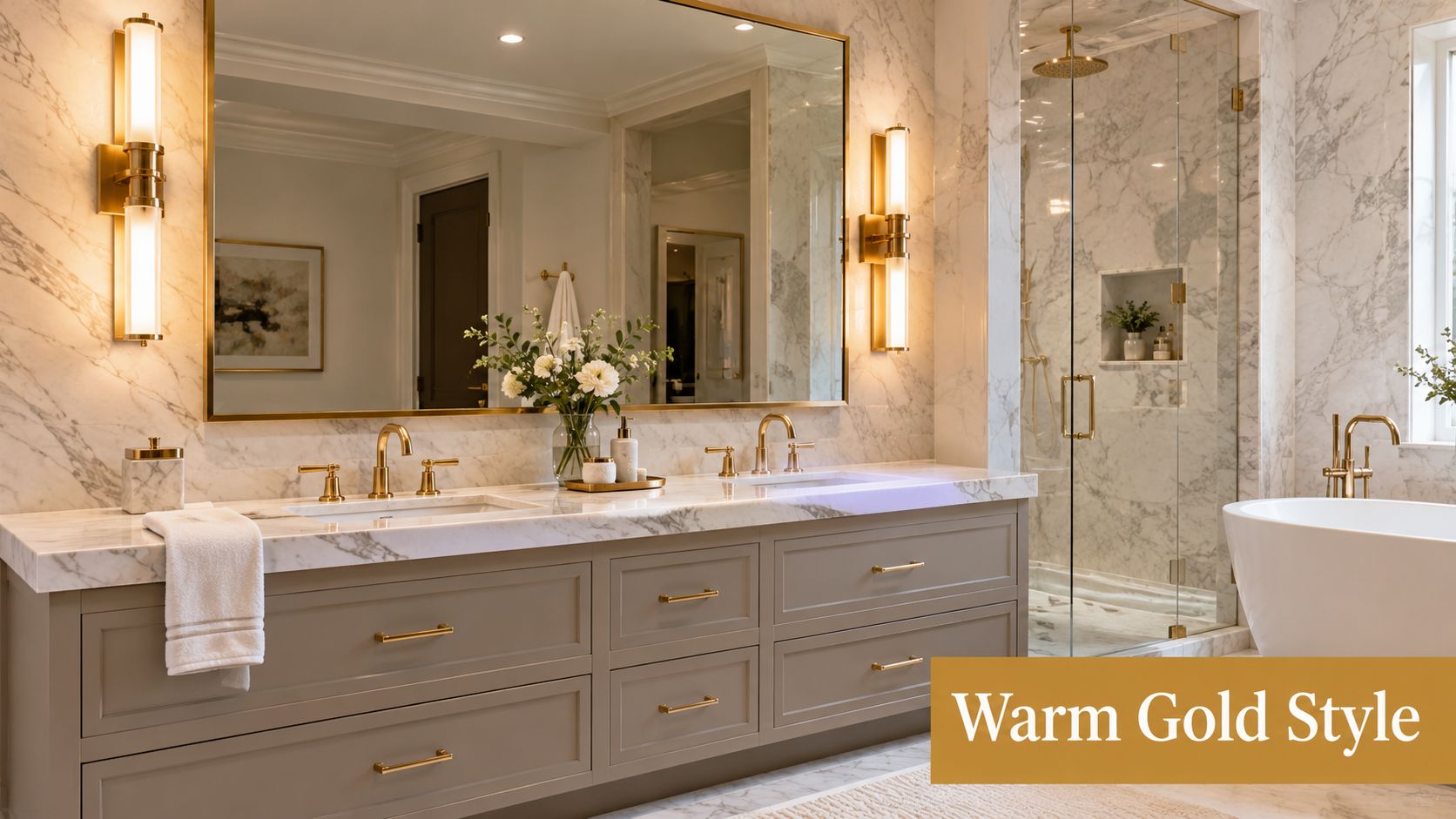
Start with the bathroom's visual language
A modern bathroom with flat-panel cabinetry suits a thin horizontal bar, cylindrical shades, or vertical sconces with a simple backplate. A transitional bathroom can handle more shape — a softly curved arm, tapered glass, or a satin-gold frame. Polished gold belongs here only when other reflective elements have a clear role.
The glass changes the fixture's character as much as the metal:
- Clear glass keeps the bulb visible and produces a brighter, more defined look.
- Frosted glass softens glare and supports a calmer grooming environment.
- Opal glass creates an even, diffused glow that works well with pale tile.
- Textured glass adds pattern, but balance it with simpler surrounding surfaces.
Clear glass can be striking against a strongly patterned marble. Frosted or opal glass is the more practical choice when the mirror faces a glossy wall or gets direct daylight. Let reflection, not catalog photography, decide.
Gold vanity lights to start with
- Elliott 2-light Vanity in Brushed Champagne Brass and Clear Alabaster Glass — swirled alabaster glass for a soft, diffused glow; damp-location rated, from YEP by Golden.
- Seaport 3-light Vanity in Brushed Champagne Brass — metal shades in a quiet brushed finish; damp-location rated.
- Calla 3-light Vanity in White Gold — hammered water glass and a finish that blends warm gold with cool silver; damp-location rated.
If you want to personalize, YEP by Golden lets you mix shades, finishes, and glass so the vanity light can relate to a distinctive mirror, cabinet color, or tile. For a more curated, statement-level bathroom, Ziva by Golden focuses on refined materials and presence without relying on excessive ornament. Carry the same warm-metal note into a nearby hallway sconce or dressing-area pendant — the finish doesn't need to repeat everywhere, but the shapes and light quality should feel related.
Bringing Your Bathroom Vision to Life
The most successful gold vanity lighting follows a simple order: establish the function at the mirror, then choose the proportions, and only then let the finish be the final filter.
The professional checklist
- Choose the finish deliberately: Brushed or satin gold for a softer contemporary or transitional effect; polished gold only where the room can support its reflectivity.
- Place for faces, not walls: Flanking sconces centered near eye level, about 60 inches above the floor — or an above-mirror bar at about 78–84 inches for standing users.
- Size against the mirror: Keep a bar slightly narrower than the mirror, never wider.
- Specify high color quality: CRI 90 or above so skin tones and makeup read accurately.
- Stay in the useful warmth range: 2700K–3000K for daily grooming.
- Control glare: Frosted or opal glass where the bulb sits in your line of sight or the room has many reflective surfaces.
- Plan the metal mix: Let gold lead or support, then repeat it through hardware, mirrors, or accessories.
- Check the installation: Damp-location rating, electrical-box position, projection, and dimmer compatibility before purchase.
Gold should be the finish that makes the room feel intentional. It shouldn't be the feature that exposes poor proportions or uncomfortable light.
Measure the mirror, photograph the existing hardware in daylight, and compare brushed, satin, and polished samples beside the tile. Then browse our wall and vanity lighting or find a Golden Lighting retailer to see the finish in person before you order.
— seen a lot of light fixtures in 80+ countries. Still learning what actually works in a home.











Share:
Color Glass Chandelier Sizing and Styling Guide