



Written by Rick Kovac, COO of Golden Lighting
The takeaway: Under an 8-foot ceiling, a wide, shallow fixture wins. Where people walk underneath, choose a broad semi-flush or flush "low profile chandelier" with enough lights to fill the room. Save hanging chandeliers for spots where a table keeps people out from under them.
Key takeaways:
- Over a walkway, the bottom of any fixture stays at least 7 feet above the floor. On an 8-foot ceiling, that leaves about 12 inches for the whole fixture.
- Over a dining table, the rule changes: hang the bottom 30–36 inches above the tabletop, because the table keeps people from walking underneath.
- Low ceilings call for width, not drop. Our design team treats wide semi-flush mounts (24 inches or more, with several lights) as the right main fixture for 8-foot rooms.
- Small fixtures with one or two bulbs underlight a room. Match the number of lights to the size of the table and the room.
A dark kitchen or a cramped dining room can make a home feel smaller than it is. The usual cause is a fixture chosen for its looks before anyone checked the vertical space. A chandelier that looks balanced in a showroom can crowd a low room, block sightlines, or make people duck. Low profile chandeliers fix that by keeping the decorative presence while cutting the drop.
What Counts as a Low Profile Chandelier
A low profile chandelier is defined by how far it projects from the ceiling, not by its finish. It keeps the body close to the ceiling while giving more character than a basic ceiling light: a wide frame, several lights, layered glass or fabric, or a ring of light.
| Fixture type | How it mounts | Where it fits best |
|---|---|---|
| Flush mount | Tight to the ceiling | Halls, closets, bedrooms, and anywhere headroom is tight |
| Semi-flush mount | A short stem or canopy below the ceiling | Entries, bedrooms, dining nooks, and 8–9 ft living spaces |
| Low profile chandelier | A wide, shallow, multi-light body, often semi-flush | The main fixture in a low-ceiling dining or living room |
Our design team's rule is that flush and semi-flush fixtures exist because ceilings are low. They look right under standard 8–9 foot ceilings and lost under double-height or vaulted ones. Judge the complete assembly, meaning canopy, body, and lowest point, rather than the product title.
For integrated LED options, our low profile LED ceiling light guide compares close-to-ceiling designs, and our semi-flush buying guide covers that category in depth.
The Two Clearance Rules
Low ceilings come with two different height rules, and mixing them up is the most common mistake we see.
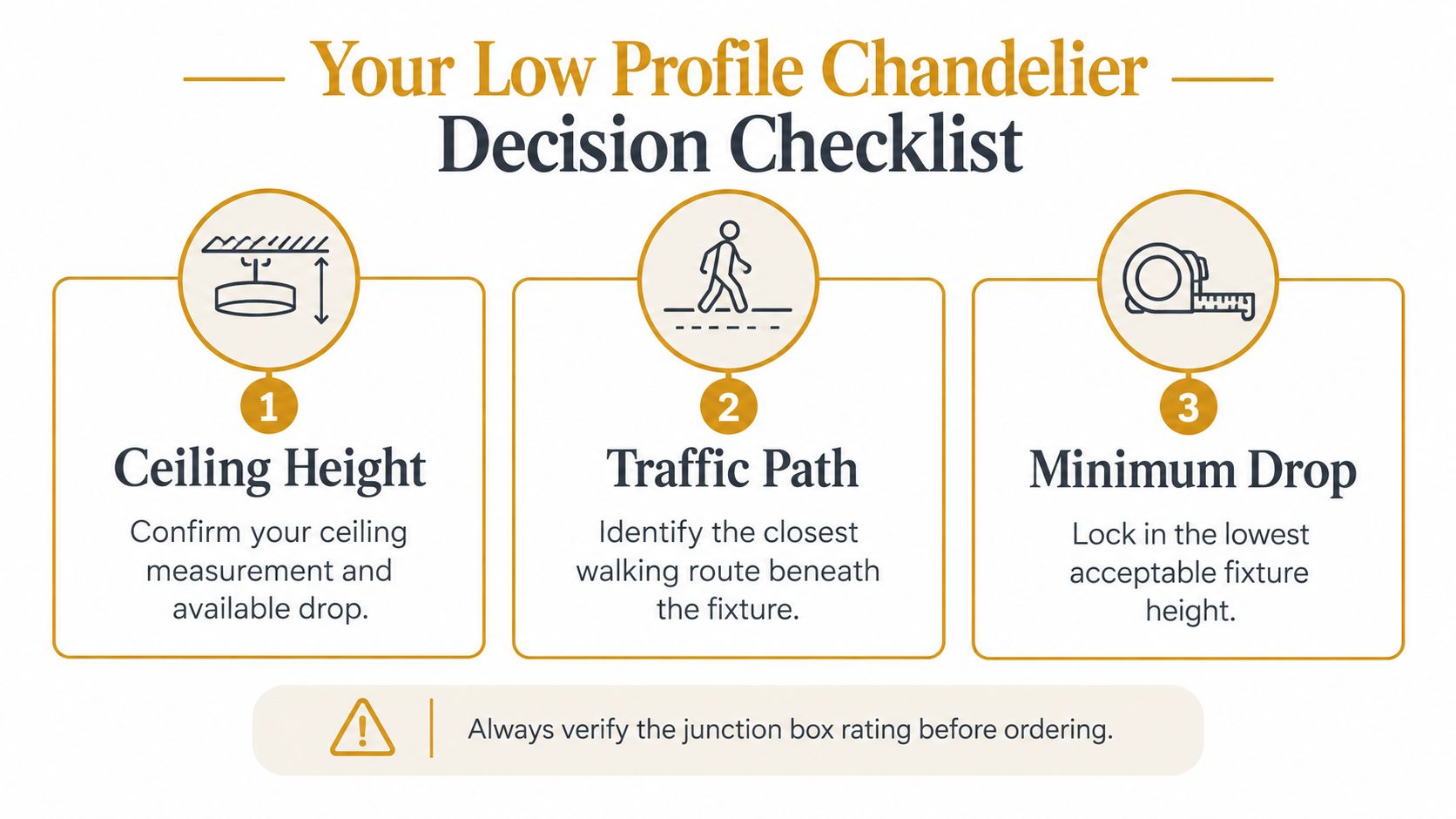
- Where people walk underneath: keep at least 7 feet from the floor to the bottom of the fixture, and aim for 7½ feet where the ceiling allows. On an 8-foot (96-inch) ceiling, that leaves about 12 inches for the whole fixture. On a 9-foot ceiling, about 24 inches.
- Over a table or island: hang the bottom of the fixture 30–36 inches above the surface. The table keeps people from walking underneath, so the 7-foot rule doesn't govern there, and even an 8-foot dining room can take a hanging fixture over the table.
If a fixture hangs over a walking path, clearance outranks drama. Choose the wider, shallower piece people can pass under without thinking about it.
Sizing by Room and Table
- Start with the room formula. Add the room's length and width in feet; the sum is a starting diameter in inches. A 12 × 14 ft room gives about 26 inches. It's a minimum starting point.
- Let the table win in a dining room. The fixture should be about one-half to two-thirds as wide as the table. When this and the room formula disagree, the table governs.
- Center it on the table, not the room. If the table sits off-center, so does the fixture.
- Match the light count to the table. Flush and semi-flush fixtures over a table have limited output. Our design team's guide: about 3 lights for small tables (48 inches or less), 5–6 lights for medium tables (54–72 inches), and a larger, higher-output fixture for six seats or more.
- Check the height on hanging fixtures. For chandeliers and pendants, a common sizing rule is 2.5–3 inches of fixture height per foot of ceiling. On a low ceiling, choose the shallow end and confirm the clearance rule above still holds.
Our guide to what size chandelier you need has worked examples, and how to light low ceilings explains why wide semi-flush mounts are our answer for 8-foot rooms.
Make sure it's enough light
Our design team sees the same failure again and again: a small single-bulb fixture in a large room. It may look proportionate and still leave the room dim. Light output scales with the total number of bulbs relative to the area, so a wide fixture with several lights does more than a small one with one. Dining illuminance targets from ANSI/IES RP-11-26 back this up: the whole tabletop is the task area, and informal family dining needs about twice the light of a formal dinner.
Installing in Tight Spaces
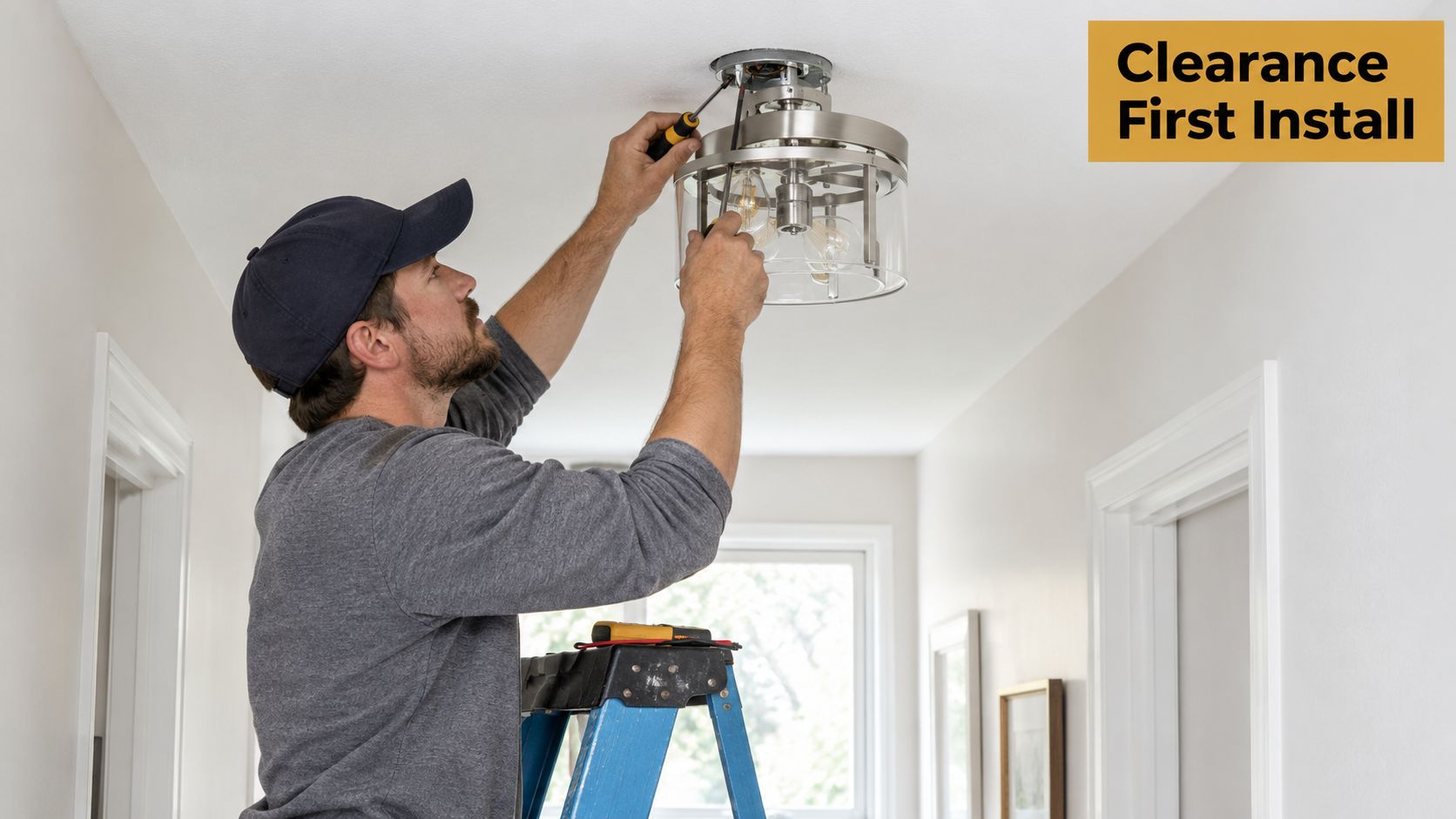
- Kill the power at the breaker and confirm it with a tester.
- Check the ceiling box. Under the National Electrical Code (NEC 314.27), ceiling boxes must support at least 50 lb; a fixture heavier than that needs independent support or a box listed for the weight.
- Assemble on the floor and measure from the canopy to the lowest point before lifting the fixture overhead. That catches a wrong stem or chain length early.
- Shorten adjustable hardware to the planned height. Every inch matters near the minimum clearance.
- Use a sloped-ceiling adapter where needed, so the body hangs level instead of tilting with the ceiling.
- Confirm the dimmer. Use a dimmer the fixture or bulb maker lists as compatible to avoid flicker or a narrow dimming range.
For uncertain wiring, heavy fixtures, or difficult ceiling angles, have a licensed electrician do the work. Our flush mount installation guide walks through the sequence.
Finishes and Silhouettes for Low Rooms
Low ceilings don't need bland lighting; they need disciplined shape. A broad, horizontal silhouette, such as a shallow drum, a ring, or a wide multi-light frame, keeps the visual weight up near the ceiling and gives the room a clear center. A sprawling multi-arm chandelier does the opposite and makes the ceiling feel busier and lower.
- Shades and diffusers: opal glass, frosted glass, and fabric soften the source when the fixture sits close to eye level. In bedrooms, our design team avoids open-bottom fixtures, because anyone lying down looks straight up into the bulb.
- Finish: pick the metal to suit the room's hardware and furniture. Matte black reads crisply against a pale ceiling; warm brass suits wood and dining rooms; nickel and chrome suit cooler, cleaner palettes.
- Ceiling color: a light ceiling (LRV 80–90) reflects more light back into the room, which matters even more when the fixture is close to it.
Shop this guide
- Aenon 6-light Semi-Flush Mount in Matte Black — about 27¾ inches wide and under 9 inches tall, so it clears a walkway under an 8-foot ceiling.
- Everly 6-light Semi-Flush Mount in Matte Black and Modern Black Rattan shade — a wide, textured six-light fixture, about 13¼ inches tall, for 9-foot rooms or over a table.
- Ellie 6-light Semi-Flush Mount in Modern Brushed Gold — a warm-metal six-light option at the same scale.
Measure the ceiling, the table, and the nearest walking path twice, then choose the widest, shallowest fixture with enough lights to fill the room. Browse our semi-flush and chandelier collections, or find a Golden Lighting retailer.
— seen a lot of light fixtures in 80+ countries. Still learning what actually works in a home.











Share:
Bathroom Wall Sconces: Placement, Ratings, and Light That Flatters