



Written by Rick Kovac, COO of Golden Lighting
The takeaway: On a brass chandelier, the shade does the lighting work. It decides whether diners see a glowing pool of light or a bare bulb, so choose its shape and depth for glare first, its finish for maintenance second, and confirm fit and weight before you order.
Key takeaways:
- A good shade hides the bulb from normal seated and standing eye level. Shade depth matters as much as diameter.
- Shape sets the beam: drums give a broad, even downlight, bells and cones focus a pool on the table, and open-top shades also wash the ceiling.
- Pick the brass finish for how the room is used: lacquered polished for formal rooms, brushed for high-touch family spaces, and living (unlacquered) brass only if you want it to age.
- Size the fixture to the table (about one-half to two-thirds of its width), hang it 30–36 inches above the top, and keep it on a dimmer.
A dining room can have a beautiful chandelier and still feel uncomfortable. If guests squint at a bright spot every time they look across the table, the frame isn't the problem. The shade is. Brass chandelier shades control the beam, soften bright points, hide the bulb, and decide whether a fixture feels relaxed, formal, or architectural.
Why the Shade Matters More Than the Frame
The frame gives the chandelier its structure; the shade decides how it performs. An open shade sends light up and out. A deeper or more opaque shade concentrates light below. A translucent liner or glass diffuser softens the bulb without making the room feel flat.
The test is simple: from a seat at the table and from a standing position nearby, can you see the brightest part of the bulb? ANSI/IES residential guidance asks for fixtures in the line of sight to read as low-brightness, with no bare "glare bombs." It also cautions against open, direct fixtures sitting right over diners' heads.
A shade that looks perfect in a product photo can still fail over a table if the bulb is visible from an ordinary chair.
The same brass frame can look formal with pleated fabric, clean and contemporary with a straight drum, or heritage-inspired with opal glass. The shade is where you set the fixture's personality.
Shade Profiles and the Light Each One Makes
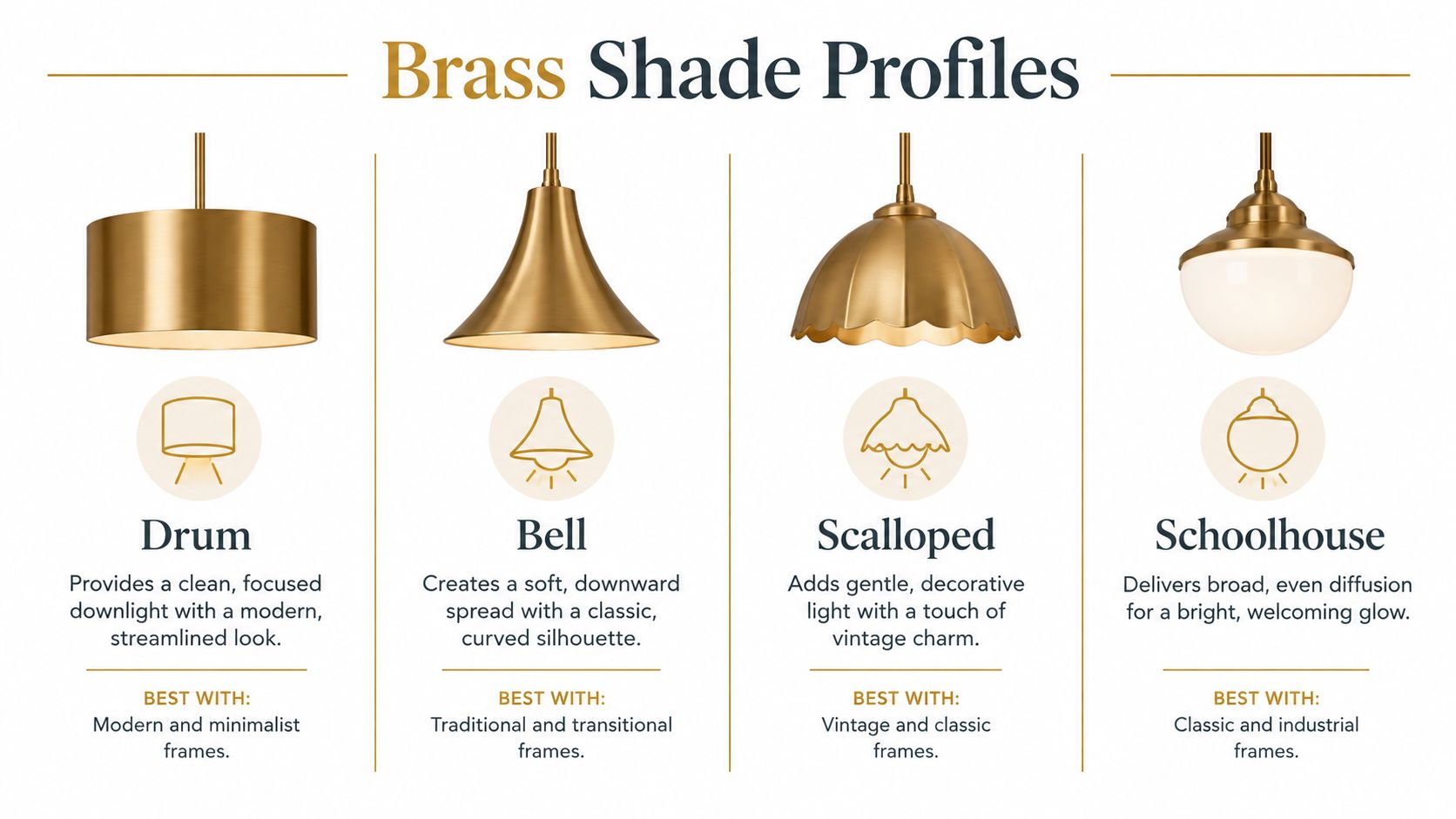
| Profile | Light it makes | Watch for |
|---|---|---|
| Drum | Broad, even downlight with a clean horizontal line | A shallow drum can expose the bulb from the side |
| Bell or empire | A defined pool of light on the table; traditional character | Less light on walls and ceiling; a narrow top can hold heat |
| Coolie or open-top | Downlight plus a ceiling wash through the open top | The bulb can show from some angles, or from above on a stair |
| Scalloped | Soft, decorative light with vintage charm | Pair with a diffused liner or frosted bulb at eye level |
| Schoolhouse or opal glass | Light spread in many directions, easy on the eyes | Changes the look from metal-led to glass-led |
| Cone | A sharp, contemporary downlight | A narrow opening can leave the room's edges dim |
The key measurement isn't diameter alone. Depth decides how much of the bulb disappears from view, and the top and bottom openings decide how much light escapes up and down. Fabric is its own family; our fabric shade chandelier guide covers it.
Brass Finishes and How They Age
| Finish | Look | Maintenance | Best room |
|---|---|---|---|
| Lacquered polished brass | High shine, formal glow | Low; the clear coat resists change | Formal dining rooms |
| Brushed brass | Soft, satin reflection | Easy; minor wear shows less | Kitchens and family spaces |
| Living (unlacquered) brass | Starts bright, then deepens | Intentional care; patina develops unevenly | Heritage or collected interiors |
Don't casually mix unrelated brass treatments within one fixture. Polished, brushed, and living surfaces reflect light differently, so an unplanned mix looks assembled rather than designed. Coordinating the chandelier with the room's hardware works best within one color family. Matching finishes is the classic default; a deliberate mix of metals is a current trend that works when it's clearly on purpose. If a listing says "solid brass," treat it as a specific material claim and check the spec sheet. Many fixtures are brass-finished steel. Our finish durability guide explains how plated finishes wear.
How to Size the Fixture and Shades
- Size to the table. The fixture should be about one-half to two-thirds of the table's width. A 42-inch-wide table suits a fixture roughly 21–28 inches across. When the room formula (room length plus width in feet equals a starting diameter in inches) disagrees, the table governs.
- Center it on the table, not the room.
- Hang it 30–36 inches above the tabletop to the bottom of the fixture, so shades sit above the conversation instead of in it.
- Check shade spacing. Shades shouldn't touch each other, the arms, or the sockets. Larger shades read as a continuous canopy of light; smaller ones show more of the brass frame.
- Sit down and look. From each chair, confirm no bulb is visible. If one is, choose a deeper shade or adjust the height.
Our chandelier sizing guide and lamp shade measurement guide cover diameter, height, and fitter measurements.
Fit, Attachment, and Weight
Shade attachment is where attractive substitutions turn into expensive mistakes. Clip-on shades sit over candle-style bulbs, threaded fitters attach through the socket, and some fixtures use their own retaining rings. A shade that tilts, rests on the socket, or blocks airflow isn't compatible, however good it looks. Our lamp shade adapter guide helps resolve fit without improvising hardware.
Metal shades also add weight. Add up the documented weight of the fixture and every shade, then check it against the canopy, chain or stem, and ceiling box ratings. Under the National Electrical Code (NEC 314.27), ceiling boxes must support at least 50 lb; anything heavier needs independent support or a box listed for the weight. Use the manufacturer's numbers. Don't estimate a "typical" shade weight.
Bulbs, Enclosed Shades, and Dimming
- Fit the bulb inside the shade without touching metal, glass, or fabric.
- Match the base to the socket (candelabra E12 or medium E26).
- Use enclosure-rated LEDs in closed shades that limit airflow.
- Stay within the fixture's maximum rating.
- Choose by lumens, not watts, and keep it warm: 2700K–3000K is the standard for dining and living spaces. Our guide on how to choose light bulbs covers brightness equivalents.
- Put it on a dimmer the bulb or fixture maker lists as compatible. Dining light should range from bright for homework to low for dinner. Standard LEDs hold their color when dimmed; they won't turn amber unless labeled dim-to-warm.
Brass and warm light flatter each other. And because one chandelier can't light a whole dining room alone, add a lower layer, such as sconces or a lit sideboard, so the shades don't have to be the only source.
Care Without Damaging the Finish
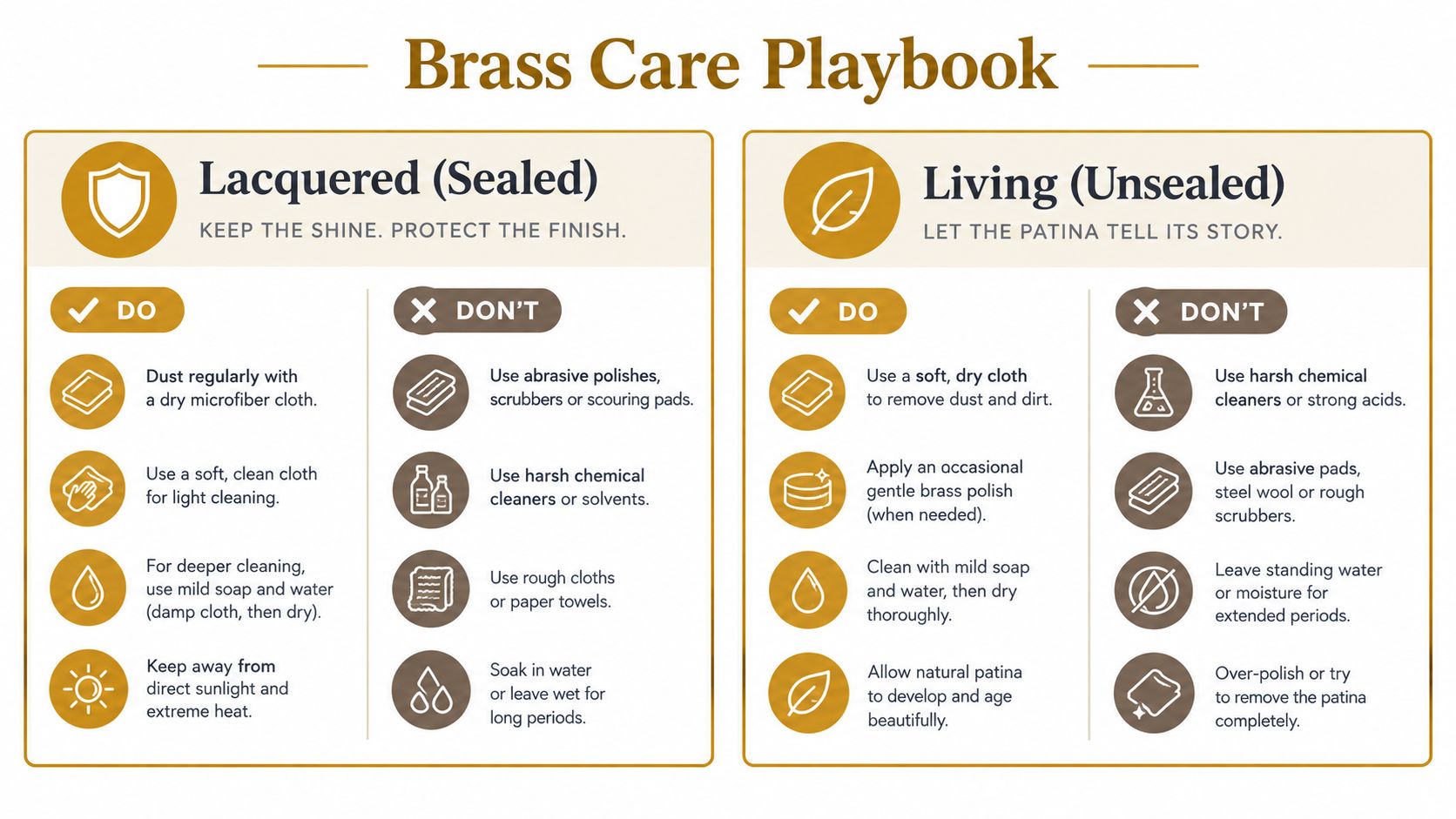
- Lacquered brass: dust with a dry microfiber cloth. For more, use a cloth barely dampened with mild soapy water, then dry. Skip abrasive polishes, scouring pads, and harsh chemical cleaners, which can cloud or wear through the coating.
- Living brass: clean gently with mild soap and water and dry thoroughly. Polish only lightly and occasionally if you want to slow the patina; aggressive polishing strips the character you chose it for.
- Fabric-lined shades: keep them dry and dust them with a soft brush.
When in doubt, identify the finish and follow the manufacturer's care instructions, and test any cleaner in a hidden spot first.
Shop this guide
- Orwell 6-light Chandelier in Brushed Champagne Brass and Aged Brass shade — brass frame with brass metal shades, about 29 inches across; a fit for tables around 44–58 inches wide.
- Reeva 5-light Chandelier in Modern Brass and Glossy Ecru shade — modern brass with soft ecru shades, about 27 inches across.
- Orwell 1-light Wall Sconce in Matte Black and Brushed Champagne Brass shade — a matching brass shade for the sconce layer.
Measure the table, record the frame's fitter and socket details, choose the shade profile for glare and beam, then confirm the total weight and bulb specs. Explore the chandelier collection or find a Golden Lighting retailer to see brass finishes in person.
— seen a lot of light fixtures in 80+ countries. Still learning what actually works in a home.











Share:
Semi-Flush Entryway Lights: How to Choose, Size, and Install One