



Written by Rick Kovac, COO of Golden Lighting
The takeaway: Brushed gold reads timeless when a disciplined silhouette carries the finish — size it by adding room length and width in feet for diameter and multiplying ceiling height in feet by 2.5 to 3 for fixture height, then let proportion, not the metal alone, do the work.
Key takeaways:
- Brushed gold sits between polished and antique gold: warmer than chrome, calmer than mirror-bright gold.
- Size with two rules: room length plus width in feet for diameter in inches, and ceiling height in feet times 2.5 to 3 for fixture height.
- A restrained silhouette keeps brushed gold timeless; an overly sculptural form paired with the same finish reads trend-driven.
- Most brushed gold chandeliers use a coated finish over steel, aluminum, or zinc alloy rather than raw brass, which means steadier color and simpler upkeep.
A dim dining room usually doesn't need more paint. A narrow entry doesn't need another mirror. Most often, the room is missing a fixture with enough warmth and presence to organize the space.
That's where a brushed gold chandelier earns its keep. It adds visual structure, brings a softer metal into the room, and gives the eye a focal point that furniture alone can't deliver. The finish matters because gold can read crisp, dated, moody, or refined depending on the sheen, the shape, and the light hitting it.
The key decision isn't just gold or not gold. It's whether brushed gold supports the room you're building, or steals attention in the wrong way.
Homeowners usually want one thing. A fixture that feels current now and still feels right years later. Designers usually want another layer. A finish that can bridge wood, stone, black accents, and cooler metals without looking forced.
A brushed gold chandelier can do both, but only when the finish, scale, and placement are handled together. Good rooms rarely get there by accident. They get there because the lighting was chosen with intent, then layered with ambient and task sources that support it. Golden Lighting's guide to layered lighting is a smart companion if the room still feels flat after the fixture is selected.
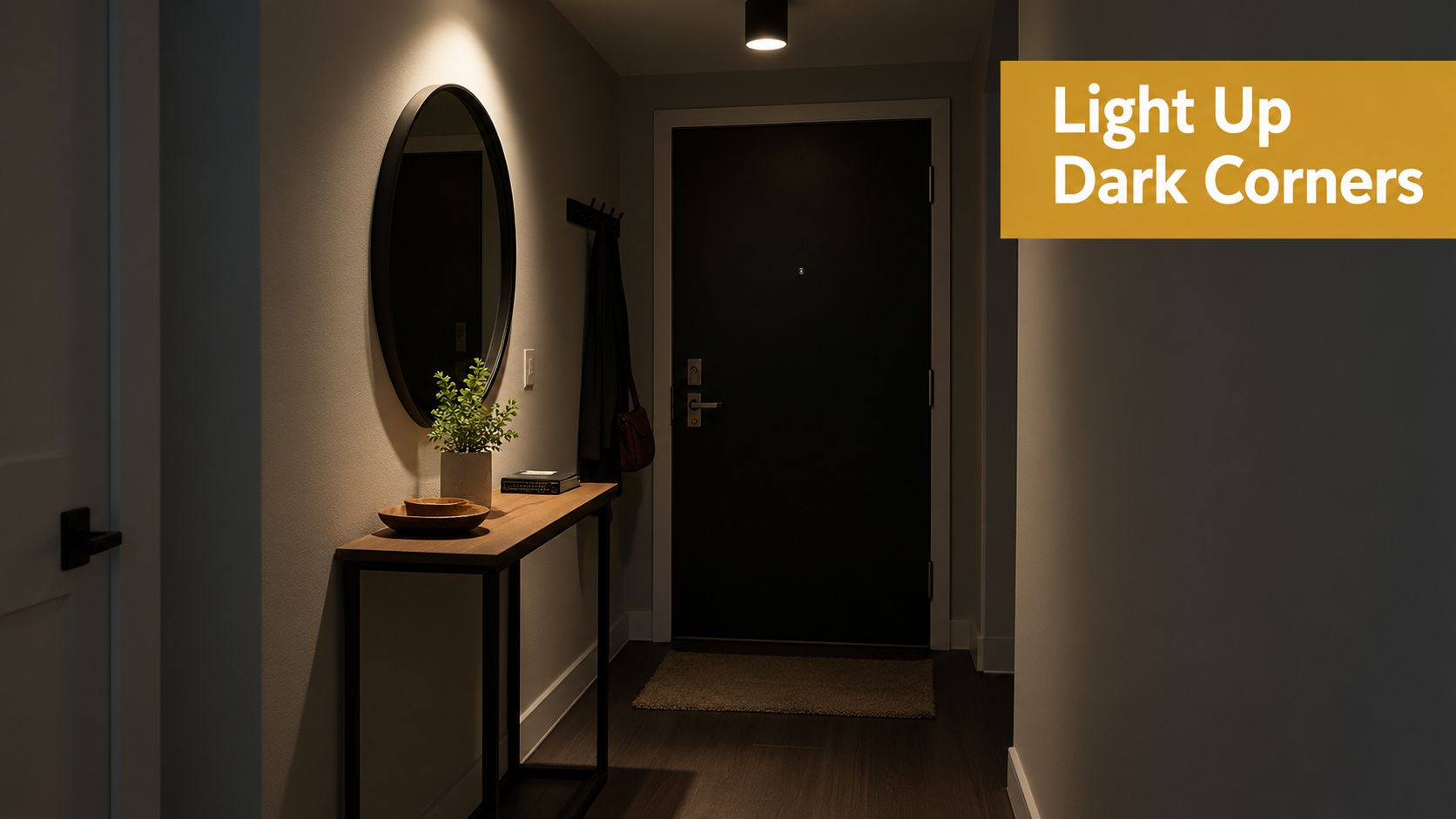
What works is practical. Choose the right gold family. Size it with real math. Hang it where it shapes the room, not where it merely fills ceiling space. Then light it so the finish reads warm instead of muddy.
Introduction That Dark Room Needs More Than Paint
A kitchen nook can feel serviceable but unfinished. A dining room can look furnished and still feel dim at night. An entry can be technically bright but visually flat because the light comes from everywhere and nowhere at once.
Those rooms usually share the same problem. They lack a center.
Why a chandelier changes the room faster than most upgrades
A brushed gold chandelier does three jobs at once:
- Adds warmth: The finish introduces a warm metal note without the high flash of polished gold.
- Creates scale: A ceiling fixture helps a small room feel intentional and a larger room feel anchored.
- Improves focus: It tells the eye where the room begins, especially over a table, in a foyer, or above an island.
That's why chandeliers still solve modern rooms so well. They aren't relics. They're structure.
Practical rule: If a room feels finished on paper but underwhelming in person, the missing element is often central lighting with enough scale.
Why brushed gold needs its own guide
Gold finishes get lumped together too often. That's a mistake. Brushed gold behaves differently from polished gold, antique gold, and flatter matte golds. It reflects less, softens contrast, and can look classic or trendy depending on the silhouette around it.
This guide stays focused on that difference. It looks at what brushed gold is, when it reads timeless, how to pair it with other finishes, how to size it correctly, and what upkeep looks like in everyday use.
A good brushed gold chandelier doesn't just decorate the ceiling. It solves a room problem.
What a Brushed Gold Chandelier Really Is
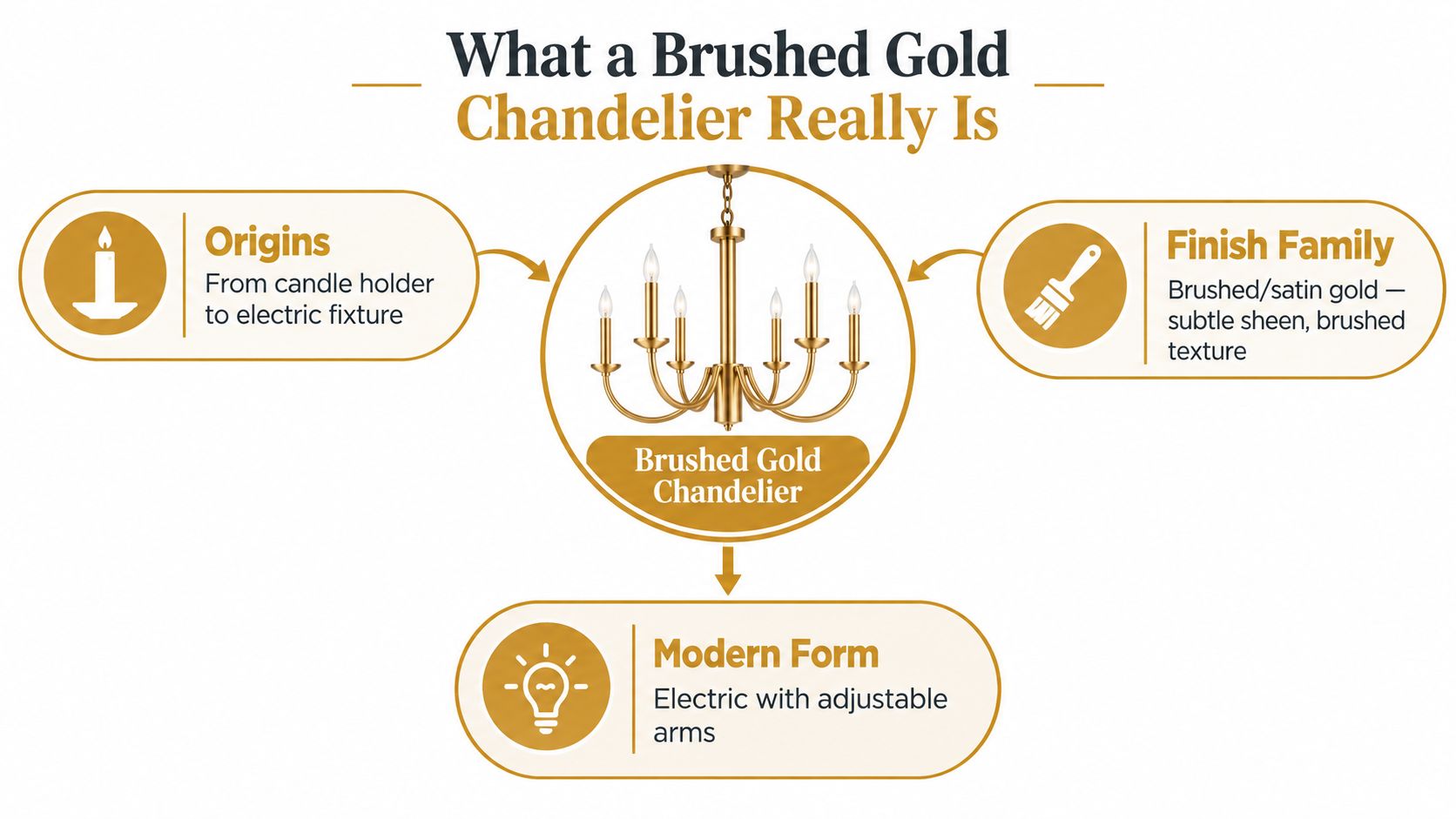
A brushed gold chandelier is a chandelier with a warm gold-toned surface and a fine directional texture that cuts glare instead of throwing back sharp reflections. That texture is the difference homeowners notice first. Designers usually notice the second difference. Brushed gold carries color without demanding the high contrast and formality of polished brass or mirror-bright gold.
A little history helps here. Chandeliers have always changed with the technology and the room. Candle models in brass and bronze gave way to electrified fixtures in the late 19th century, while the core job stayed the same: bring centered light and visual structure to a space. The finish changed with manufacturing methods, but metal chandeliers never left the category. Brushed gold is part of that long line, which is why it can read classic when the proportions and silhouette are right.
The plain-language definition
A brushed gold chandelier is an electric chandelier finished in a muted gold tone with a visible or subtle grain, giving it a soft sheen instead of a mirror shine.
That surface treatment matters more than the label on the carton. In one product line, "gold" may mean champagne, honey, brass-gold, or a flatter satin tone. Brushed gold usually sits in the middle. It feels warmer than chrome or nickel, but calmer than polished gold.
What it is made of, and why that affects the finish
Modern brushed gold chandeliers are rarely made from solid brass with a naturally aging surface. Many are built from steel, aluminum, or zinc-alloy parts, then finished with plated, painted, or PVD-applied coatings. Physical vapor deposition (PVD) is a well-established coating process in lighting and hardware manufacturing, valued for creating a hard finish layer with good wear resistance and more consistent color than untreated live metal.
That changes the ownership experience in practical ways:
- The color stays steadier: You are buying a defined finish, not a surface that is meant to darken and shift.
- Routine care is simpler: Dusting with a dry microfiber cloth is usually enough.
- Touch points hold up better: On fixtures near kitchen grease or frequent handling, a protected finish is easier to live with than raw brass.
There is a trade-off. A stable coated finish will not develop the patina some designers want from unlacquered brass. If the goal is an old-house evolution, brushed gold can feel too controlled. If the goal is consistency across an open-plan home, that control is exactly the benefit.
When brushed gold looks timeless, and when it looks trendy
The finish itself is not what pushes a chandelier into trend territory. The silhouette does that.
Brushed gold reads timeless on shapes with clear structure: simple candle arms, well-scaled globes, drums, restrained linear frames, and proportions that fit the room. It starts to read trend-driven when the finish is paired with overly sculptural forms, crowded branching, exaggerated geometrics, or details that depend on novelty more than lighting performance.
I use a simple test. If the fixture would still look balanced in matte black or aged iron, the form is probably strong enough to carry brushed gold for the long haul. If the whole design depends on the gold tone to feel interesting, it has a shorter style life.
Why one brushed gold chandelier looks rich and another looks flat
Light source and surrounding materials do part of the work. A warm bulb tends to bring out the depth in the brushing. A cool bulb can make the same fixture look greenish, pale, or muddy. Cabinet color matters too. Against walnut, white oak, plaster, or soft white paint, brushed gold usually looks grounded. Against several competing warm metals, it can lose definition.
That is why brushed gold works best as a deliberate dominant finish, not a vague accent. Give it enough visual support, and it reads settled. Treat it like a last-minute color choice, and it can look temporary.
Finish and Style Variations You Will Actually See
Walk through any chandelier assortment and “gold” won't mean one thing. The market splits the category into families such as antique, polished, matte, glossy, textured, and brushed or satin finishes, which signals sustained demand for warm-metal finishes across consumer lighting assortments.
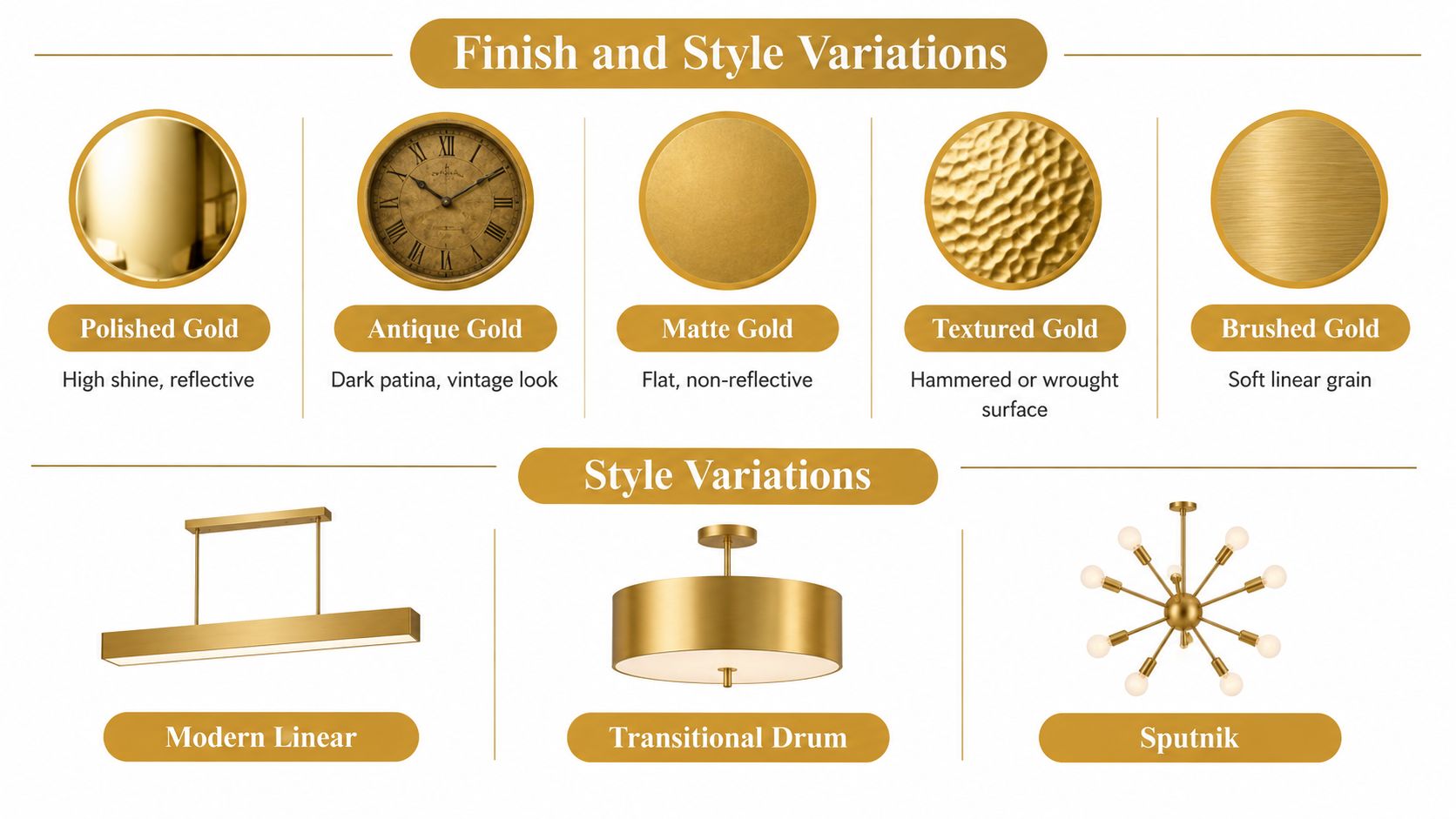
Brushed gold sits in the middle of that family. It isn't mirror-bright like polished gold. It doesn't try to mimic age the way antique gold does. That middle position is exactly why it works in so many homes.
Brushed Gold vs Other Gold Finishes at a Glance
| Finish | Look and Feel | Best For |
|---|---|---|
| Brushed Gold | Soft sheen, visible grain, warm without harsh reflection | Dining rooms, kitchens, entryways, open-plan interiors |
| Polished Gold | Bright, reflective, dressier presence | Formal rooms, glamorous interiors, statement fixtures |
| Antique Gold | Darker, aged character, more historical mood | Traditional spaces, collected interiors, vintage-inspired rooms |
| Matte Gold | Flatter appearance, low reflection | Clean modern rooms, restrained palettes |
| Textured Gold | Hand-worked or hammered appearance | Organic interiors, artisan-forward spaces |
The finish is only half the choice
Shape decides whether the fixture feels timeless or trend-led.
A modern linear chandelier in brushed gold usually works best over a long dining table or island where clean geometry matters. A transitional drum shape makes the finish feel more architectural and less decorative. A sputnik or branch form introduces more motion and personality, but it needs stronger room editing to avoid looking tied to a specific design moment.
The safest route to a long-lasting room is simple. Use a fashionable finish on a disciplined silhouette, or a bold silhouette in a restrained finish. Avoid making both dramatic at once.
Matching the fixture to the buyer
Different buyers want different things from the same finish.
- For the homeowner: A classic chandelier shape in brushed gold usually offers the best long-term value because it's easy to live with and easy to coordinate.
- For the creative: Mix-and-match systems open more freedom. YEP by Golden is especially relevant when changing shades or glass matters as much as the frame finish.
- For the professional: Refined forms with tighter detailing and showroom-level restraint are the stronger choice. Ziva-type styling works best when the fixture needs to support a broader material story instead of becoming the entire story.
Readers comparing warm-metal finishes may also find this champagne bronze finish overview useful, especially when the room sits between brass warmth and a slightly softer metallic note.
If the goal is a timeless brushed gold chandelier, the silhouette should carry more weight than the trend cycle. Quiet geometry tends to last longer than novelty.
How to Choose the Right Size for Your Space
Most chandelier mistakes are sizing mistakes. The fixture is either too small to command the room or too heavy for the ceiling height. Both problems are preventable.
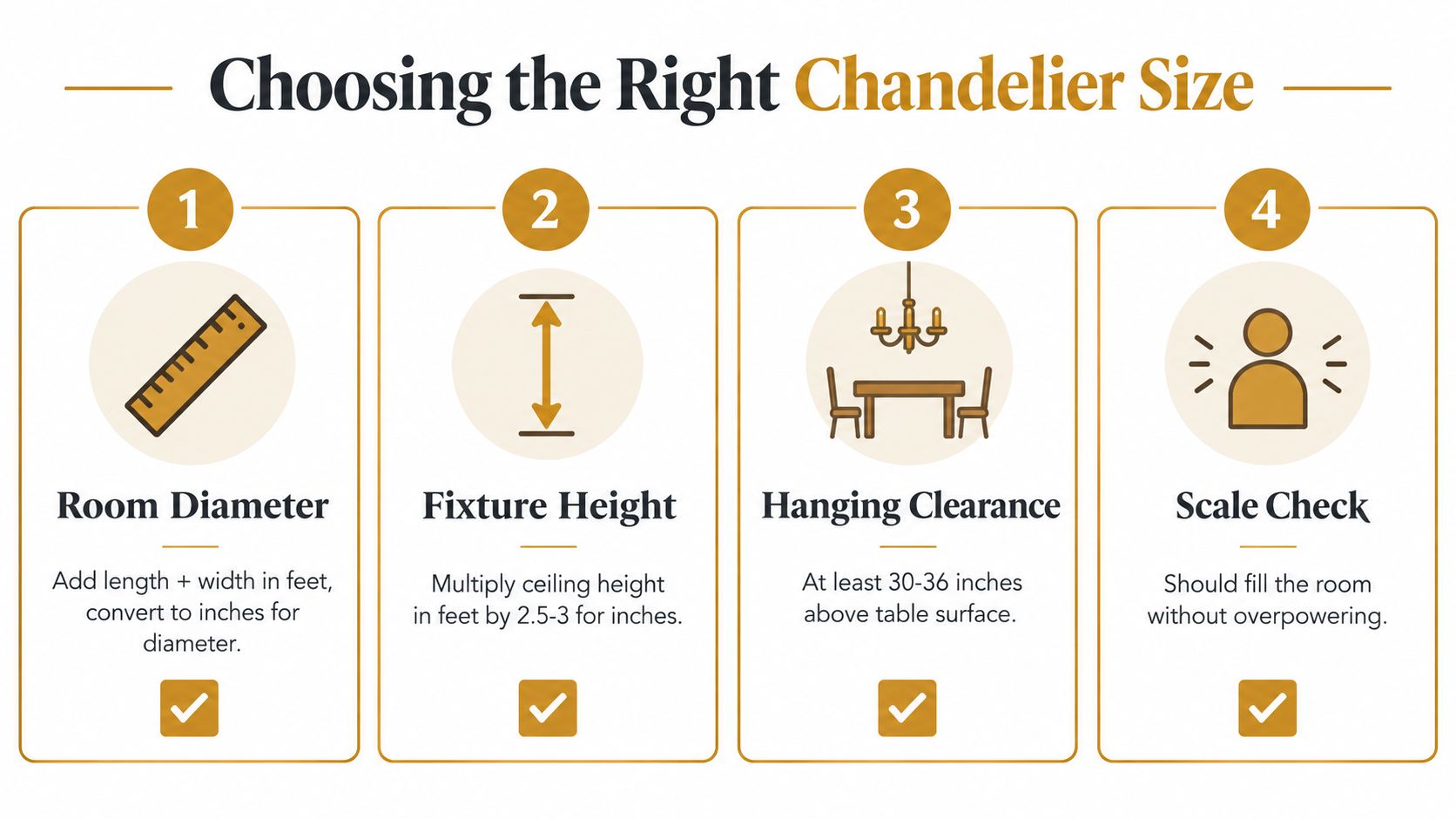
The most reliable starting rule is simple. Add the room's length and width in feet, then use that total as the chandelier diameter in inches. For vertical proportion, multiply the ceiling height in feet by 2.5 to 3 to estimate fixture height, per Golden Lighting's chandelier sizing standard.
Start with the room, not the fixture
A chandelier shouldn't be chosen by browsing product thumbnails and hoping scale works out. The room gives the first answer.
Use these two rules first:
- Diameter rule: Add room length and width in feet. Use that number as fixture diameter in inches.
- Height rule: Multiply ceiling height in feet by 2.5 to 3 for an estimated fixture height in inches.
That gets the proportion into a workable range before style enters the conversation.
Quick Sizing Reference for Brushed Gold Chandeliers
| Room Scenario | Diameter Guidance | Height Guidance |
|---|---|---|
| Compact dining room | Add room length and width in feet, then use that total in inches | Ceiling height in feet × 2.5 to 3 |
| Open entry or foyer | Add room length and width in feet, then use that total in inches | Ceiling height in feet × 2.5 to 3 |
| Kitchen breakfast area | Add room length and width in feet, then use that total in inches | Ceiling height in feet × 2.5 to 3 |
| Living room focal zone | Add room length and width in feet, then use that total in inches | Ceiling height in feet × 2.5 to 3 |
Dining tables need their own math
Room math alone isn't enough over a table. The chandelier must relate to the furniture below it.
A practical benchmark is a fixture about 12 inches narrower than the table width, or roughly one-half to two-thirds of the table width with at least 6 inches from each table edge.
That gives a clear filter:
- Too wide: Guests feel crowded and chairs risk bumping visual clearance.
- Too narrow: The table overpowers the fixture and the room feels underlit at the center.
- Well-sized: The chandelier frames the table without tracing its exact footprint.
Hanging height matters as much as diameter
For standard 8-foot ceilings, Golden Lighting's clearance standard calls for hanging the bottom of the chandelier about 7 to 7.5 feet above the floor. Above 8 feet, treat the height rule (ceiling height in feet × 2.5 to 3 for fixture height) as the primary guide rather than a fixed per-foot add-on, and confirm the result against the room in person before ordering.
Pro-Tip
The most common buying mistake is going too small because the fixture looks large on a product page. Tape the proposed diameter on the floor or table first. That fast mock-up usually reveals whether the chandelier will anchor the room or disappear in it.
Readers working through room-by-room scale can also use this designer-focused chandelier sizing article for a second pass before ordering.
A brushed gold chandelier often looks lighter than a darker fixture, which can tempt buyers to undersize it. That's exactly when disciplined math protects the room.
Where to Hang It and What to Pair It With
Placement is where style becomes usable. A brushed gold chandelier may be perfectly sized and still feel wrong if it's hung off-center, paired with competing metals, or dropped into a room that treats finish as the whole design story.
Recent style coverage suggests brushed gold remains strong, but the shift is toward softer, matte, and hand-brushed variations, with brushed gold and other warm metals repeatedly listed among the leading finishes for 2026. The broader move is toward sculptural forms, integrated LED, and quieter luxury, which means finish alone shouldn't carry the room.
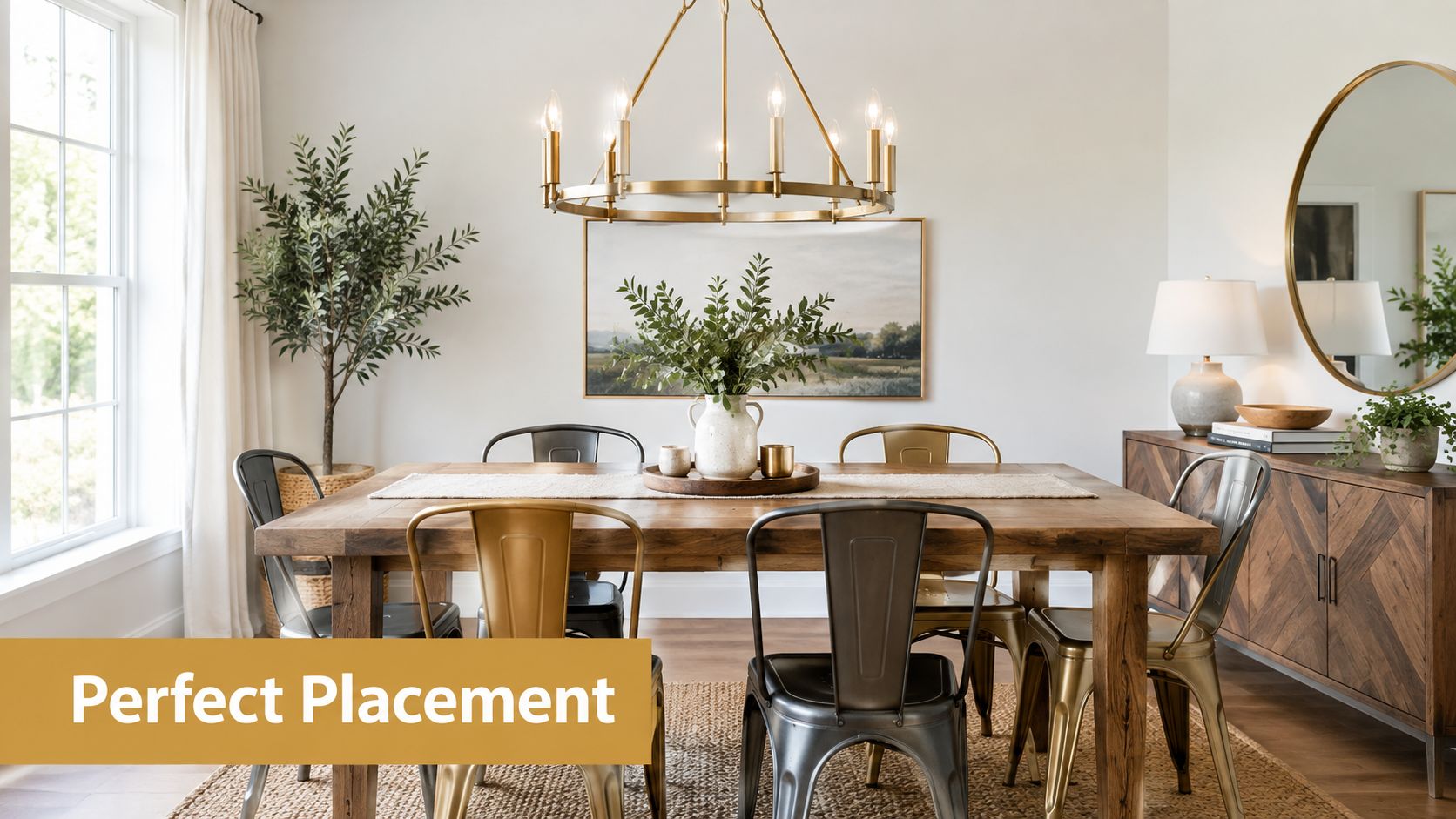
Where brushed gold performs best
A brushed gold chandelier usually feels strongest in spaces where it can warm hard finishes.
- Dining room: Center it over the table, not necessarily the room, if those two points differ.
- Entryway: Use it where the eye lands first from the doorway. The fixture should clarify the volume of the space.
- Kitchen: Brushed gold works especially well near wood cabinetry, stone counters, and muted paint because it softens those surfaces instead of competing with them.
- Living room: It should relate to the main seating zone, not drift toward an empty ceiling center.
How to mix metals without losing control
Compatibility is where brushed gold becomes more useful than flashy. Independent style guidance recommends one metal act as the dominant finish and one or two act as accents. Brushed gold also works well across lighting, hardware, and bath fixtures because its matte surface feels softer and less reflective than polished gold.
That leads to a practical formula:
- Let brushed gold lead when the room needs warmth.
- Use chrome or nickel as support when plumbing fixtures or appliances already lean cool.
- Bring in black carefully to sharpen contrast, especially through frames, hardware, or furniture bases.
- Repeat natural materials like wood and stone so the gold doesn't read isolated.
A timeless brushed gold chandelier doesn't ask every metal in the room to match. It asks the room to choose a leader.
For walls around the fixture, layered art helps bridge the finish into the rest of the palette, especially when a chandelier feels visually disconnected from the room below it.
When brushed gold looks timeless, and when it looks trendy
It reads timeless when the finish supports classic proportion, quiet forms, and a restrained material palette.
It reads trendy when every decision stacks in the same direction. Overscaled sculptural shape, highly stylized room, and warm metal on every visible surface can push the look into a short-lived era.
The fix is simple. Let the finish warm the room, but let proportion do the heavy lifting.
Maintenance Durability and Long Term Value
A brushed gold chandelier earns its keep when it still looks right after years of cooking residue, seasonal dust, bulb changes, and routine cleaning. Long-term value comes from finish technology, fixture design, and serviceability.
Many brushed gold chandeliers use a deposited coating over steel, brass, or zinc alloy rather than raw gold or unlacquered brass. In practical terms, that usually means more color stability and less day-to-day fuss. The finish is meant to stay consistent under normal indoor conditions, without developing the patina that some homeowners expect from living brass.
That difference matters because maintenance changes the ownership experience. A fixture that asks for polishing becomes a project. A fixture that only needs dusting stays part of the room.
What holds up well in daily use
Brushed gold has one clear advantage over shinier warm metals. Its lower reflectivity hides minor fingerprints, light dust, and small wipe marks better than polished finishes do. That does not make it maintenance-free, especially over an island or dining table, but it does make it easier to live with.
The fixture's shape matters almost as much as the finish.
Open-arm chandeliers, simple stems, and accessible glass are faster to clean and cheaper to maintain over time. Dense decorative frames, tight crystal clusters, and layered ornamental parts collect more grease and dust, and they turn relamping into a longer job. For a homeowner, that means more ladder time. For a designer or builder managing several rooms, it means higher labor every time the fixture needs attention.
A good spec check includes:
- Finish construction: Coated finishes generally hold color more consistently than unlacquered warm metals.
- Cleanability: Fewer crevices and easier shade access reduce routine maintenance time.
- Replaceable parts: Standard sockets, accessible bulbs, and serviceable glass help extend fixture life.
- Location rating: Damp or covered outdoor-adjacent placements need the right listing before installation.
Light source changes how the finish reads
Lamping affects perceived finish quality every night. Brushed gold usually looks strongest under warm-white light, and it can turn flat or slightly green if the lamp is too cool. Good color rendering also helps the metal read richer and more natural indoors. Warm lamping consistently supports the finish better than cooler residential lamps do, which is one of the most common specification notes for gold-toned fixtures.
This is one of the easiest mistakes to fix.
If the chandelier feels cheaper at night than it did in the showroom, the problem is often the bulb, not the metal.
Value lasts when the fixture is engineered to age well
The best long-term purchase is usually the one with the fewest surprises. Stable finish application, solid arms, clean welds or joins, and straightforward maintenance beat novelty every time. This is also where brushed gold can stay timeless instead of slipping into trend. The finish works for the long haul when the form is disciplined and the material choices are easy to maintain. If the chandelier relies on an intricate silhouette and a warm metal finish to create all its impact, it dates faster and costs more to keep looking sharp.
Care should stay simple. Use a dry microfiber cloth. If residue builds up, use a lightly damp soft cloth first and dry the surface immediately. Skip abrasive pads, harsh cleaners, and metal polishes. They can change the sheen and wear down the brushed character that made the fixture appealing in the first place.
For buyers comparing options, specification details matter more than styled photography. Golden Lighting offers brushed warm-metal fixtures across categories, and the right way to compare them is the professional way: finish description, dimensions, socket access, replacement parts, and location suitability.
Your Next Step to the Right Brushed Gold Chandelier
A room usually gets clearer once the fixture decision gets more disciplined. If brushed gold is going to be the dominant metal, make sure it earns that role. It should carry the room with controlled warmth, hold up against the scale of the table or seating area, and still make sense five years from now if the accessories change.
Start with five decisions, in this order:
- Finish intent: Choose brushed gold when you want warmth and softness, not mirror-like shine.
- Form: A restrained silhouette reads timeless longer than a highly decorative frame that depends on finish alone.
- Scale: Use the room formula, then check the fixture against the furniture below so it does not read undersized or crowded.
- Placement: Align it to how the room is used. In many projects, that means centering over the dining table or seating zone instead of defaulting to the ceiling junction box.
- Compatibility: Treat brushed gold as the lead finish, then support it with quieter metals and materials rather than competing warm metallic tones.
For a homeowner, the safest path is a classic profile with enough presence to anchor the room, but not so much personality that every future update has to answer to it.
For a designer, the question is usually range. YEP by Golden makes sense when the scheme depends on coordinating shade, glass, and finish choices across more than one fixture type.
For trade professionals, a good brushed gold chandelier should specify cleanly into a full package. The strongest options give you controlled scale, dependable finish consistency, and a form that can read refined in one project and relaxed in another.
Useful next stops include pendants, outdoor lighting, and the broader Golden Lighting blog for room planning and application guidance.
Ready to move from inspiration to specification? Explore fixture options by category, Download the 2026 Catalog, or Find a Showroom Near You.











Share:
Wall Sconce Design Ideas to Layer Light Beautifully