



Written by Rick Kovac, COO of Golden Lighting
The takeaway: A "bronze" chandelier can mean solid cast bronze, a modern bronze finish over another metal, or a lightly distressed burnished treatment — and the right pick depends on knowing which one you're buying, then sizing and styling it around your table, ceiling, and surrounding metal palette.
Key takeaways:
- "Bronze" can describe the metal itself or just a surface finish — check the spec sheet, not the product title, before assuming which one you're getting.
- Size the fixture from the table first: about one-half to two-thirds of the table's width is the standard starting point, with the room's length-plus-width formula as a secondary check.
- Oil-rubbed, burnished, and raw bronze read very differently in a room — match the finish to how much contrast and visual weight the space can carry.
- A darker bronze finish absorbs more visual brightness than polished metal, so plan for enough light points and consider dimming rather than assuming one fixture will feel bright enough.
A dark dining room or cramped entryway can make an otherwise finished home feel unresolved. Often, the furniture isn't the problem. The room needs a fixture with enough presence to define the space, soften the light, and give the eye a deliberate focal point.
A chandelier bronze antique can do that without looking tied to a single decorating era. The difficult part is knowing what "bronze" means. A solid historic bronze fixture, a modern chandelier with an antique-bronze finish, and a painted metal fixture can look similar in a photograph while differing substantially in weight, surface behavior, maintenance, and value.
The right choice depends on more than color. Scale, construction, patina, lamping, ceiling height, and the surrounding metal palette all affect whether the chandelier feels like an enduring architectural detail or an oversized purchase that never quite settles into the room.
Introduction to the Timeless Appeal of Bronze
A homeowner may spend weeks choosing a dining table, cabinet color, and wall finish, then hesitate at the final step: ordering the chandelier. The fixture looks beautiful online, but the questions arrive quickly. Will the bronze appear too dark? Will the arms feel dated? Will the scale overwhelm the table? And is the piece actually antique, or just finished to look that way?
Those concerns are reasonable. A chandelier occupies a prominent visual position and changes how surrounding colors and materials appear. In a real home, the decision becomes clear only when the fixture is considered from the doorway, from the seated position, and with the room's evening light switched on.
Bronze has earned its staying power because it combines decorative detail with visual weight. Hanging fixtures with crown rings and multiple tiers became popular in European palaces and upper-class homes as early as the 15th century, and bronze remained important as chandeliers evolved through candlelight, gas, and electricity. The form changed mechanically as lighting technology changed, but the silhouette stayed recognizable, which helps explain why bronze and gilt bronze remain closely associated with historic interiors (The Finery's overview of chandelier history).
Why the finish still works in contemporary rooms
Antique bronze can anchor a pale, neutral interior, enrich dark millwork, or bring warmth to a room dominated by stone and cool hardware. It doesn't require a fully traditional setting. Traditional bronze chandelier designs now include crystal accents, industrial glass, and sculptural details, so the category reaches beyond ornate period styling (Visual Comfort's traditional bronze chandelier collection).
A fixture with a low-sheen brown surface usually feels quieter than polished brass or chrome. That makes it useful in dining rooms, foyers, great rooms, and hospitality-style spaces where the chandelier should establish mood without producing harsh glare. Room placement also matters. Bronze chandelier collections are commonly positioned for hallways, dining rooms, and great rooms, with variations that include gun metal and antique-burnished brass (Visual Comfort's bronze chandelier collection).
Practical rule: Choose bronze for the atmosphere it creates after sunset, not only for how the metal looks in a product photograph.
The strongest purchase begins with a clear material description and a realistic understanding of the room. A genuine antique deserves historical sensitivity and careful handling. A modern bronze-finished fixture may offer easier installation, consistent engineering, and a more predictable surface. Both can be successful, but they solve different design problems.
Understanding the Bronze Finish vs Material
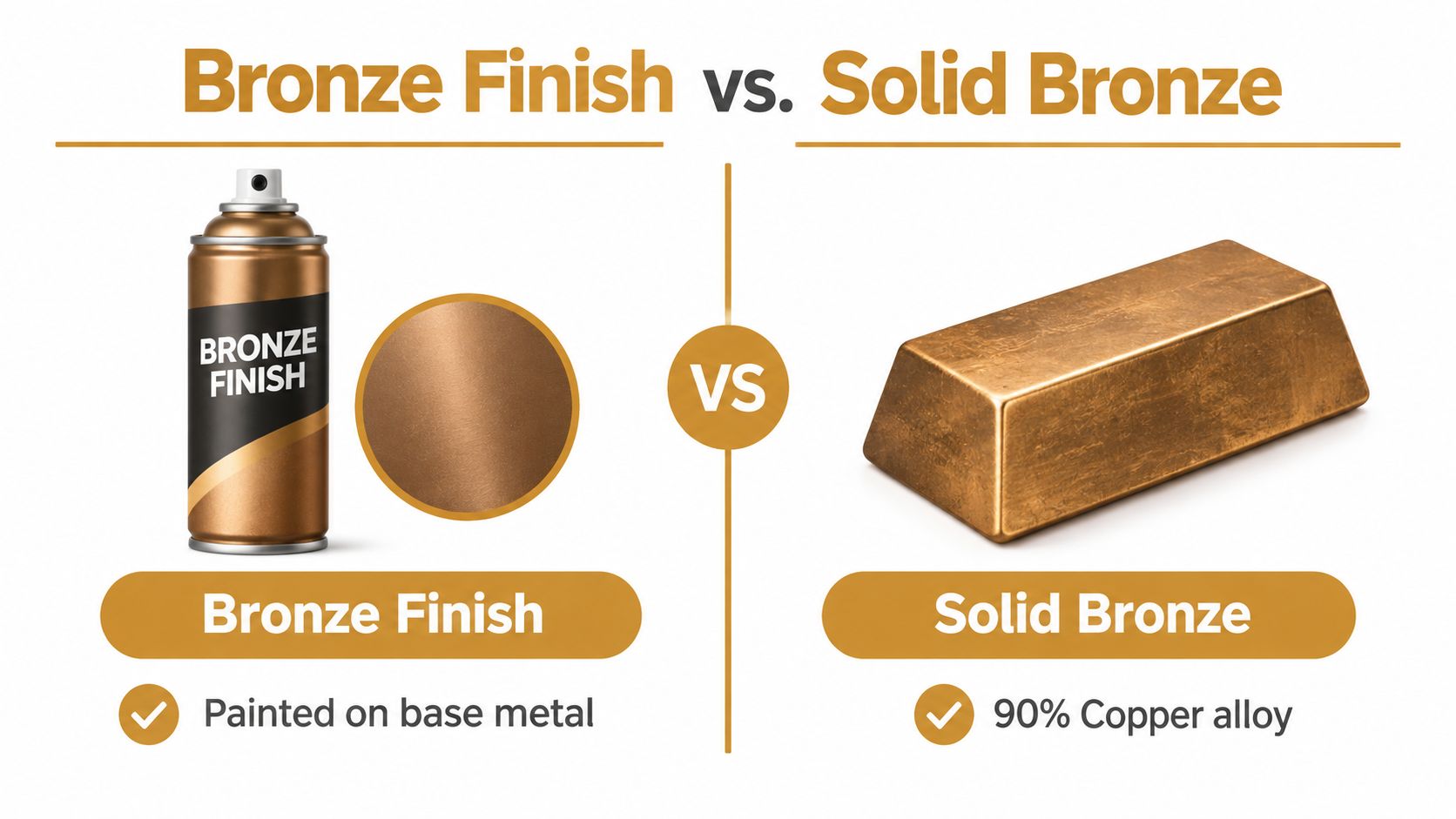
The label bronze can describe the metal itself or only the surface treatment. That distinction affects weight, durability, patina, repair options, and the historical value assigned to a chandelier.
True bronze is a copper-based alloy valued in decorative work for its density and casting qualities. A fixture sold as antique bronze may instead use steel, iron, brass, or another base metal covered with paint, plating, chemical treatment, or a faux finish. Lustria's guide to recognizing bronze and brass chandeliers explains why product labels do not always identify solid bronze and outlines differences in color, density, and patina between bronze and brass.
How to assess the construction
Read the specification sheet before relying on the product title. Check the body material, finish description, listed weight, dimensions, electrical certification, and cleaning instructions. If the description says only "bronze finish," treat it as a finished-metal fixture unless the seller clearly states that the body is solid bronze.
A solid bronze chandelier will usually have more density and may feel markedly heavier than a similar fixture made from finished steel or brass. Its exposed surface can develop a changing patina. A coating over another metal can wear through and reveal a contrasting color, especially on projecting edges, canopy hardware, touch points, and areas cleaned frequently. Those details matter more in a lived-in home than they do in a showroom photograph.
History gives "antique" a separate meaning. The antiques trade generally uses 100 years old as the threshold for an antique, placing many surviving antique bronze chandeliers in late-19th-century or earlier production periods. Age alone does not establish quality. Inspect the casting, wiring, repairs, alterations, provenance, condition, and how much of the original finish remains.
What the surface tells the buyer
Patina is an oxide layer that forms as bronze reacts with oxygen and moisture. A stable layer can slow further corrosion, so patina is not automatically a defect. Alloy composition, surface treatment, coating thickness, and humidity can shift the color from reddish brown to golden brown or near-black, as explained in Terralumi's explanation of patinated bronze surfaces.
A modern faux finish may be the more practical choice for a new installation. It can provide the desired warmth, consistent color, easier replacement, and predictable maintenance. Choose a genuine antique when material history, handworked construction, and an evolving surface justify the extra care. Choose a modern bronze finish when controlled appearance, reliable engineering, and straightforward ownership matter more.
Exploring Common Bronze Variations
Bronze finishes don't create the same mood. The difference can be subtle in a small online image, yet obvious once the chandelier hangs beneath a ceiling and reflects nearby walls, wood, and textiles.
| Bronze variation | Visual character | Practical fit |
|---|---|---|
| Antique burnished bronze | Warm, softened brown with lighter highlights | Traditional, transitional, and relaxed dining spaces |
| Oil-rubbed bronze | Deep brown to near-black with bronze undertones | Rooms needing contrast, definition, or a grounded accent |
| Raw or unlacquered bronze | More active surface that changes with exposure | Buyers who welcome natural variation and visible aging |
Antique burnished bronze
An antique burnished surface usually gives carved arms and cast details enough contrast to remain legible. It works well where the chandelier needs warmth without becoming the room's darkest object. Wood flooring, linen upholstery, aged leather, and cream or mineral wall colors can support this finish without making the room feel overly coordinated.
The surface may be faux finished and lightly distressed to imitate vintage bronze. That process creates visual age without requiring the fixture itself to be historically old, a distinction described by vintage-lighting finish guidance from House of Antique Hardware.
Oil-rubbed bronze
Oil-rubbed bronze is the stronger choice when the room needs a dark outline. It can frame a pale ceiling, reinforce black window frames, or connect with dark furniture without the starkness of a flat black finish. The risk is visual heaviness. In a small room with dark walls and limited ambient light, an almost-black chandelier may disappear rather than create a focal point. Golden Lighting's own Cambria 6-Light Chandelier in Oil Rubbed Bronze is a working example of the finish at this end of the range.
Raw or unlacquered bronze
Raw bronze appeals to buyers who want the surface to participate in the life of the room. It may change gradually as air, moisture, handling, and cleaning affect the metal. That evolution is part of the material's character, but it also means the finish won't remain perfectly uniform.
A sample is worthwhile when the finish must coordinate with cabinet hardware or plumbing. For a broader warm-metal comparison, the champagne bronze finish guide helps clarify why neighboring bronze and brass finishes can appear different under the same light.
How to Choose the Right Size for Your Space
Scale determines whether a chandelier feels intentional or misplaced. A small fixture can look like an afterthought over a generous table, while an oversized one can obstruct sightlines, dominate conversation, and make a compact entryway feel tighter.
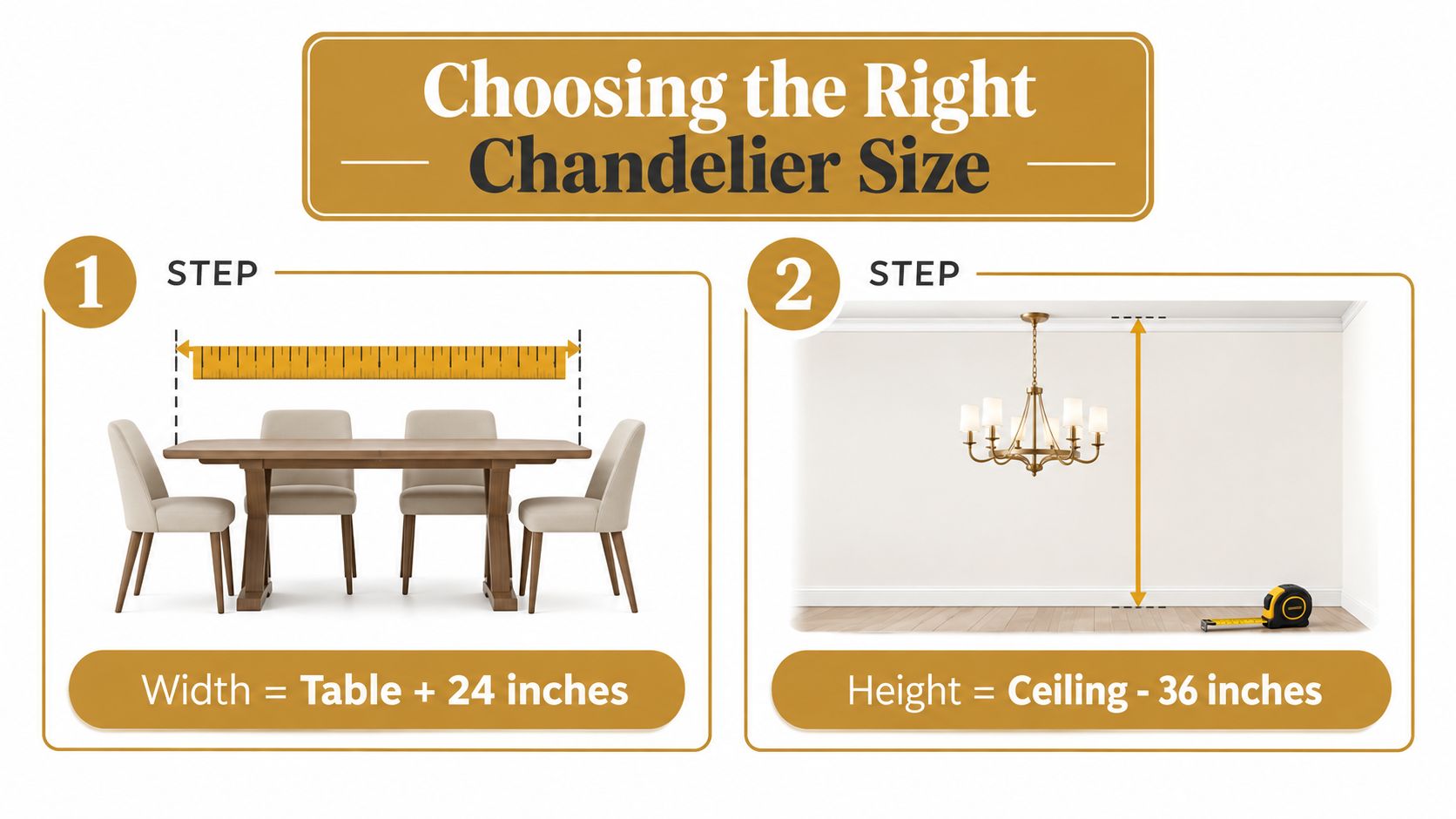
The first measurement should be the furniture beneath the chandelier. For a dining table, a practical starting point is to select a fixture whose width is about one-half to two-thirds of the table's width. A fixture may be wider in a room with generous clearance and a strong architectural ceiling, but the table remains the useful visual reference.
Use the room and furniture together
For a rectangular table, a long chandelier or linear fixture usually follows the table's direction. A round or square table can support a more centered, symmetrical form. Multiple tiers and dense arms add visual mass, so the listed width alone doesn't tell the whole story.
Use these checks before ordering:
- Measure the table: Compare the chandelier width with the table rather than relying only on room size.
- Check the sightline: Seated diners should be able to see across the table without the body of the fixture cutting through faces.
- Study the ceiling: A tall foyer can carry more vertical ornament than a low dining room.
- Account for visual weight: Dark bronze, dense arms, and multiple tiers appear heavier than open frames in a lighter finish.
- Confirm the electrical location: A perfect fixture won't solve an off-center junction box without additional planning.
A common room-sizing formula adds the room's length and width in feet and treats the result as an approximate chandelier diameter in inches. That method offers a useful starting point for a foyer or great room, but furniture, ceiling height, and sightlines should overrule a formula when the room has unusual proportions.
Set the hanging height deliberately
For a dining room, the lower edge should create intimacy without interfering with conversation or table service. The exact position depends on ceiling height, table thickness, fixture proportions, and the occupants' sightlines. In a foyer or other walking area, keep at least 7 feet of clearance from the finished floor to the fixture's lowest point as a hard minimum, with 7.5 feet as the more comfortable target where the ceiling allows it.
A useful design check is to view the chandelier from the room's primary entrance. If the fixture looks visually detached from the table, it may be too high. If it blocks the room's central view or feels physically close to traffic, it may be too low.
The designer chandelier sizing rules provide an additional measurement reference before a final order is placed.
A bronze finish can absorb more visual brightness than polished metal, so lamp count and light distribution deserve attention. A darker surface behaves differently under raking versus direct light, and a multi-arm fixture with several smaller light sources generally reads better against bronze than a single strong point of light, since it spreads illumination across the surface rather than creating one hot spot against a dark finish.
Styling Suggestions and Metal Pairing
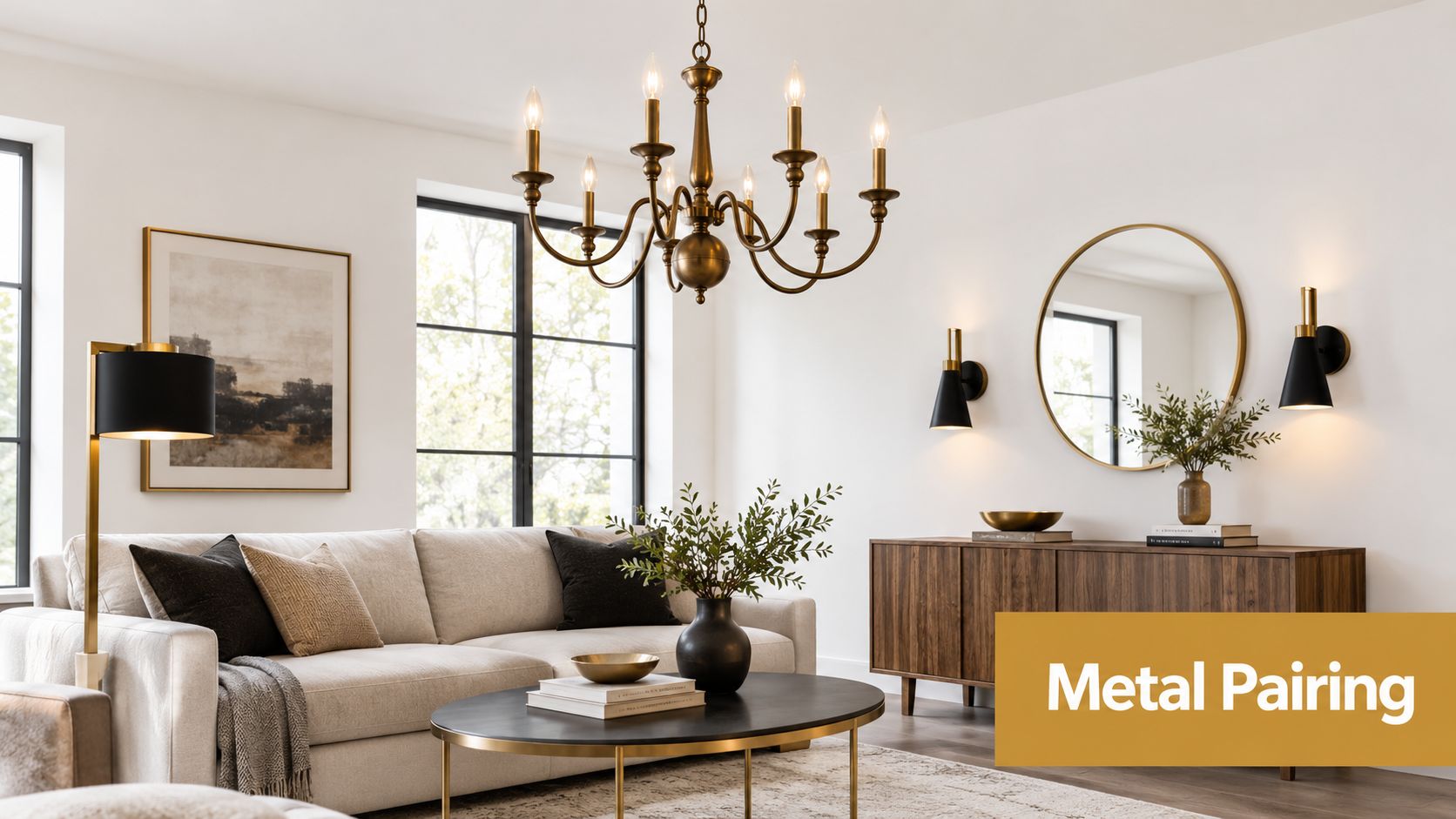
A bronze chandelier doesn't need matching bronze throughout the room. The more reliable approach is to establish one dominant finish, then introduce a secondary metal or material with enough repetition to look intentional.
Warm bronze pairs naturally with walnut, oak, leather, plaster, stone, linen, and muted paint colors. It also contrasts effectively with cooler metals such as polished nickel or brushed stainless, provided the difference looks deliberate rather than accidental.
Build the room around one dominant finish
A dominant finish gives the eye a clear visual anchor. If the chandelier is the primary bronze element, repeat that warmth through a picture frame, table base, mirror detail, or adjacent sconce. The repetition doesn't need to be exact, but the color family should feel related.
Try these room-specific combinations:
- Dining room: Pair burnished bronze with warm wood, stoneware, and soft textiles. Crystal can add sparkle without forcing a formal period look.
- Kitchen: Use bronze lighting against pale cabinetry and let stainless appliances provide cool contrast. Keep plumbing fixtures grouped by function rather than matching every metal in the room.
- Living room: Combine a sculptural bronze chandelier with neutral upholstery and one or two darker accents. Repeating the finish in sconces or a frame can prevent the chandelier from floating alone.
- Entryway: Let the fixture establish the welcome. A bronze chandelier above a console can work with aged wood, woven textures, and a restrained mirror frame.
For a more detailed approach to coordinating lighting, hardware, and furniture metal, consult Golden Lighting's guide to making one finish decision across a room. The guiding principle is simple: pair finishes that have a clear relationship, and avoid several almost-matching metals that suggest an ordering mistake.
A room feels collected when the metals relate by temperature, texture, or repetition. They don't need to match perfectly.
Warm bronze is especially relevant to current interiors. Design coverage for 2026 identifies aged finishes, dark bronze, antique brass, aged copper, and patina surfaces as part of a broader return to warmth after extended interest in chrome and brushed nickel (Good Housekeeping's 2026 vintage lighting trend coverage). That direction doesn't make every antique-style chandelier appropriate. It confirms that a carefully chosen aged finish can work in a contemporary scheme.
Care and Maintenance Tips for Longevity
Bronze rewards restraint. Aggressive cleaning can remove a surface treatment, flatten a deliberately varied patina, or expose the underlying metal on raised details.
Dust the chandelier with a soft, dry cloth or a clean, gentle brush. Turn off power before cleaning, allow lamps to cool, and support delicate arms or decorative elements rather than pulling on them. Regular light dusting prevents buildup without forcing the owner into repeated wet cleaning.
A safe cleaning routine
For a modern finished fixture, follow the manufacturer's care instructions first. If the instructions permit damp cleaning, use a mild soap solution on a soft cloth, apply minimal moisture, and dry every surface thoroughly to reduce spotting and moisture exposure.
Avoid common household products that can harm the finish:
- Skip abrasive pads: They can scratch coatings and polished details.
- Avoid strong solvents: They may soften or strip faux finishes.
- Don't saturate electrical areas: Moisture can reach sockets, wiring, and connection points.
- Test discreetly: A hidden section can reveal whether a cleaner changes the color or sheen.
- Leave stable patina alone: Natural variation isn't a defect when the surface remains sound.
Unlacquered bronze may change gradually as the fixture responds to its environment. That change can be desirable, but owners should understand that a living finish won't remain identical to the day of installation. A coated modern finish generally offers more control, while genuine aged material carries more visible history.
Protect the setting as well as the metal
Humidity, cooking residue, smoke, and frequent touching can accelerate surface change. In a kitchen or dining room, placing the chandelier away from direct grease exposure and keeping ventilation effective can reduce cleaning pressure. Maintenance also includes checking sockets, canopy hardware, chain or rod connections, and visible fasteners during routine dusting.
Conclusion and Next Steps
A chandelier bronze antique choice is ultimately a decision about material, proportion, and atmosphere. The surface may be historically aged bronze, a modern finish designed to reproduce that character, or a lighter burnished treatment that brings warmth without the visual weight of near-black metal. Naming the difference helps the buyer compare products clearly.
The most durable selection process follows a practical order:
- Confirm the material: Determine whether the fixture is solid bronze, another metal with a bronze finish, or a historically significant antique.
- Evaluate the patina: Decide whether natural variation is desirable or whether a consistent modern coating better suits the room.
- Size from the furniture: Use the table, room proportions, ceiling, and sightlines together.
- Plan the light: Darker surfaces may need multiple light points and a considered lamp choice so the fixture doesn't read as a heavy silhouette.
- Create a finish hierarchy: Let bronze lead, then support it with related metals, wood, textiles, or stone.
- Protect the surface: Clean gently, keep moisture controlled, and preserve stable patina rather than trying to make aged bronze look new.
A well-chosen chandelier can turn an underlit entry into a composed arrival space or give a plain dining room the architectural focus it lacks. It can also remain useful through several decorating changes because bronze works with traditional, transitional, and contemporary materials when its scale and finish are right.
Golden Lighting offers bronze-finished chandelier options within its broader assortment, including the Galveston 9-light Chandelier in Rubbed Bronze, the Cambria 6-Light Chandelier in Oil Rubbed Bronze, and the Orwell 6-light Chandelier in Matte Black with a Rubbed Bronze shade. Those examples illustrate the range between warmer, traditional forms and cleaner contemporary silhouettes.
The next step is to measure the room and the furniture, identify whether the desired fixture is truly antique or merely antique-finished, and compare the finish in the actual lighting conditions where it will hang. Explore the current chandelier collection and contact a lighting specialist or showroom with the table dimensions, ceiling height, room photographs, and preferred finish in hand.
Ready to choose with confidence? Shop the chandelier collection, compare bronze finishes against your room materials, and speak with a Golden Lighting specialist before placing the order.
— seen a lot of light fixtures in 80+ countries. Still learning what actually works in a home.











Share:
New White Paper: The Golden Kitchen Layering Method