


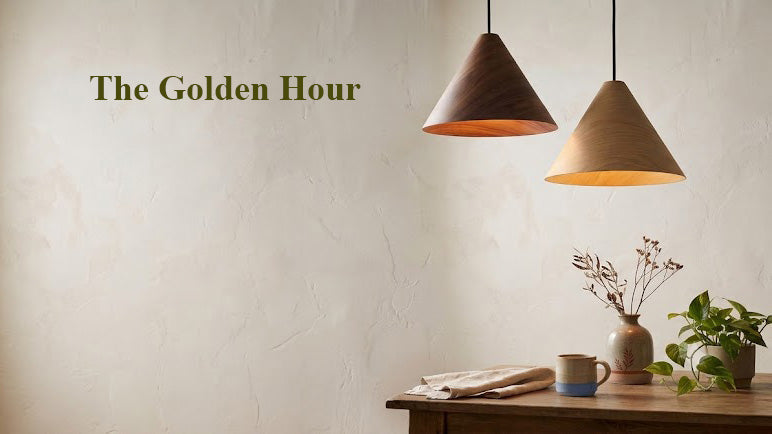
Written by Rick Kovac, COO of Golden Lighting
The takeaway: Rustic modern lighting works when warm materials ride on disciplined geometry and controlled light — judge the fixture by its silhouette, scale, and how it shields the source, not by how distressed the finish looks.
Key takeaways:
- Rustic modern pairs raw textures and warm metals with clean lines; if a silhouette still looks balanced in plain black, it has a strong foundation.
- Start foyer sizing with the room formula — room length plus width in feet equals a starting fixture diameter in inches — and keep at least 7 feet of clearance under any fixture in a walkway.
- Exposed-bulb cages and seeded glass look great but can glare and scatter light; over a kitchen island, a shaded or diffused pendant usually performs better.
- Keep color warm — 2700K–3000K indoors, and never cool-white above 4000K on residential exteriors — and layer ambient, task, and accent light on separate controls.
A dark entryway can make a generous home feel cramped, while a dim kitchen island turns the busiest surface in the house into a frustrating work zone. The problem usually isn't a lack of taste. It's a mismatch between fixture shape, light distribution, room proportions, and how people use the space.
Rustic modern lighting solves that tension by combining warm materials and familiar forms with controlled, contemporary geometry. The result feels approachable rather than sterile, but it still delivers the precision needed for cooking, dining, moving through the house, and entertaining outdoors.
Solving the Dark Room Dilemma
A tall foyer with dark flooring and a sightline into the kitchen exposes weak lighting quickly. A large chandelier may fill the vertical volume yet leave walls and floors in shadow. A small flush mount provides general light, but the entry still feels flat and underscaled. The fixture has to work with the architecture, not merely occupy the ceiling.
Use the ceiling fixture to establish presence, then add light where people move and look. A rustic modern lantern or open-frame chandelier brings texture to the center of the foyer, and wall sconces add a lower, more welcoming layer along the path. Because people see lit walls before they notice footcandles on the floor, that wall layer does more for perceived brightness than a bigger ceiling fixture would.
Professional observation: A statement fixture should define the focal point, while layered sources provide the useful light people need.
The same test applies above a kitchen island. An open-cage pendant with an exposed decorative bulb suits an industrial interior, but a bare source at eye level creates glare and uneven light across the counter. A shaded pendant or linear fixture with controlled downward distribution usually performs better when the island handles food prep, homework, and casual meals. Check beam direction, shade opacity, mounting height, and spacing before judging a fixture by its finish.
Defining the Rustic Modern Aesthetic
A fixture can look convincing in a showroom and feel wrong once installed. Rustic modern lighting depends on four visual characteristics:
- Raw textures add grain and variation through wood, seeded glass, woven elements, or softly weathered metal — best when the light source itself stays controlled rather than exposed from every angle.
- Sleek lines establish order through geometric frames, uncomplicated arms, and disciplined proportions.
- Industrial hardware makes construction visible through bolts, brackets, stems, and functional metal joints — hardware that supports the structure, not decoration without purpose.
- Warm neutrals connect the fixture to natural interiors through bronze, brass, black, cream, brown, and muted earth tones.

The useful tension between old and new
A rustic modern fixture should look intentionally made, even when its finish shows wear. Distressed metal works when the surface variation follows the form. A dark finish gains authority beside a precise shade, clean diffuser, or carefully welded frame. Natural irregularity supplies warmth; manufacturing discipline protects alignment, durability, and consistent light output.
The room should follow the fixture's style family, too. Pair a rustic modern fixture with furniture, window treatments, and decor that read in the same family or a deliberately compatible one — the most common mismatch we see is an industrial fixture over a formal table.
How to recognize the right piece
Remove the finish mentally. If the silhouette still looks balanced in plain black, the design has a strong foundation. If its appeal depends on heavy distressing, decorative cutouts, or a novelty bulb, it may have limited staying power. Our earlier guide to the perfect rustic light shows how this style borrows cues from older buildings and refines them for today's rooms.
Materials and Finishes That Perform
Material selection changes more than appearance. It affects how light leaves the fixture, how glare reaches the eye, how easily the surface shows wear, and how well the piece adapts after a renovation.
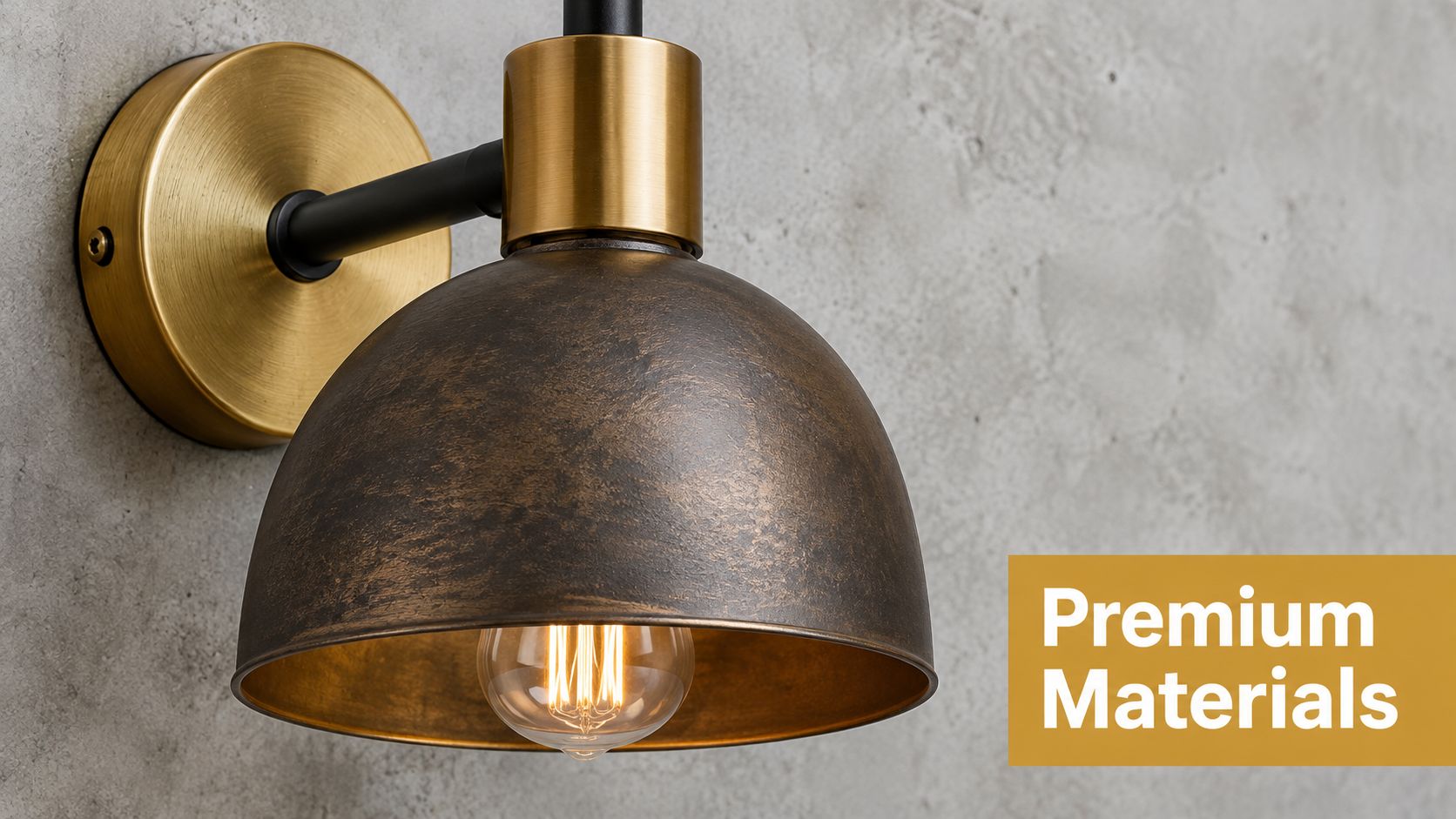
Modern brass adds warmth without ornate detailing. A brushed or satin surface softens reflections and sits comfortably beside timber, stone, painted cabinetry, and warm textiles. High-polish brass works as an accent, but broad reflective surfaces can compete with other highlights in a compact room.
Aged bronze brings visual weight and a grounded quality. It suits entry lanterns, dome pendants, and sconces where a darker frame defines the fixture against pale plaster, and minor handling marks show less than on reflective finishes.
Matte black is the most adaptable. It draws a crisp outline around clear or milky glass and connects dark window frames with lighter cabinetry. The risk is overuse: a room full of black fixtures, hardware, and furniture loses the tonal variation that makes rustic modern feel relaxed.
Shades change the character of the light
Seeded glass scatters light and adds texture, but its bubbles also reduce how much light reaches the room directly. Fabric-lined shades soften the source and reduce harshness, while opaque metal shades push more light down or sideways depending on the opening. When dark metal, textured glass, or fabric absorbs part of the output, an efficient LED with controlled distribution does more than simply raising the wattage.
What factory-floor quality looks like
A reliable fixture is more than a convincing finish. The frame should feel stable, the shade should seat cleanly, and the socket or LED module should line up with the intended light path. A shade that sits off-center creates uneven brightness and signals broader assembly problems.
A showroom also reveals what catalog photography can't. Brushed surfaces show directional grain, seeded glass varies piece to piece, and dark finishes can read brown, charcoal, or true black under different light. View samples beside the actual cabinet, countertop, wall color, and flooring rather than choosing from a screen.
How to Choose the Right Size for Your Space
Proportion is where attractive fixtures succeed or fail. A well-made chandelier looks awkward when it's too small for the room, while an oversized pendant blocks sightlines and crowds a modest entry.
- Start with the room formula. Add the room's length and width in feet; the sum is a starting fixture diameter in inches. A 10 × 12 ft foyer gives a 22-inch starting point. This sizing rule appears across major lighting references, including the American Lighting Association's training manual — treat it as a minimum starting size, not a final answer.
- Adjust for visual weight. Airy, open-frame designs can size up a step; dense or ornate designs can size down.
- Size over a table by the table. Over a dining table, the fixture should be roughly one-half to two-thirds of the table's width, and the table governs when it disagrees with the room formula.
- Protect head clearance. In any walkway — foyers, halls, open living areas — keep at least 7 feet from the floor to the bottom of the fixture, and aim for 7½ feet where the ceiling allows.
- Set the height over a table or island. Hang the bottom of the fixture about 30–36 inches above the surface.
For more detail, see our fixture sizing and placement guide.
In a tall foyer, the extra ceiling height is a reason to choose a larger, taller fixture rather than to hang a small one lower. The 7-foot clearance is the floor, not the target — let the fixture's scale fill the volume while it stays clear of heads. Foyer fixtures hung above eye level should also be shielded at the bottom so people walking underneath don't look straight into bare bulbs; if the fixture is visible from a stair landing above, shield the top as well.
Front doors and covered entries
Exterior fixtures should be scaled to the door and the facade, not chosen from a small product photo. Fixtures tend to look smaller outdoors than they do on a showroom wall, so mock up the size with cardboard against the door trim before ordering. Use only wet- or damp-rated fixtures as the location requires — exposed walls are wet locations, covered porch ceilings are at least damp.
Dining rooms need visual conversation
A dining chandelier should support the table rather than compete with it. An open frame preserves sightlines, while a solid shade creates a stronger anchor and more concentrated downward light. Sit at the table and look across it: if the lamps or lower frame interrupt the view, the fixture needs a different height, a more open structure, or a shallower profile. The formula starts the decision; human sightlines finish it.
Mastering Layered Lighting and Color Temperature
A dining room with one bright chandelier often feels harsh during cleanup and underlit during dinner. Rustic modern spaces work better when each layer has a defined job, while the finishes, glass, and proportions keep a consistent visual language.
Three layers, three responsibilities
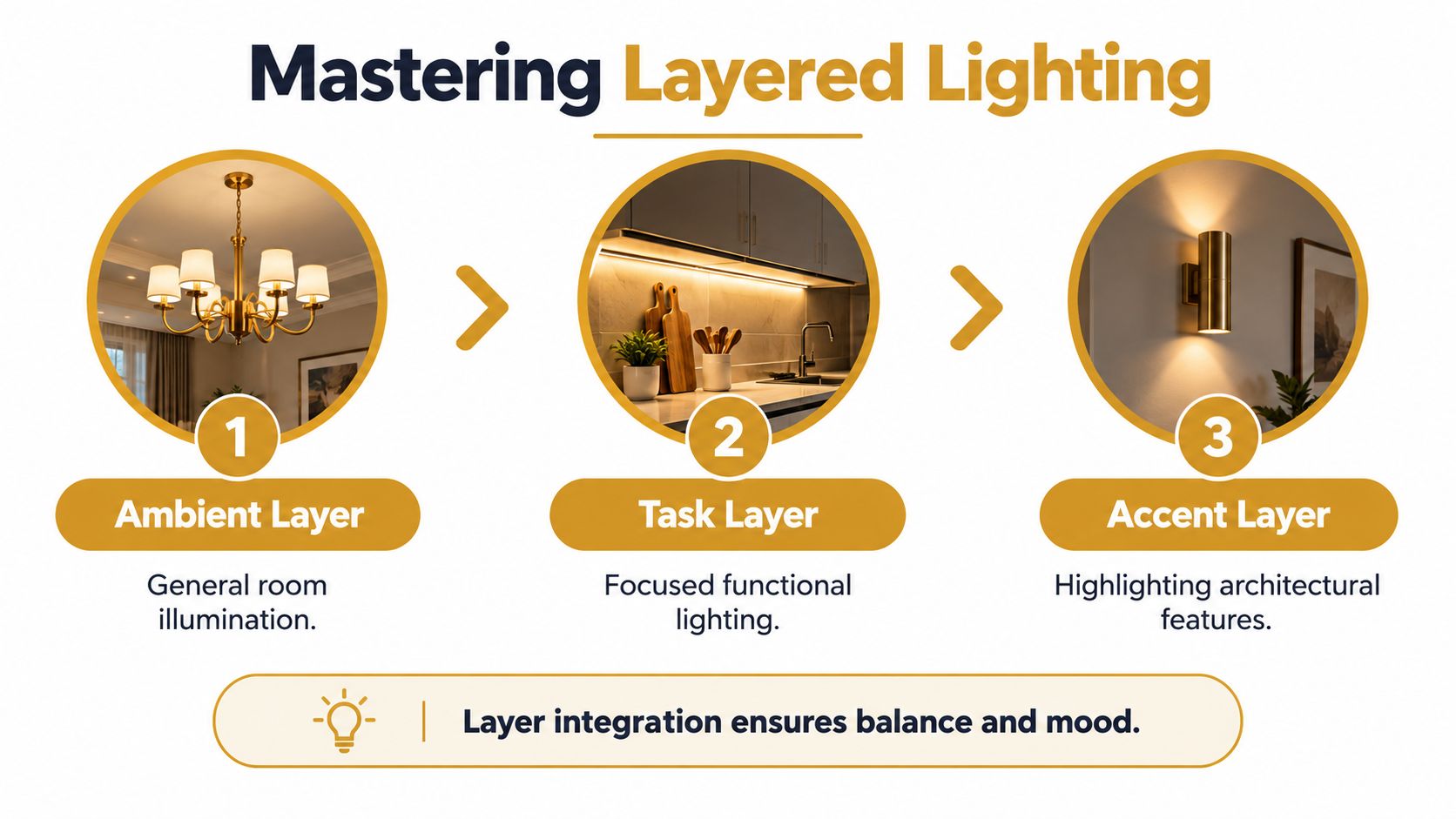
Ambient lighting sets general brightness. A chandelier, semi-flush mount, or well-distributed linear fixture can provide it — but check the fixture's actual light distribution, not only its look. A vintage-inspired cage may look substantial while sending little useful light across the room.
Task lighting serves the surfaces where work happens: kitchen pendants, under-cabinet lighting, vanity fixtures, and adjustable sconces. It needs enough control to light the work surface without putting a bright bulb in the viewer's line of sight. Frosted glass, deeper shades, and well-aimed beams preserve the rustic character while cutting glare.
Accent lighting adds depth and directs attention. A sconce can frame artwork or a mirror, and a small directional fixture can graze a stone wall or a beam — on textured surfaces like stone and brick, close, low-angle light brings out the texture that an even wash would flatten.
Put each layer on its own control and dimmer. The statement fixture can run low for atmosphere while task and accent sources provide targeted support, so no single source has to do everything.
Warm color without weak performance
Indoors, warm white in the 2700K–3000K range is the standard for living and dining spaces, and traditional or rustic interiors tend to look best toward the warmer 2700K end.
Outdoors, our design team's guidance is to hold residential exteriors to 2700K–3000K as well — about 2700K on warm materials like wood and stone and at decorative fixtures, about 3000K on plantings — and never use cool-white (4000K or higher) landscape lighting. Exterior fixtures should show a soft glow, not a visible bare bulb, with light aimed down where it's needed rather than toward neighbors' windows or the sky.
Dimming and warm-color compatibility should be confirmed before installation. Our guide on how to choose light bulbs covers color temperature and dimmer compatibility.
Room-by-Room Styling and Application
Rustic modern lighting is easier to specify when each room gets a clear performance brief. The same finish can appear in the kitchen, bedroom, and patio, but the fixture geometry shouldn't be identical.
Kitchen islands
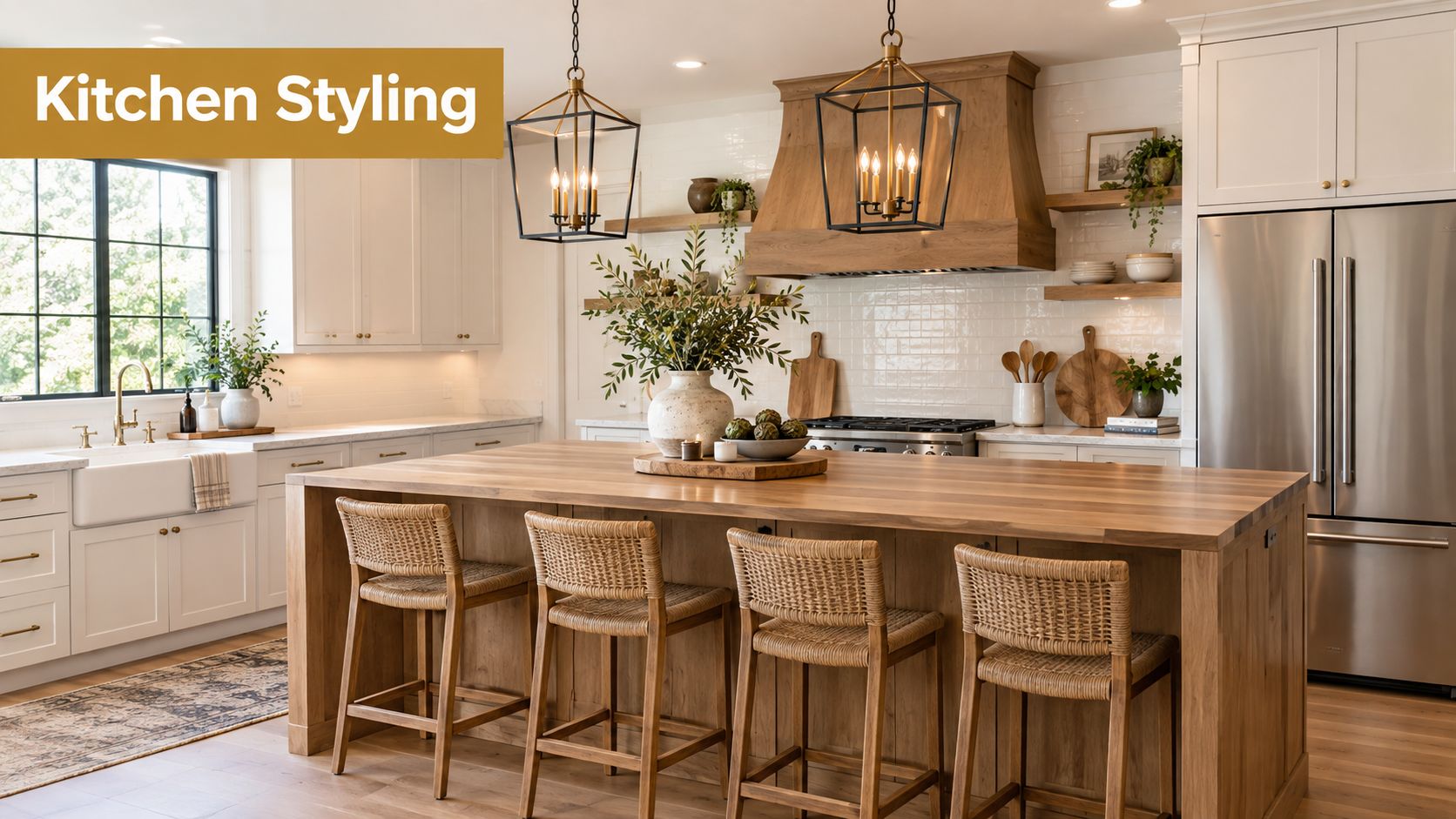
Islands need real task light: pendants in multiples spaced evenly along the island's long centerline, or a single larger fixture with enough output. Long islands get the right count of matched fixtures, never one lone small pendant. Open cages and exposed bulbs give an industrial edge, but because the source is visible from several angles they need careful placement and dimming. A dome shade, milk glass globe, or diffusing pendant is the safer choice for food prep.
Modern brass works well over white, cream, or light wood cabinetry, while matte black draws a stronger outline against pale finishes. Mix-and-match lines such as YEP by Golden let you coordinate shades, finishes, and glass without making every fixture in the house identical.
Baths, bedrooms, and hallways
In a bathroom, milk glass or a softly shaped globe brings farmhouse familiarity to a modern brass vanity fixture. The shade should spread light across the face without a hard hotspot in the mirror. Sconces flanking the mirror perform better than a single overhead source because they light both sides of the face.
Bedrooms benefit from lower contrast. A semi-flush mount with an enclosed, diffused bottom preserves ceiling height without glare for someone lying in bed, while bedside sconces keep reading light close to the task.
Patios and entryways
Exterior applications need more discipline than indoor styling. Dark bronze, matte black, and lantern forms create a welcoming threshold, but the optics should aim downward and shield the source. Make the front door the brightest point in the scene and let everything else step down. A patio may need a ceiling fixture for general light, sconces at doors, and low accent light near planting or seating; repeat one finish across the property while shade shapes change with the task.
Investing in Quality and Next Steps
A decorative fixture is a long-term building component. The visible finish attracts attention, but the internal wiring, socket alignment, mounting hardware, shade fit, and heat management decide whether it stays dependable after years of daily use.
A practical inspection before purchase
- Check the mounting system. The canopy and bracket should suit the junction box, and the box must be rated for the fixture's weight.
- Review source compatibility. Confirm the fixture accepts the intended LED bulb or module and works with the selected dimmer.
- Study the shade geometry. Look for openings that direct light where the room needs it, rather than exposing the bulb from every seated or standing angle.
- Evaluate the finish in person. Brushed brass, bronze, black, and textured glass look different under showroom light than at home.
- Ask about serviceability. Bulb access, replacement parts, and clear installation documentation protect the investment.
Pro-Tip: Before approving a decorative fixture, trace the path from the bulb to the shade opening. If the source is trapped inside dark metal or heavy textured glass with no controlled exit, the fixture may look bright while delivering weak, uneven light where the room needs it.
The most successful rustic modern plans align material, scale, distribution, and control. A kitchen pendant should light the island. A foyer chandelier should respect head clearance and ceiling height. An outdoor lantern should welcome guests without sending light up or into neighboring spaces. For a refined, statement-level specification, look at Ziva by Golden; for a personal mix of shades, finishes, and glass, start with YEP by Golden.
Select one room, measure its ceiling and walkways, and identify the ambient, task, and accent layers. Then browse our chandeliers, farmhouse, and outdoor collections, or find a Golden Lighting retailer to see finishes, glass, and scale in person.
— seen a lot of light fixtures in 80+ countries. Still learning what actually works in a home.

Share:
Bronze Wall Sconce Buyer's Guide for 2026