



Written by Rick Kovac, COO of Golden Lighting
The takeaway: Buy a bronze wall sconce to add a layer of eye-level light, not to rescue a room that's missing a lighting plan — decide the job first, then the finish.
Key takeaways:
- Wall sconces add the missing mid-height layer between ceiling light and table lamps; they supplement a room's main lighting, they don't replace it.
- "Bronze" names a finish family — oil-rubbed, aged, brushed, champagne — not a metal. Match undertone and sheen to nearby hardware before matching the label.
- Decorative sconces typically mount 60–72 inches above the floor; at a bathroom mirror, center a flanking pair near eye level, around 60 inches.
- Choose 2700K–3000K LEDs and a dimmer the fixture maker lists as compatible — standard LEDs don't warm as they dim unless they're labeled dim-to-warm.
You switch on the ceiling fixture and the room becomes bright, yet still feels wrong. Faces look flat, corners fall into shadow, and a narrow entry or dark kitchen feels more cramped because every bit of light comes from above.
That gap isn't a lack of brightness. It's a lack of mid-level, eye-height light. A bronze wall sconce adds the layer between ceiling illumination and tabletop lamps, softening shadows, lighting the wall, and giving the room a warmer visual anchor.
The finish matters, but it shouldn't lead the decision. The better question is where the fixture must perform — accent light, layered ambient light, or real task light. This guide covers bronze finish families, placement, bulb selection, dimming, and the room-by-room calls that decide whether a bronze sconce earns its place.
The Lighting Problem Hiding in Plain Sight
A typical living room exposes the problem quickly. The ceiling fixture supplies broad, top-down brightness, while a floor lamp handles one seat. The wall behind the sofa, fireplace, or artwork stays dark, and people in the room get uneven light from above.
A wall sconce changes that by putting light closer to eye level. Lit vertical surfaces are what make a room feel bright and spacious — one fixture can wash a textured wall, frame a fireplace, or create a soft pool beside a console without asking the ceiling light to do every job.
Professional rule: A room feels more balanced when light arrives from more than one height.
Bronze works well in this strategy because its warm brown tone gives the wall layer visual weight without the sharp contrast of a bright polished metal. In transitional, craftsman, and modern farmhouse interiors, bronze usually sits more comfortably beside wood cabinetry, natural stone, and warm paint colors than a cool chrome or highly reflective nickel.
The layer most rooms are missing
- Overhead ambient light: Covers the room broadly but can create top-down shadows.
- Table and floor lamps: Provide local warmth and useful pools of light.
- Wall-mounted light: Adds eye-level illumination, wall definition, and visual rhythm.
That makes a bronze sconce a lighting-strategy decision first and a finish decision second. Our design team's rule is that wall sconces are never the primary light source — they supplement ceiling fixtures in a layered scheme. If the room needs focused reading light, a swing arm or directional shade matters more than the bronze tone. If the room already has functional light and needs depth, a diffused bronze fixture is the stronger choice.
What a Bronze Wall Sconce Actually Is
A bronze wall sconce is a wall-mounted fixture with a body, arm, backplate, or trim finished in a bronze tone. Depending on its design, it can send light up, down, outward, or several directions at once while acting as a decorative object on the wall.
- Backplate: Attaches to the wall and covers the electrical junction box.
- Arm or stem: Extends the light source from the wall. A swing or articulated arm improves reading performance.
- Shade or diffuser: Controls glare and decides whether light feels focused, soft, upward, or downward.
- Socket or light engine: Holds the bulb or produces light through an integrated LED module.
- Mounting bracket: Secures the backplate to the electrical box.
The category is old. Wall-mounted candleholders go back centuries, and in the second half of the eighteenth century the ornate girandole — a candle-bearing wall bracket with a mirror behind it to amplify the light — was at the height of fashion in France and England. It's the same instinct behind flanking a mirror with sconces today.
Finish name versus solid metal
"Bronze" on a listing usually describes the appearance, not the metal. Modern sconces may be brass, steel, aluminum, or zinc with a plated, painted, rubbed, or hand-applied bronze finish. That affects weight, price, corrosion behavior, and how a damaged surface can be repaired. Treat bronze as a finish family first, then check the spec sheet for the base material, electrical listing, and care instructions.
Bronze Finishes and How They Read
Bronze isn't one color. The family runs from deep reddish brown to soft taupe-gold.
Oil-rubbed bronze is the darkest and most traditional, often a brown-black base with reddish warmth. It works naturally with shaker cabinetry, stained wood, and farmhouse architecture, but can look heavy beside bright white surfaces in an ultra-modern kitchen.
Aged or antique bronze reads lighter and more golden brown. It suits transitional rooms because it bridges dark furniture and warm brass hardware without looking formal.
Brushed bronze has a softer satin sheen that hides fingerprints and reduces glare — useful where a dark metal is wanted without the weight of glossy black.
Champagne or golden bronze moves toward warm taupe and muted gold. It pairs easily with soft white, natural oak, and contemporary stone. Our champagne bronze finish guide covers this family in detail.
| Finish | Look | Best with |
|---|---|---|
| Oil-rubbed bronze | Deep brown with reddish warmth | Stained wood, shaker cabinets, farmhouse rooms |
| Aged or antique bronze | Lighter golden brown | Transitional rooms mixing dark wood and brass |
| Brushed bronze | Soft satin surface, low glare | Modern living rooms, bedrooms, kitchens |
| Champagne or golden bronze | Warm taupe-gold | Soft white walls, natural oak, contemporary stone |
In kitchens and baths, the surrounding hardware is the fastest coordination test. Compare undertone, not just the label: a dark, red-leaning sconce can clash with pale champagne cabinet pulls even when both say "bronze." Match temperature and sheen first, then decide whether an exact match matters. In a compact room, repeating one bronze family across sconces, pulls, and plumbing creates control. In a larger room, a deliberately contrasting warm metal works — but avoid near-matches that look accidental.
Style Variants Worth Knowing
| Style | Signature features | Best-fit rooms |
|---|---|---|
| Modern Farmhouse | Slender gooseneck arms, seeded glass, soft bronze | Kitchens and hallways |
| Industrial | Metal shades, exposed hardware, jointed arms | Lofts and mudrooms |
| Mid-Century Modern | Brushed bronze, opal globes, slim backplate | Living rooms and bedrooms |
| Transitional | Rounded shades, warm bronze, drum or bell forms | Dining rooms and primary suites |
| Traditional | Ornate backplates, candle-style arms, deep oil-rubbed bronze | Formal entries and dining rooms |
Modern Farmhouse is the safest choice for a kitchen or hallway with paneled cabinetry or natural wood. Industrial bronze belongs where exposed construction is part of the design language; it can feel busy beside delicate millwork. Mid-Century Modern needs restraint — a slim backplate and opal globe beat an ornate arm. Transitional is the most adaptable, moving between dining rooms and bedrooms as furnishings change. Traditional bronze should be chosen with conviction: candle-style arms create a formal focal point but can overpower a pared-back room.
One practical note on candle-style designs: their lamps can't aim light downward, so they belong flanking a mirror, doorway, or artwork as ambient light — not where you need light on a task.
How to Place a Bronze Sconce
A tape measure matters more than a product photo. For general decorative sconces in entries, hallways, and living spaces, the American Lighting Association's residential guidance places them about 5 to 6 feet (60–72 inches) above the floor. Start there, then adjust to the architecture and the people using the room.
- Hallways and stair landings: Mount within the 60–72 inch band at a consistent height so the fixtures read as a rhythm along the wall. Keep them clear of door swings and art.
- Entries: Center on the architectural feature — the console, mirror, or door — so the sconces relate to something rather than floating on the wall.
- Bedrooms: Mount a reading sconce at the side of the bed above the nightstand, never centered over the headboard, close enough that the light reaches the page. Swing arms belong where the arm won't extend into a walkway.
- Bathroom mirrors: Use single-light sconces in a pair flanking the mirror rather than one above it. NKBA guidance centers side-of-mirror fixtures at about 60 inches above the floor, adjusted to the user's eye level, so light falls on the face instead of the forehead.
For rooms with unusual ceiling heights or furniture layouts, our fixture sizing and placement reference walks through the measurements.
Installation caution: Check door swings, casing, trim, and the fixture's projection before drilling. A beautifully placed sconce becomes a daily nuisance if a door clips the arm or a shade sticks out into a walkway. Heavier fixtures also need a wall box rated for their weight.
Bulbs, Color, and Dimmer Behavior
A bronze sconce can look warm in one room and harsh in another. The bulb and the fixture's shade decide that, not the bronze.
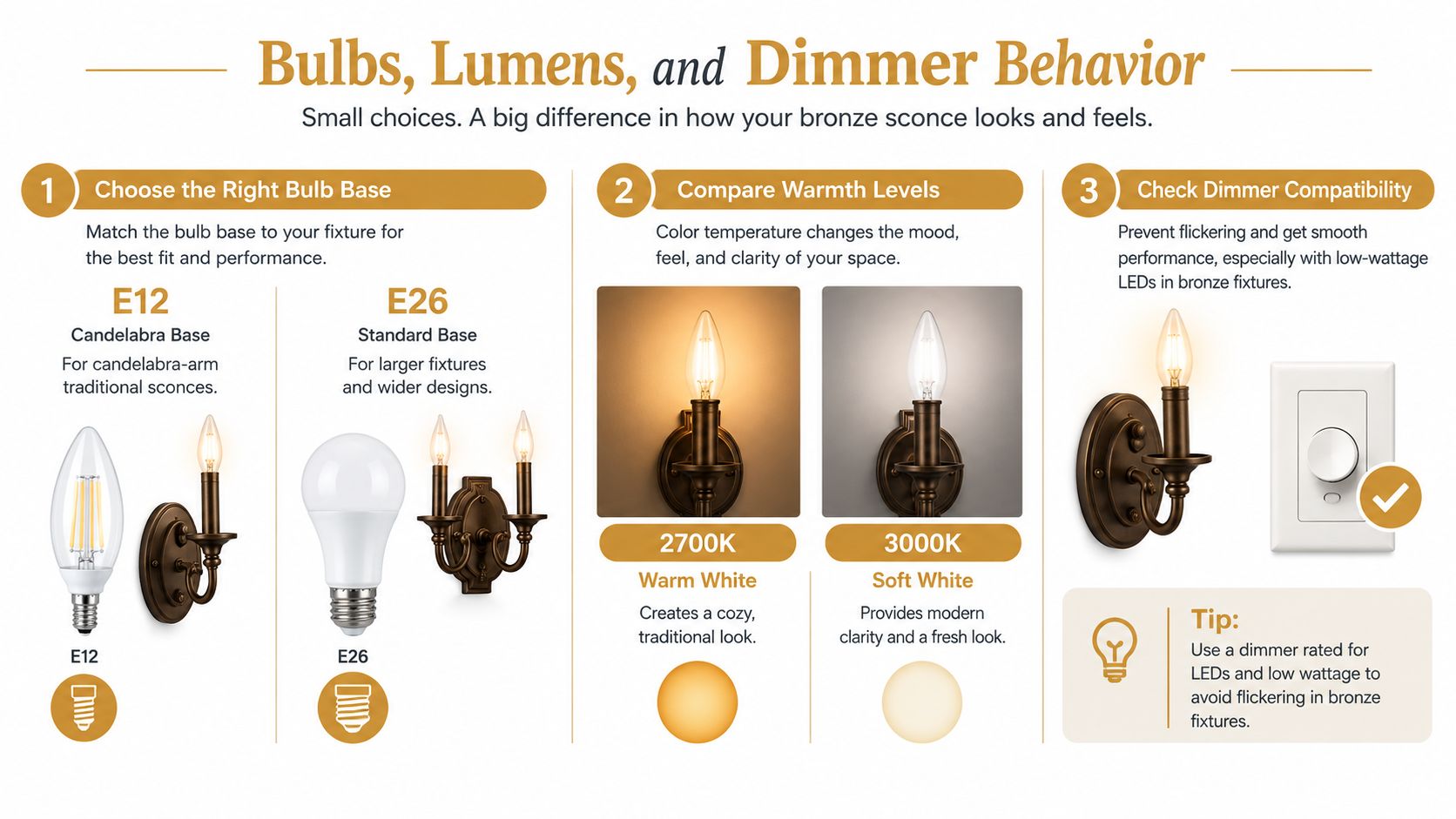
Candle-style sconces usually take E12 candelabra-base bulbs; larger fixtures commonly use E26 medium-base bulbs. Confirm the socket on the product page before buying — similar silhouettes can take different bases.
For color, warm white in the 2700K–3000K range is the standard for living and dining spaces: 2700K reinforces bronze's cozy character, while 3000K gives a cleaner, more contemporary look. Where the sconce lights faces, artwork, or wood, choose a bulb with a CRI of 90 or higher — every Golden Lighting LED is in that band, above the 80-CRI industry minimum.
Brightness depends on the shade as much as the bulb. A dense or opaque shade lowers perceived brightness, while an exposed lamp feels stronger at the same output. If a sconce lights a vanity, it's doing grooming work and needs a diffused source close to the face; if it's accent light, let it glow softer than the room's main light so it adds depth rather than glare.
Dimming needs the same care. Use dimmable bulbs and a dimmer the fixture or bulb maker lists as compatible — don't assume an older dimmer will work smoothly with LEDs. One common misconception: a standard LED holds its color as it dims. It will not drift warmer like an incandescent bulb unless it's labeled dim-to-warm. If flicker appears, match the dimmer and bulb families, and see our bulb styling tips.
Where Bronze Sconces Earn Their Keep
Bronze sconces perform best when they add depth and atmosphere. They underperform when a decorative fixture with a small shade is expected to replace every functional source in the room.
| Room | Role for a bronze sconce | Why it works or fails |
|---|---|---|
| Living room | Accent and layered ambient | Adds wall definition beside art, a sofa, or a fireplace |
| Dining room | Dimmable atmosphere | Builds a lower, warmer evening layer around the chandelier |
| Hallway or stair | Repeated architectural light | Guides movement and breaks up blank walls |
| Bedroom | Reading companion | Works for reading when it has a directional arm or shade |
| Bathroom | Vanity pair | Works as a flanking pair at the mirror; a single decorative sconce isn't enough face light |
| Laundry room or garage entry | Limited decorative layer | These spaces need direct, practical light first |
Bathrooms deserve a firm boundary: at the mirror, sconces should come in a flanking pair with diffused shades that put light on both sides of the face. A single decorative bronze sconce beside the mirror leaves half the face in shadow. Check that any bathroom sconce is damp-location rated.
Wall color changes the result too. Dark or deeply textured walls absorb more light, so a bronze sconce against a dark accent wall will read moodier and may need a brighter bulb or a second fixture.
The takeaway is direct: buy bronze to add a layer, not to hide a missing lighting plan.
Choosing Well and Next Steps
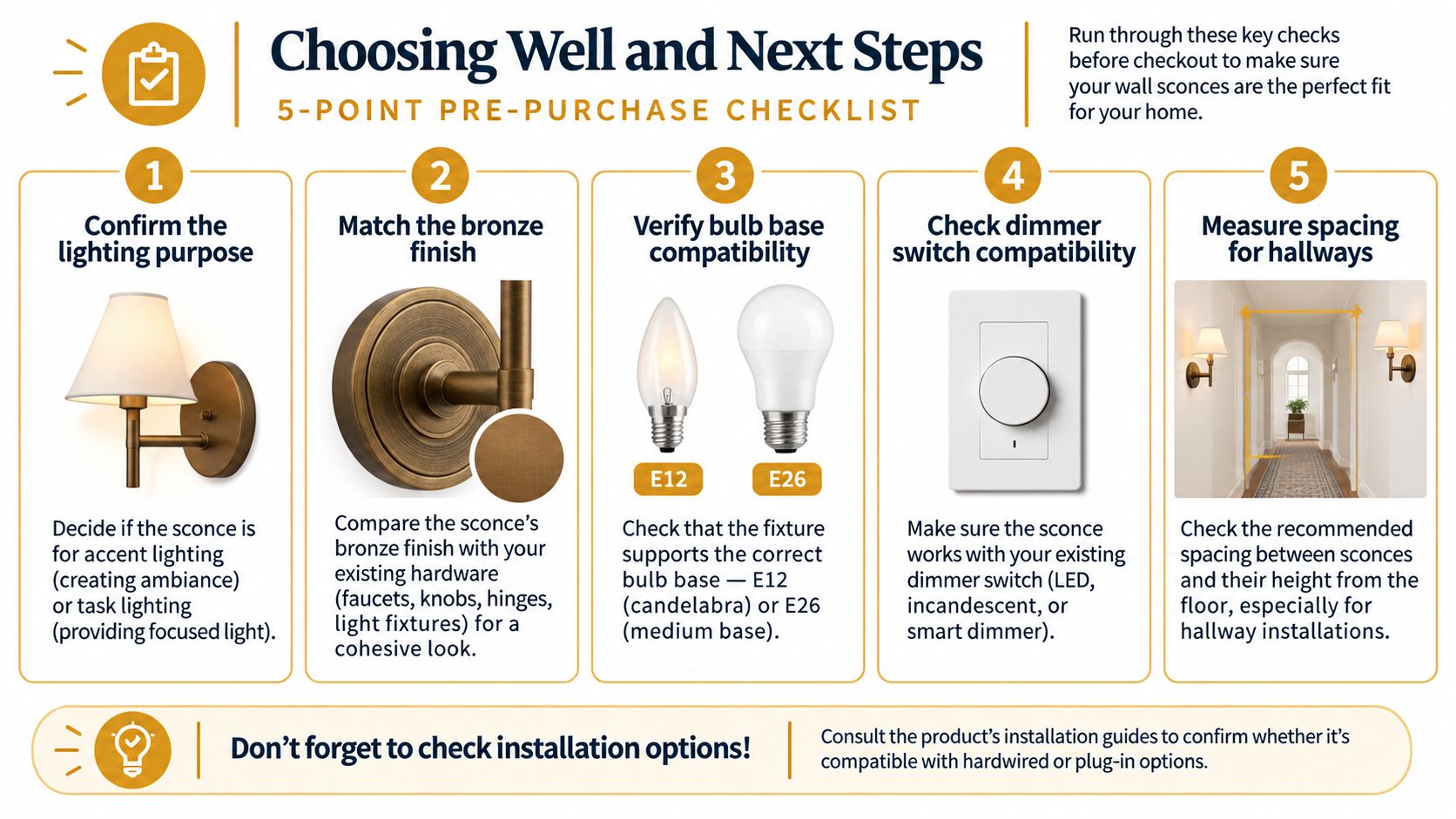
- What job will the fixture own? Accent or layered ambient light, unless its arm, shade, and output clearly support task use.
- Where will the center land? Measure floor to fixture center: 60–72 inches for general decorative placement, about 60 inches at a mirror, adjusted to eye level.
- Which finish family belongs in the room? Compare undertone and sheen with cabinet hardware, plumbing, mirror frames, and nearby metal furniture.
- Which bulb and control will work? Confirm E12 or E26, choose a dimmable 2700K–3000K LED, and verify dimmer compatibility before installation.
- Does the backplate cover the electrical box? Measure the existing box and wall condition, especially in plaster or older drywall.
Bronze sconces to start with
- Dorinda 1-Light Wall Sconce in Brushed Champagne Bronze with Opal Glass — a scalloped opal shade with a soft, diffused glow; a natural fit for transitional rooms.
- Bella 1-light Wall Sconce in Rubbed Bronze — the deeper, traditional end of the bronze family.
- Orwell 1-light Wall Sconce in Matte Black with Rubbed Bronze shade — an industrial metal shade with coppery highlights, from YEP by Golden.
Pick the layer the bronze sconce should own, then let the rest of the room support it. Browse the full wall lighting collection or find a Golden Lighting retailer to compare finishes, shades, and proportions in person.
— seen a lot of light fixtures in 80+ countries. Still learning what actually works in a home.











Share:
Flush Mount vs Recessed: How to Choose
Rustic Modern Lighting Fixtures Guide