


Written by Rick Kovac, COO of Golden Lighting
The takeaway: The right outdoor post light comes down to five checkable specs — height, lumens, IP rating, IK rating, and surge protection — not the fixture's finish or price tag alone.
Key takeaways:
- Match post height to the job: 72–84 in for entry and driveway posts, 36–48 in for path and garden posts, spaced roughly 8–10 ft along a walk or 12–15 ft along a drive.
- Treat IP65+ weather sealing, IK08 (5-joule) impact resistance, and a surge-rated driver as buying requirements for any exposed installation, not optional upgrades.
- Match material to climate: powder-coated cast aluminum for most inland and four-season homes, brass or bronze where salt or pool chemicals are a persistent factor.
- A photocell-equipped LED is the practical default control; add motion for less-visible side and back areas rather than relying on a smart-hub app alone.
A dark driveway makes even a familiar home feel uncertain. Guests hesitate at the gate, residents search for the lock, and the front entry loses the welcoming presence it has during the day. The best outdoor post lights solve that specific problem by placing dependable illumination where people arrive, walk, and make decisions.
Golden Lighting approaches exterior fixtures from the factory floor and showroom with a practical standard: engineering comes before decoration. Height, weather protection, impact resistance, surge immunity, material, finish, and mounting geometry determine whether a post light will still look and perform properly after years outdoors. Style matters, but it has to work inside that framework.
Why Outdoor Post Lights Change the Way a Home Feels at Night
An outdoor post light isn't merely a glowing ornament beside a walkway. It creates the vertical anchor that helps the entire exterior make sense after sunset. Unlike a low path light, a post-mounted fixture can spread illumination outward and downward from a higher position, making the driveway, entry route, and property edge easier to read.
A well-placed post light performs three jobs:
- It establishes visibility: Even ambient light helps people recognize steps, driveway edges, gates, and changes in grade.
- It marks the threshold: A post at the walk or drive tells visitors where the property begins and where they should move next.
- It creates visual rhythm: Repeated vertical fixtures give the eye a comfortable sequence from curb to entry door.
Without that anchor layer, exterior lighting often becomes a collection of disconnected effects. Wall lanterns brighten the door, path lights dot the ground, and uplights draw attention to trees, yet the route between those points remains unclear. A pair of thoughtfully placed posts flanking a drive creates a stronger arrival experience because the property has a readable beginning, middle, and destination.
Practical rule: Choose the post-light locations before selecting path lights, uplights, or wall lanterns. Those secondary fixtures should support the main sight lines, not compete with them.
Outdoor lighting also has a safety role: visibility and curb appeal work together around entrances, paths, and yard boundaries, a balance covered in Golden Lighting's own landscape lighting ideas guide. The strongest plan makes movement feel natural without turning the property into a brightly lit parking area.
For a broader look at layering exterior fixtures, the Golden Lighting outdoor house lighting guide offers helpful context. The decisive first move remains the same: establish the post-light anchor, then build the rest of the exterior scheme around it.
The Main Types of Outdoor Post Lights and Where Each One Belongs
The right silhouette depends on the architecture, the route being illuminated, and the scale of the surrounding property. Four categories cover most residential applications.
Traditional lantern posts
Traditional lanterns use open frames, clear panes, or seeded glass panels. They suit Colonial, Craftsman, Tudor, and other homes with recognizable architectural detailing. Their strongest use is an entry drive, front walk, or gate where symmetry matters.
They generally work best within the residential post-light range of 6 to 9 feet, with 6 to 8 feet commonly used for gardens and pathways, as described by American Gas Lamp's outdoor lighting sizing guidance. The failure case is proportion. A modest lantern on a tall post can disappear beside a two-story entry, while an oversized lantern can make a compact bungalow feel crowded.
Modern cylindrical and square posts
Cylindrical or square bollard-style fixtures create a cleaner profile for contemporary homes. Their shields and controlled openings can reduce direct glare along pathways, making them appropriate where people walk close to the fixture or where accessibility and clear sight lines are important.
These posts tend to suit lower applications, often around 36 to 48 inches for path and garden work. They fall short when a homeowner expects them to provide the broad, downward task illumination needed for a driveway or a large entry court.
Pier-mount lanterns
A pier-mount lantern sits on a short post, masonry column, gate pier, or low wall. It's the right choice when a buried post would interrupt the architecture or when a gate column already establishes the mounting point. This format is particularly effective on coastal elevations, stone walls, and formal entry gates.
Its limitation is reach. A pier lantern defines an edge and adds local illumination, but it won't replace a taller post where the goal is to guide a long approach. For a deeper look at this format specifically, see Golden Lighting's exterior pier-mount lights buying guide.
Solar and low-voltage path-top caps
Solar or low-voltage caps work well along long garden runs where trenching wire is unwanted. They're easy to position around planting beds and informal paths, but their output and consistency depend on the selected system and installation conditions. They shouldn't be treated as the primary illumination for a driveway or a security-sensitive entry.
| Type | Typical Height | Best Location | Watch Out For |
|---|---|---|---|
| Traditional lantern | 6 to 9 feet | Driveways, front walks, gates | Lanterns can look undersized beside two-story façades |
| Modern cylindrical or square post | 36 to 48 inches | Contemporary paths and gardens | Limited downward task lighting |
| Pier-mount lantern | Short pier or column installation | Gates, low walls, masonry entries | Doesn't provide long-range path coverage |
| Solar or low-voltage cap | Low garden and path applications | Long landscape runs | Avoid using it as the main driveway light |
A reliable design rule is simple: match the silhouette to the home's architectural era, then scale the fixture to the route it serves. Traditional houses benefit from lantern detailing, contemporary houses favor disciplined geometry, and masonry entries often need a pier-mounted solution.
Key Specs That Actually Matter When You Buy a Post Light
A product page can make a fixture look complete while leaving out the information that determines outdoor performance. Buyers should read the specification sheet as carefully as the finish photo.
Start with height and output
Residential post fixtures commonly sit around 72 to 84 inches for entry applications, while path and bollard installations often fall around 36 to 48 inches. The correct height affects both coverage and glare. A taller source can spread light more comfortably, while a short, overly bright fixture can put the lamp directly into a walker's line of sight.
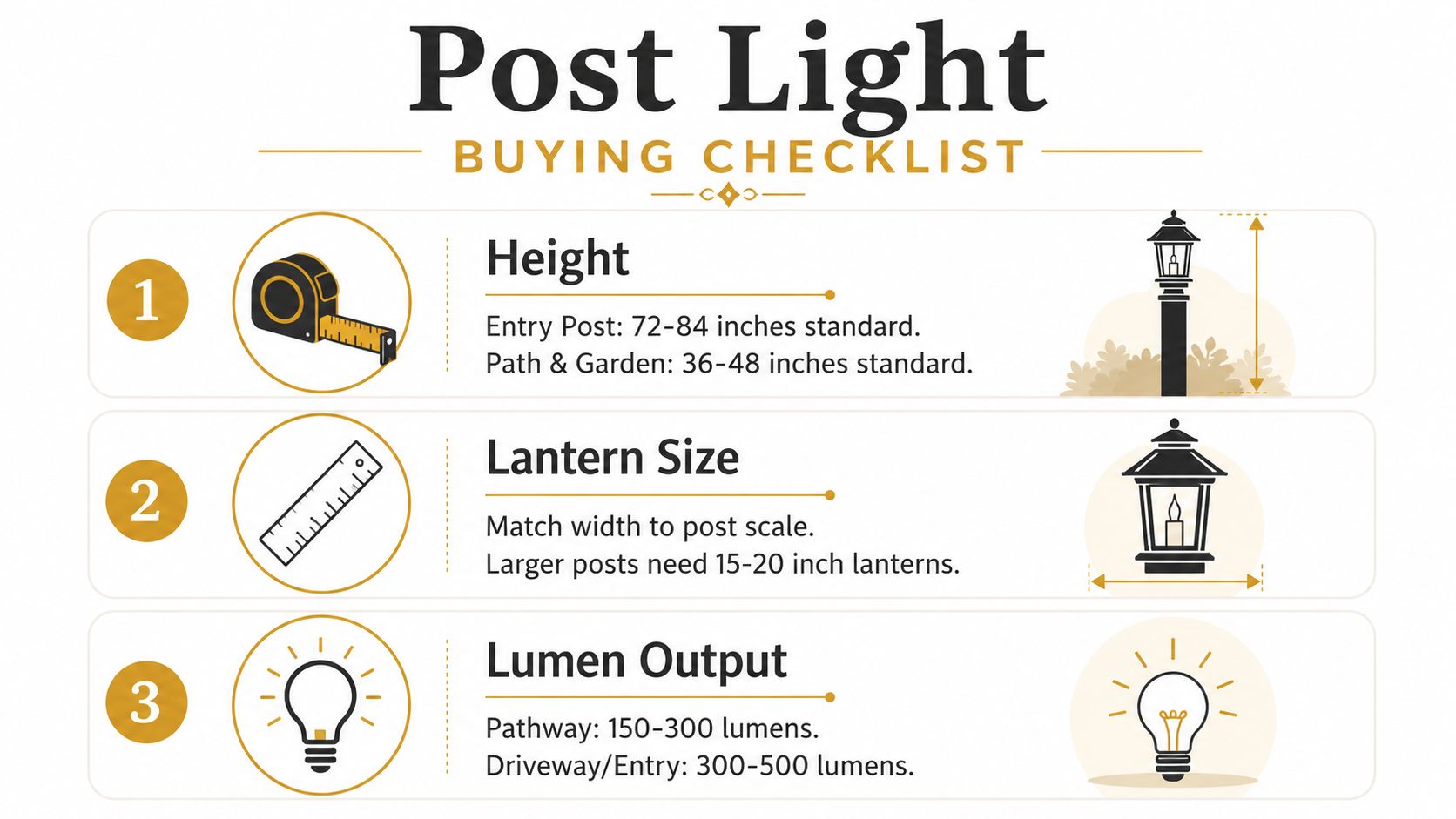
For ambient entry illumination, a practical target is 400 to 800 lumens. Pathway posts generally need 200 to 400 lumens when the goal is orientation rather than floodlighting. The attached checklist infographic also presents entry posts at 72 to 84 inches, path and garden posts at 36 to 48 inches, and separate output guidance for pathways and driveways.
Treat weather and impact ratings as buying requirements
IP44 can be acceptable for a covered post location, but exposed coastal sites, sprinkler zones, and open-drive installations deserve IP65 or higher. An IP65 enclosure is dust-tight and protected against water jets, while the IP rating guidance for exposed post-top fixtures explains why that baseline matters.
IK rating addresses impact. IK08 corresponds to 5 joules of impact energy, a practical minimum for fixtures that may encounter maintenance equipment, accidental knocks, or light vandalism. Public-facing installations benefit from stronger protection where the fixture's location and replacement access justify it.
Surge protection deserves equal attention. Outdoor circuits are exposed to transient overvoltage from lightning-adjacent events and grid switching, so a driver with strong surge immunity is less likely to flicker or fail prematurely. Outdoor lighting guidance identifies exposure levels of 6 kV/3 kA for low exposure and 10 kV/10 kA for high exposure, with demanding applications sometimes specified at 20 kV/10 kA in ANSI/IEEE C62.41.2 location-category material.
Before clicking add to cart, confirm:
- Height: Does the post suit the entry, path, or driveway?
- Lumens: Is the output appropriate for ambient guidance or broader coverage?
- IP rating: Is the enclosure suitable for direct weather and sprinklers?
- IK rating: Can the glass, lens, or cage handle the site's exposure?
- Surge and mounting details: Does the driver offer credible protection, and does the base fit the post or pier?
For a closer look at LED-specific considerations, the Golden Lighting LED post light guide helps frame the performance questions that matter beyond appearance.
Choosing the Right Material and Finish for Your Climate
Finish selection starts with exposure, not a color sample. A post light faces rain, sun, wind, irrigation, salt, and seasonal temperature changes, so the body material and coating should reflect the site.
Cast aluminum is the practical default for many inland and four-season homes. It's light, doesn't corrode like ferrous steel, and accepts durable powder coating. In humid regions, powder-coated cast aluminum is the clear starting recommendation.
Brass and bronze earn their place where salt or pool chemicals are persistent concerns. They're heavier, resist corrosion, and can develop a deliberate patina when left untreated. Stainless steel offers a sleek contemporary appearance, but chloride exposure can cause pitting in coastal locations, so it isn't automatically the superior marine choice.
Composite and resin fixtures eliminate rust concerns and can offer modest cost, but their design vocabulary is usually narrower. They work best when the priority is practical resistance rather than a highly detailed lantern profile.
Finish technology also changes long-term behavior. The provided industry guidance states that powder coat over aluminum can withstand 3,000 hours of salt spray, compared with 500 hours for liquid paint, while untreated brass can patina intentionally. Those figures make the recommendation straightforward for exposed properties.
| Material | Best Climate | Finish Recommendation | Watch-Out |
|---|---|---|---|
| Cast aluminum | Inland, humid, four-season | Exterior powder coat | Inspect coating and joints for damage |
| Brass or bronze | Coastal and pool-deck exposure | Marine-suitable finish or living finish | Heavy material needs secure mounting |
| Stainless steel | Dry or lightly exposed modern settings | Carefully specified exterior finish | Chloride pitting in coastal zones |
| Composite or resin | Rust-sensitive, budget-focused applications | UV-suitable exterior coating | More limited styling options |
Arid regions can use either brass or powder-coated aluminum. The final finish should coordinate with door hardware, house numbers, mailbox details, and nearby exterior fixtures. That small consistency makes the post light read as part of the architecture instead of a late addition.
How to Place and Space Post Lights Around Your Property
Placement should be measured at night, not guessed from a catalog image. Start with the route people use, then position fixtures so each pool of light supports the next without producing a line of glare.
For pathways, residential posts often sit at 6 to 8 feet, with lanterns between 15 and 20 inches wide. A starting interval of 8 to 10 feet keeps the rhythm comfortable. On a curved walk, stagger fixtures from side to side rather than placing them in a rigid line. That arrangement follows the route and avoids the runway effect.
Driveways call for a larger visual scale. Use 8- to 10-foot posts with lanterns around 22 to 26 inches wide, spaced at 12- to 15-foot intervals where that geometry suits the fixture and site. Set each post at least 12 inches from the paved edge to reduce the chance of tire strikes, snowplow damage, or accidental contact.
At a gate or pier, match the post or lantern height to the door or gate transom. On a single-story façade, the post generally belongs within 6 inches of the door height, while a two-story entry may require a taller proportion. A pier base often produces cleaner geometry than burying a post beside masonry.
Pro-Tip: The lantern's top should sit just below the sightline from interior eye level through the nearest window. The lamp stays hidden, while the glow still reaches the glass and makes the entry feel occupied.
Posts taller than 7 feet usually need a stabilizer kit or concrete footer to manage wind load. Installation details deserve the same attention as the fixture itself. The Golden Lighting outdoor post-light installation guide provides additional context for planning the base, wiring, and placement.
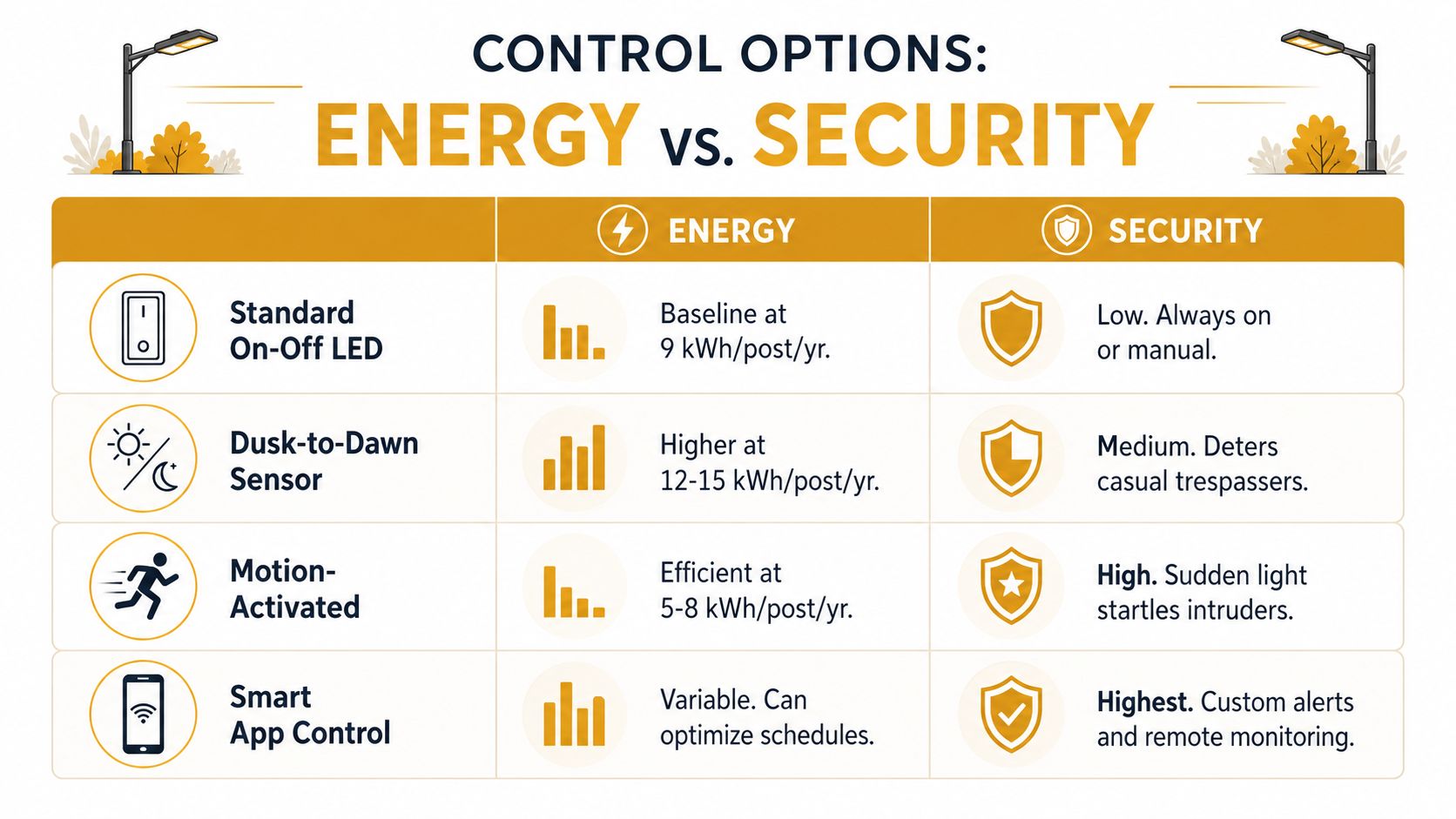
Control choice also changes how the installation behaves after sunset. The following visual compares common options, but its embedded energy figures should not replace fixture-specific electrical data.
Energy, Security, and Smart Controls Worth the Upgrade
A post light that turns on reliably at dusk delivers more practical value than one that looks excellent but depends on someone remembering a switch. The strongest default for most homes is an LED fixture with a photocell, because it provides consistent presence without requiring daily attention.
Modern photocells can consume less than 0.5 watts, or about 4.4 kWh per year, while some units use less than 100 milliwatts, or under 1 kWh per year, according to the Lucy Zodion photocell technical guide. At an electricity price of £0.17 per kWh, that guide estimates annual photocell costs of about £0.74 for a 0.5-watt unit and £0.15 for a 0.1-watt unit. The example illustrates a larger operational truth: small savings multiply across a neighborhood, campus, or property portfolio.
The controls should be ranked by actual use:
- Standard on-off: Cheapest and simplest, but dependent on manual operation and weak for consistent security presence.
- Photocell-only: The best default for most entries because the fixture responds to dusk automatically.
- Motion overlay: A strong choice for side yards and back gates where a sudden brightness change improves awareness.
- Smart control: Appropriate when the homeowner already uses a compatible hub and wants schedules or remote access. Otherwise, the app can become another forgotten login.
Layered control makes the most sense where exposure and replacement access are difficult. A photocell can maintain evening presence, while motion can raise attention in less-visible areas. For surge protection, outdoor installations should be specified against the site's exposure. The technical guidance cited earlier includes demanding applications at 20 kV/10 kA, while product-specific driver protection must be verified in the actual specification sheet.
For homeowners extending illumination along boundaries with solar or low-voltage caps rather than a full post light, low-voltage post cap light specifications from Kings Outdoor Lighting are a useful reference point for comparing wattage and voltage across systems. The right control isn't the most complicated one. It's the one the household will use.
Golden Lighting's Post and Pier Lantern Options
Golden Lighting's outdoor post and pier lighting currently comes in two lantern families, both built for direct-exposure installation and priced within a few dollars of each other — so the real choice is glass and silhouette, not budget tier.
The Smyth 1-light Outdoor Post ($259.99) is the traditional-lantern pick from the categories above: a Natural Black frame paired with either Opal Glass (a soft, milky, glare-free diffusion) or Seeded Glass (small trapped air bubbles for a vintage, artisanal texture) — both read well on Colonial, Craftsman, and other homes with real architectural detailing.
The Tribeca 1-light Outdoor Post ($253.99) is the cleaner, modern-profile pick: the same Natural Black frame with a clear glass shade polished to a high-gloss shine, so the bulb and fixture geometry read as the focal point rather than the glass texture.
| Product | Price | Glass | Best For |
|---|---|---|---|
| Smyth 1-light Outdoor Post | $259.99 | Opal or Seeded Glass | Traditional lantern look; softer diffused or vintage-textured glow |
| Tribeca 1-light Outdoor Post | $253.99 | Clear Glass | Cleaner, modern silhouette with unobstructed light |
Both are UL Wet Location Rated for direct rain and snow exposure, mount on either a pier or a post for flexible installation, and take a single E26 medium-base bulb up to 100 watts. Confirm the exact lumen output and bulb pairing on the live product page before ordering — the fixture rating alone doesn't set the light output.
Golden's YEP and Ziva lines carry other outdoor formats — wall and ceiling fixtures — in a similar design language, worth a look if you want a matched look across the rest of the exterior. For post and pier lighting specifically, Smyth and Tribeca are Golden's current lineup; browse the full Outdoor Pier & Post Lights collection for current pricing and availability before finalizing a layout.
Care, Troubleshooting, and Your Next Step
The purchase decision can be reduced to five essentials:
- Height: Match the post to the route and architecture.
- Lumens: Use enough output for visibility without creating glare.
- IP rating: Choose protection appropriate to direct weather and irrigation.
- Material: Match aluminum, brass, bronze, stainless steel, or composite to the climate.
- Control: Select photocell, motion, smart, or manual operation based on how the property is used.
Most early failures trace back to a small group of preventable issues. Missing or poorly seated gaskets allow water into the housing. A finish can oxidize when the material choice ignores salt, pool chemicals, or persistent humidity. An underprotected driver can fail after a surge event, especially on a long or isolated outdoor circuit.
Before installation, inspect every gasket, thread, fastener, base plate, and wire entry. After installation, clean the glass, check fastener tightness, and inspect the post base for corrosion or standing water. Coastal properties also deserve regular seal inspection and lens-sealant maintenance as needed.
A practical troubleshooting sequence starts with the bulb or LED module, then the photocell, nearby GFCI protection, corrosion, water at the post base, and whether the problem affects one fixture or the entire zone. That power-path approach is consistent with the diagnostic guidance in this outdoor post-light troubleshooting guide.
The next step is to compare fixture dimensions, ratings, finish, and control options in the curated Golden Lighting outdoor pier & post collection. For a larger renovation or trade project, request the relevant specification sheets and trade pricing before finalizing the layout.
Choose the post-light locations, measure the architecture, and verify the five essential specifications before ordering. Then shop the Golden Lighting outdoor collection and select the fixture that fits the property's climate, scale, and nightly routine.
— seen a lot of light fixtures in 80+ countries. Still learning what actually works in a home.
Share:
How to Install a Sconce Light Fixture the Right Way