



Written by Rick Kovac, COO of Golden Lighting
The takeaway: Size a foyer chandelier by adding the room's length and width in feet, keep the lowest point at least 7 feet above the floor, and let the entry's ceiling height and traffic pattern decide whether a chandelier belongs there at all.
Key takeaways:
- Add the foyer's length and width in feet to get a starting diameter in inches, then adjust upward for ceilings above 14 feet.
- Keep the lowest point of the chandelier at least 7 feet above the finished floor so it doesn't interrupt circulation.
- Check the fixture from every approach, not just the front door, including the stair landing and hallway sightlines.
- Low ceilings, narrow entries, or heavy traffic often call for a flush or semi-flush mount instead of a chandelier.
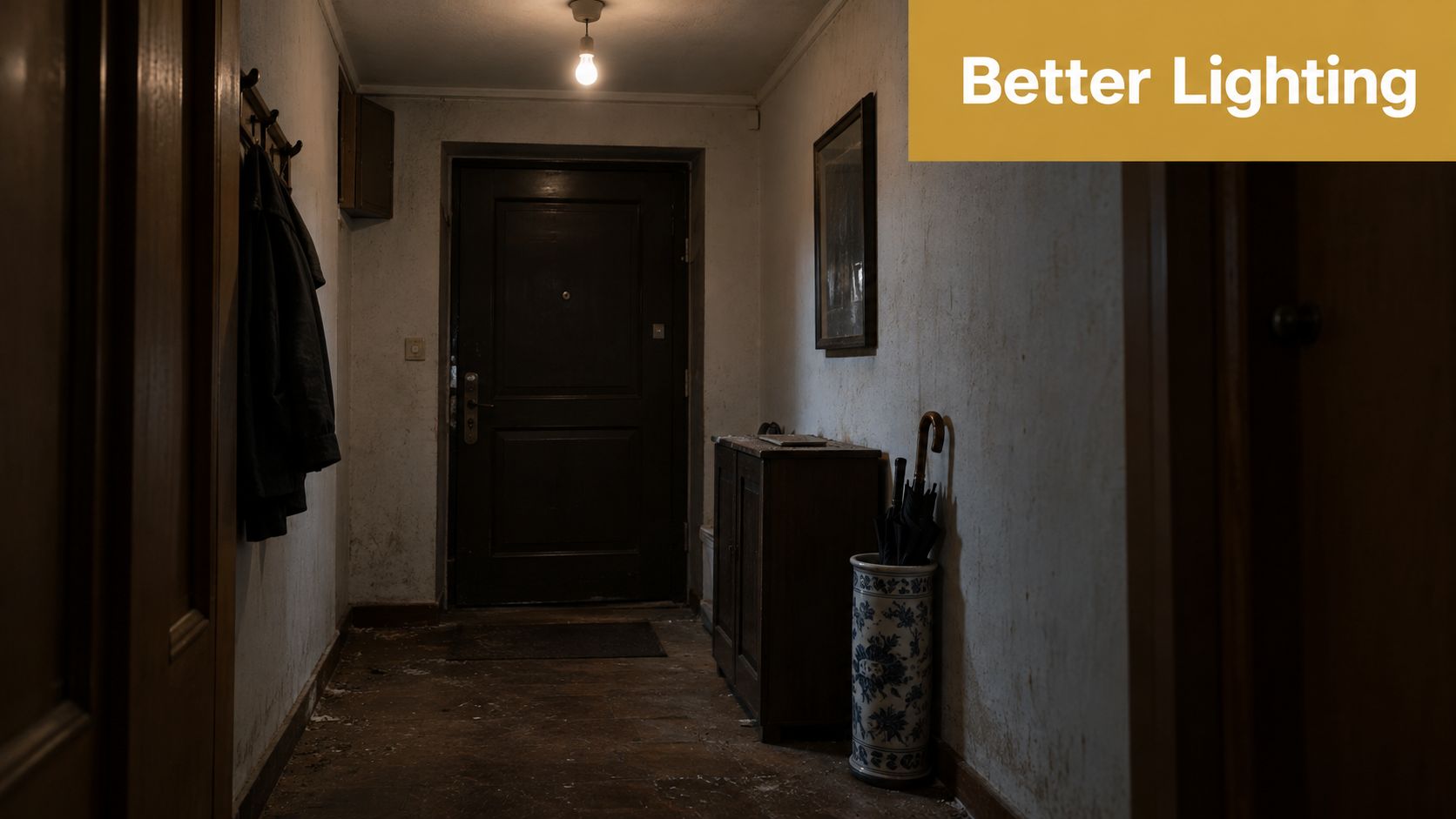
A foyer can be technically lit and still feel dark, cramped, or forgettable. One bare bulb may reveal the floor, but it won't create the welcoming pause guests feel when they enter a thoughtfully designed home. The right fixture can establish scale, guide the eye toward a staircase or console, and connect the entryway to the rooms beyond.
Choosing chandeliers for foyer spaces starts with architecture, not shopping. Ceiling height, circulation, sightlines, and the relationship between the front door and adjacent rooms should determine whether a chandelier belongs there at all. From that point, size, hanging height, finish, and material become much easier to decide.
Why Your Foyer Deserves Better Lighting
A foyer carries more visual responsibility than its square footage suggests. It's the first interior space visitors experience, and it often has to perform several jobs at once: welcome guests, support coat and shoe traffic, reveal the home's architecture, and create a transition from outdoors to indoors. A fixture that's too small can leave the entry feeling unfinished. One that's too low or visually heavy can make the same area feel crowded.
A chandelier has served this first-impression role for centuries. The earliest identifiable precursor, the Byzantine polycandelon, dates to the 6th century, while the first rock crystal chandeliers appeared in the 17th century. Wealthy European households were already using chandeliers by the late 14th century, and craftsmen in Bohemia and England produced branching wrought-iron and brass forms in the 15th and 16th centuries. Murano crystal later turned the fixture into a status object designed to refract candlelight across large rooms.
That history still matters in a foyer because the fixture is visible before most of the home. It communicates proportion, craftsmanship, and hospitality without requiring the space to carry a lot of furniture or decoration. A restrained lantern can suit a traditional entry, while a sculptural form can give a modern foyer its defining shape.
Golden Lighting's guide to lighting for entrance foyers offers useful context for building the rest of the welcome, including the relationship between the ceiling fixture, wall color, flooring, mirrors, and console pieces. The practical sequence is straightforward: decide whether the architecture supports a chandelier, establish the correct scale, verify the hanging height, and then select a style that belongs with the home.
Professional perspective: A foyer fixture shouldn't be chosen in isolation. It should make the door, stair, ceiling, and adjoining rooms feel like parts of one composition.
How to Choose the Right Size for Your Foyer
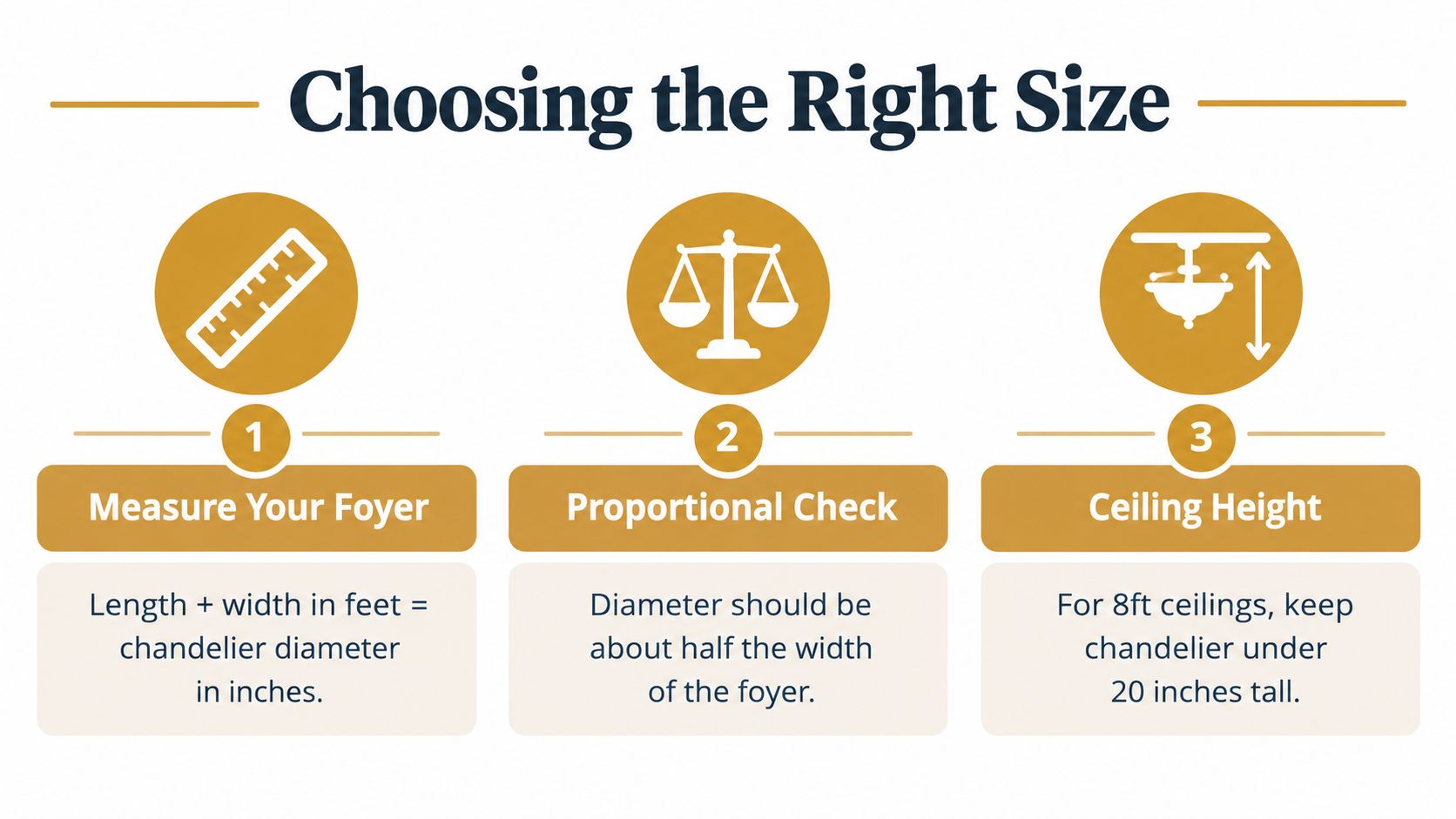
A reliable starting point for chandelier diameter is simple: add the foyer's length and width in feet, then use that sum as the fixture diameter in inches. This method translates room dimensions into a visual scale that's easy to apply before visiting a showroom or ordering online. The sizing guidance is also summarized in Golden Lighting's chandelier sizing rules.
Measure the room before measuring the fixture
Measure the usable foyer area, not an adjacent hallway that happens to share the ceiling. If the entry opens into a stair hall, identify the zone the chandelier will visually anchor. A console, bench, open stair, or double-height void can change the point that feels like the center of the foyer.
For example, a foyer measuring 12 feet by 14 feet produces a starting diameter of 26 inches, because 12 plus 14 equals 26. The formula isn't a final verdict. It gives a proportion to test against the ceiling height, fixture shape, door swing, and amount of visual activity in the room.
A round chandelier and a vertically elongated lantern can share a similar visual footprint while occupying the space differently. Open-cage fixtures often appear lighter than dense crystal or layered glass, so the material and silhouette should be judged alongside the measurement.
Increase scale in tall vertical spaces
A standard formula can undersize a two-story foyer because it accounts for the floor plan but not the full volume above it. For ceilings above 14 feet, Golden Lighting's design team typically increases the base result by roughly 20 to 30 percent to preserve visual scale.
Pro-Tip: In a very tall foyer, a chandelier reading as roughly one-quarter to one-third of the total ceiling height tends to hold the room's proportion, which puts a fixture in a 20-foot ceiling in the neighborhood of 5 to 7 feet tall. Scale up first, then confirm that the fixture clears doors, stairs, railings, and walking paths.
A tall space can handle a larger fixture, but larger doesn't mean visually busier. A long, open frame may provide the necessary vertical presence without blocking views between levels. In a foyer with ornate trim or a complex staircase, a simpler silhouette may create better balance than a heavily layered centerpiece.
For readers comparing forms beyond traditional chandeliers, Golden Lighting's pendant hanging guide can help clarify how pendant proportions and suspension styles affect a high-entry composition.
Getting the Hanging Height Just Right
Size determines how much visual presence a fixture has. Hanging height determines whether that presence feels comfortable or obstructive. A well-sized chandelier can still fail if it interrupts the path from the front door, competes with a transom, or sits low enough to make visitors instinctively duck.
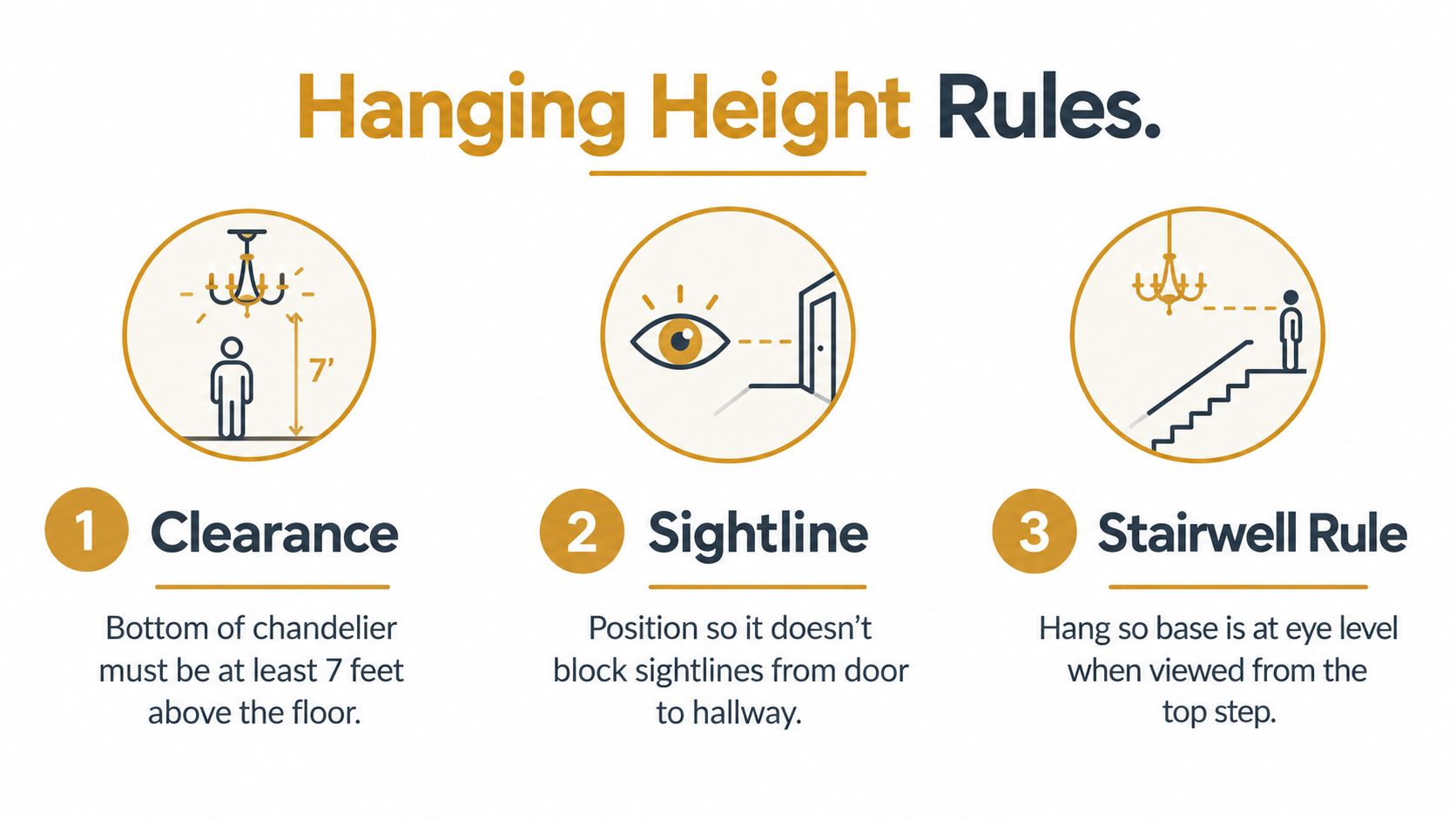
For a single-level foyer, the bottom of the chandelier should remain at least 7 feet above the floor, per Golden Lighting's floor-clearance standard. This clearance protects everyday circulation while keeping the fixture present in the room. The measurement should be taken from the finished floor to the lowest part of the chandelier, including a finial, decorative frame, or pendant element.
Check the approach from every direction
The front door is only one viewing position. Stand where someone would enter, then check the view toward the hallway, staircase, living room, and coat storage. A chandelier that looks perfect from the threshold may block the sightline to the stair landing once the door opens.
Use this quick installation check:
- Floor clearance: Confirm that the lowest fixture element stays at least 7 feet above the finished floor.
- Door movement: Open the front door fully and verify that the fixture doesn't visually collide with the door, transom, or trim.
- Stair approach: Walk up the stairs and inspect how the chandelier reads from the landing and top step.
- Sightlines: Check that the fixture doesn't obstruct the route from the entry to the main hallway.
- Maintenance access: Confirm that bulbs and glass can be reached safely without placing a ladder in an active traffic zone.
A chandelier in a two-story foyer needs a different visual target. It should feel intentional from below and from the upper landing, rather than appearing centered only for the first-floor view. Aligning the lower portion with the second-floor level can create a strong connection between the two stories, but the final position must also account for the door height, stair geometry, and surrounding openings.
The Golden Lighting pendant hanging guide provides additional placement context for fixtures suspended from the ceiling. The same disciplined approach applies here: measure the finished conditions, mark the intended position, and review the sightlines before installation begins.
A foyer chandelier should welcome movement, not compete with it. If guests notice the risk of hitting the fixture before they notice its shape, the fixture is hanging too low.
Matching Chandelier Style to Your Entryway
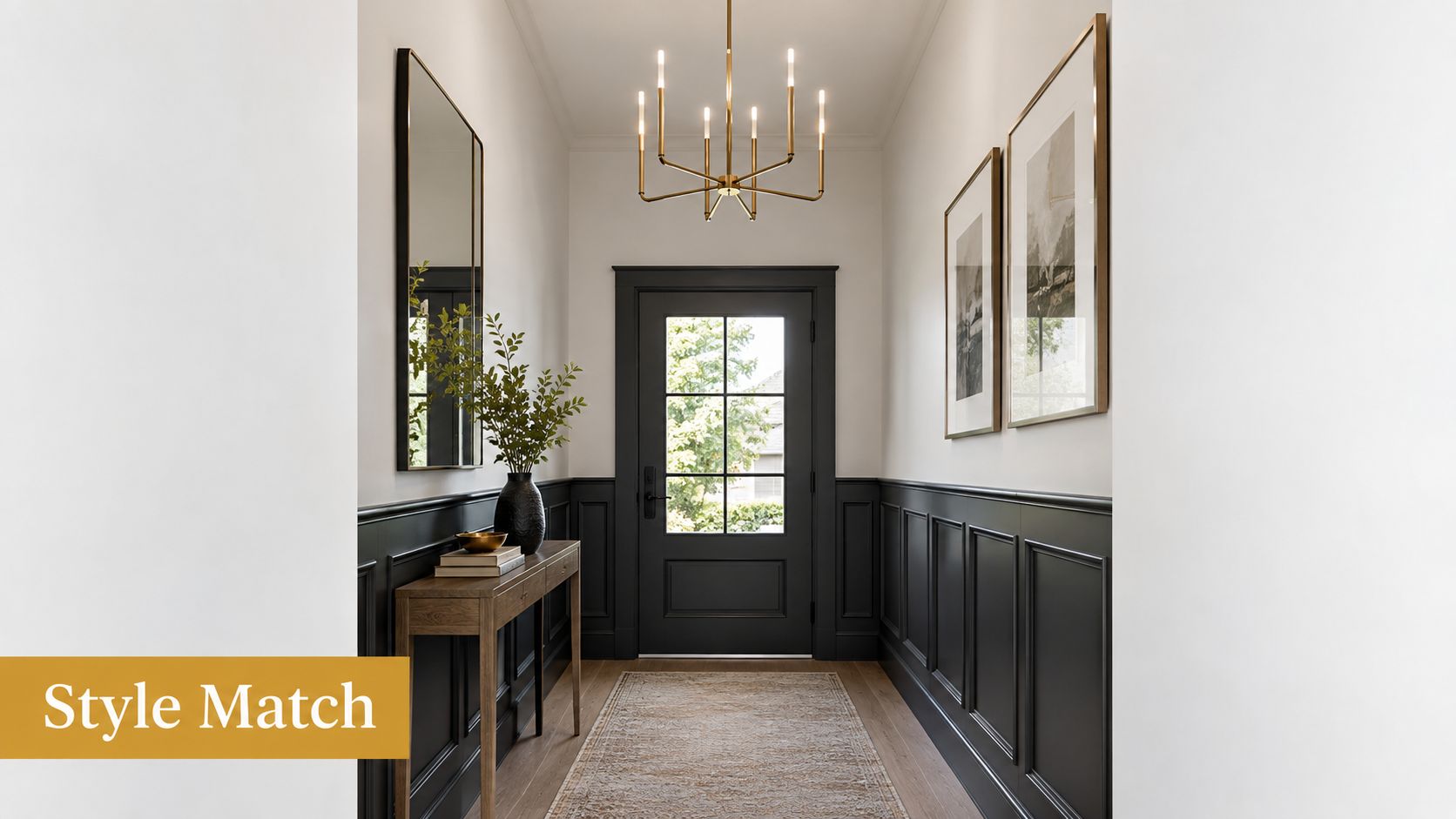
Once proportion and clearance work, style becomes a conversation between the fixture and the architecture. A narrow foyer usually benefits from a chandelier with an open silhouette, while a broad entry can support more layered glass, branching arms, or a stronger central form. The right choice doesn't match the furniture. It reinforces the lines already present in the home.
Read the materials already in the room
Warm wood floors and a timber console can support brass, bronze, or other warm metal finishes. Cool stone, pale plaster, and crisp architectural trim may pair well with a restrained dark finish or a lighter metal that keeps the entry feeling open. These aren't rigid rules. They're ways to prevent the chandelier from looking detached from the surfaces around it.
Traditional architecture often benefits from familiar candelabra arms, lantern proportions, or glass that softens the light source. Modern foyers can take an open-cage structure, a sculptural cluster, or a geometric frame that echoes stair rails and window grids.
The finish should also relate to the rest of the home without matching every metal exactly. Repeating a finish in a console detail, mirror frame, door hardware, or nearby sconce can make the chandelier feel integrated. Requiring every element to be identical usually makes the entry look staged rather than collected.
Choose a personality that fits the project
A homeowner seeking long-term flexibility may prefer a classic silhouette that can move between traditional, transitional, and updated interiors. A creative homeowner may want the YEP by Golden approach, which supports mix-and-match personalization through shades, finishes, and glass. A designer or showroom professional specifying a more refined focal point may look toward the Ziva by Golden brand, where high-end materials and intricate design language suit a more curated scheme.
The central decision is whether the foyer needs the chandelier to blend, frame, or lead:
- Blend: Choose a quieter finish and open profile when the architecture already provides strong detail.
- Frame: Use the fixture to emphasize a console, stair opening, or artwork wall.
- Lead: Select a sculptural form when the entry lacks a clear focal point and needs one decisive gesture.
A chandelier shouldn't copy the foyer's style mechanically. It should translate it into light, material, and scale.
When a Chandelier Is Not the Best Fit and What to Choose Instead
A chandelier isn't automatically the right answer for every foyer. Low ceilings, narrow passageways, frequently opened doors, and heavy visual clutter can make a suspended fixture feel intrusive. In those conditions, a flush or semi-flush mount can deliver a finished, welcoming ceiling without sacrificing headroom or circulation.
Recent entryway lighting coverage points toward natural materials, warm tones, sculptural forms, and brass or bronze finishes, while low-ceiling entries are increasingly directed toward flush and semi-flush fixtures rather than chandeliers. The important question isn't whether a chandelier is fashionable. It's whether the fixture respects the architecture.
Use the foyer condition as the decision point
| Foyer Condition | Best Fixture Type | Why It Works |
|---|---|---|
| Tall or two-story ceiling | Chandelier | Fills vertical volume and creates a focal point visible from multiple levels |
| Low ceiling | Flush or semi-flush mount | Preserves headroom while adding finish and warmth |
| Narrow, high-traffic entry | Low-profile semi-flush mount | Keeps the circulation path visually and physically clear |
| Wide foyer with a strong central axis | Chandelier or sculptural pendant | Establishes a center and supports the room's broader proportions |
| Entry with complex trim or a busy stair | Simple chandelier or flush mount | Adds light without competing with existing architectural detail |
For a narrow foyer, a compact chandelier can work if its arms or frame stay visually open and the fixture doesn't project into the walking route. If the entry feels crowded before furniture arrives, a lower-profile fixture is usually the more confident choice.
A semi-flush mount can still be expressive. Sculptural metalwork, layered glass, warm finishes, and natural material accents can create the same sense of welcome without a long drop. A coordinated wall sconce or nearby pendant can add another layer where the ceiling fixture alone can't reach.
Residential demand remains an important part of the chandelier category, with statement entry fixtures continuing to anchor foyer design across both traditional and contemporary homes. That context supports continued interest in statement fixtures, but it doesn't override the practical decision. The fixture should fit the foyer first.
Bringing It All Together in Your Entryway
A successful foyer chandelier does three jobs at once. It gives the entry enough presence to feel intentional, keeps movement comfortable, and connects the design language of the front door to the rooms beyond. Beauty matters, but engineering, finish quality, serviceability, and proportion determine whether the fixture will continue to work after the first impression fades.
Use this final review before purchase:
- Architecture first: Decide between a chandelier, semi-flush mount, or flush mount based on ceiling height, traffic, and sightlines.
- Scale second: Add the foyer's length and width in feet to establish a diameter in inches, then adjust for a tall ceiling when appropriate.
- Height third: Verify the lowest point, door movement, stair views, and the route guests take.
- Materials together: Relate the finish and silhouette to floors, trim, hardware, console pieces, and nearby lighting.
- Installation planned: Confirm the electrical location, support, bulb access, and dimming needs before the electrician arrives.
For a broader entry composition, Golden Lighting's guide to lighting for entrance foyers can help connect the exterior approach with the interior welcome. The transition matters because guests experience the door, threshold, foyer, and first room as one sequence.
The strongest foyer decisions aren't driven by the largest fixture or the newest shape. They come from a clear reading of the home. A classic chandelier can provide enduring value in a traditional entry, a customizable system can give a creative homeowner room to evolve, and a refined sculptural fixture can meet the expectations of a professional project. The right choice is the one that looks proportionate, hangs safely, and still feels appropriate when the surrounding décor changes.
Measure the foyer, photograph the sightlines from the door and stair landing, then explore the Golden Lighting chandelier collection alongside pendants and lower-profile fixtures. For help with a broader project, review the upcoming 2026 catalog or find a Golden Lighting showroom and bring those measurements to a lighting professional.











Share:
Best Outdoor Post Lights for a Warm, Well-Lit Exterior