


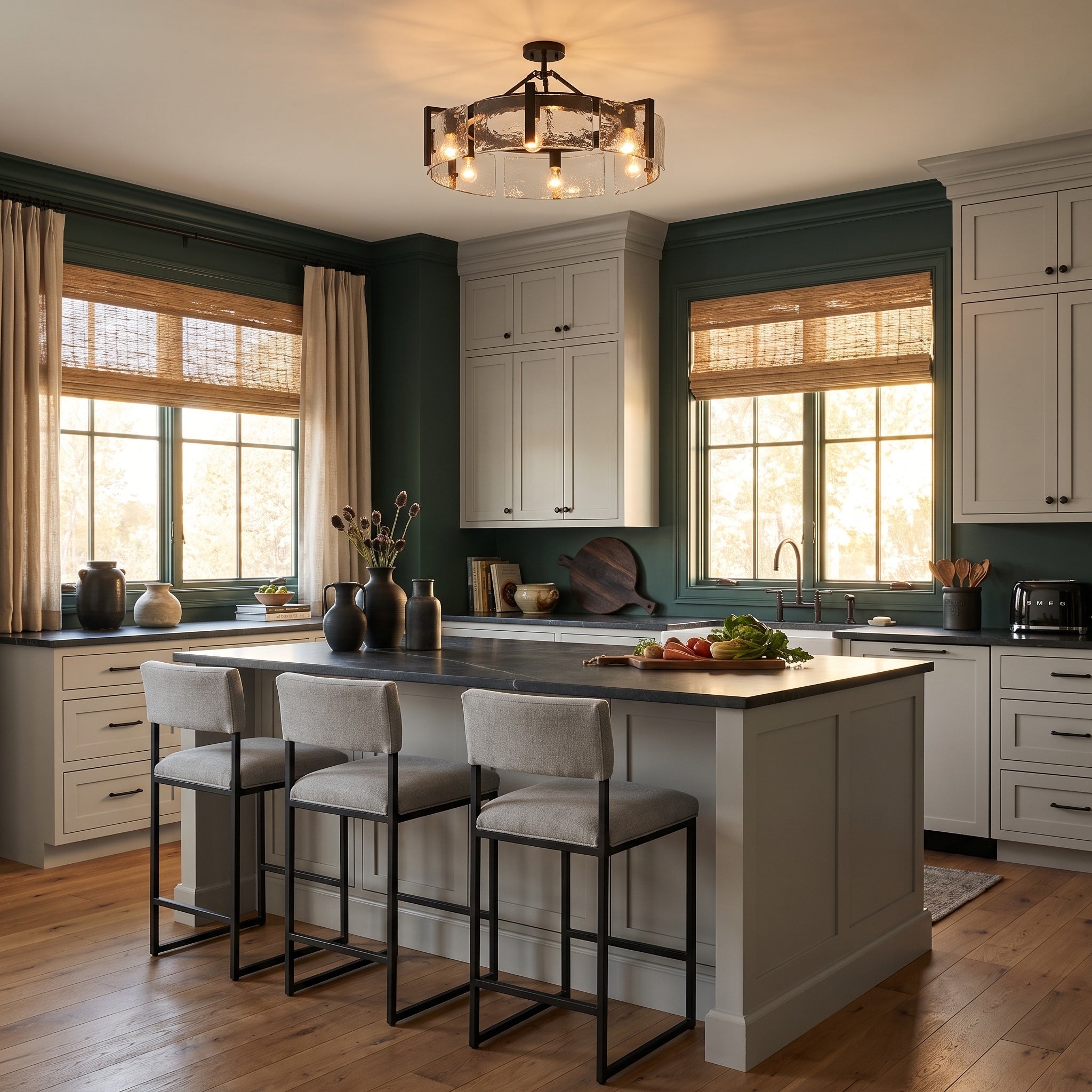
If you've stood in a lighting showroom with an 8-foot ceiling at home, staring at chandeliers built for two-story foyers, you already know the problem: most "statement lighting" is designed for rooms you don't have. Ranch houses, split-levels, and character homes built before ceilings got taller all share the same math — and that math points to one clear answer.
The clearance problem, in numbers
Code requires at least 7 feet of clearance from the floor to the bottom of any fixture in a walking area. On an 8-foot ceiling, that leaves as little as 12 inches to work with once you account for the fixture itself — barely enough room for a pendant to hang at all, let alone hang well. Add a dining table, and a hung fixture has to clear the tabletop by 30 to 36 inches and keep 7 feet of walking clearance beyond the table's edge — two constraints that a low ceiling makes almost impossible to satisfy at once.
It's a mismatch between the room and the fixture type — not a flaw in your home.
The fix: go wide, not down
A wide-diameter semi-flush mount — 24 inches or more, with a generous lamp count — solves the low-ceiling problem by solving a different problem: instead of buying clearance by hanging lower, it buys presence by spreading out. Mounted close to the ceiling, it never competes with the 7-foot rule, and its width fills the visual role a chandelier would play in a taller room.
A wide semi-flush at this scale reads as a genuine statement fixture, not a compromise pick — and it's one of the areas where fixture scale actually works in your favor: fixture body height scales at roughly 2.5 to 3 inches per foot of ceiling height, so an 8-foot ceiling is exactly where a broad, low-profile silhouette looks intentional rather than squeezed in.
Even a 6-seat dining table — usually a "you need a bigger fixture" situation — is well served by a wide semi-flush, as long as it's 24 inches or more across with six or more lamps. The width does the job a hanging fixture's height normally would.
Matching lamp count to your table
If the semi-flush is going over a dining table, lamp count should scale with the table, the same way it would for any dining fixture:
- Small tables (48 inches or less): around 3 lamps is plenty
- Medium tables (54–72 inches): look for 5 to 6 lamps
- Large tables (6-seat and up): step up to a larger, higher-output fixture — this is exactly where the 24-inch-plus wide semi-flush earns its keep
Where else low-profile fixtures do the heavy lifting
Low ceilings aren't confined to one room, and neither is this solution:
- Long, narrow rooms — hallways, galley kitchens, long bathrooms — are better served by a series of flush or semi-flush units spaced along the ceiling's centerline than by one fixture trying to cover the whole run: three units for runs of 16 feet or more, two for 10–15 feet, one for anything shorter.
- Bedrooms are the one place to skip open-bottom, bare-lamp flush mounts — anyone lying down looks straight up into the light source. Choose a diffused or enclosed-bottom design instead; save open designs for halls, kitchens, and living spaces where no one's looking straight up at them.
The takeaway
A low ceiling is a specific, solvable problem with a specific, good-looking answer — nothing to design around apologetically. In an 8-foot room, a wide semi-flush mount is simply the right fixture for the job, not a consolation prize for skipping soaring ceilings.
Recommendations from Golden Lighting's design rulebook: professional design judgment paired with the clearance math in the IES/ALA recommended practice for residential lighting (ANSI/IES RP-11-26) and the National Electrical Code.












Share:
How to Hang Pendant Lights a Designer's Guide
What Size Chandelier Do I Need? The Sizing Rules Designers Actually Use