



Written by Rick Kovac, COO of Golden Lighting
The takeaway: Wall sconces work best when height, glare control, and beam direction are decided before style — center general sconces roughly 60 to 72 inches above the floor, shield the light source from direct view, and match beam direction to the task before choosing a finish.
Key takeaways:
- Center most wall sconces 60 to 72 inches above the finished floor, adjusting for ceiling height, fixture projection, and room function.
- Set mounting height by where the bright source sits, not by the backplate — a visible bulb or diode at eye level means the fixture is too low or too exposed.
- Match beam direction to the job: up-light for ambient mood, down-light for tasks, diffused for even spread.
- Bedside, vanity, and hallway sconces each need their own height and spacing logic — a single rule doesn't fit every room.
A dark hallway, a bathroom mirror that throws shadows across the face, a living room leaning on one ceiling light. Those are the moments when a room feels unfinished, even when the furniture is right.
Wall sconces solve that problem better than most homeowners expect. They free up table space, add a second or third layer of light, and bring illumination closer to where people move, read, groom, and gather. They also aren't a passing trend. Wall sconces trace back to Classical antiquity, expanded dramatically in the European Middle Ages, evolved through mirrored and reflective forms in the 17th century, and became even more decorative with electric lighting and flame-shaped bulbs.
The category is also far from niche. Wall sconces remain one of the most consistently specified fixture types in residential lighting, with steady year-over-year demand tied to entryways, halls, stairwells, baths, and bedrooms rather than to any single design trend. That matters because it reflects how people use sconces now: not as decoration alone, but as practical lighting for the rooms where people actually spend time.
The challenge is that most wall sconce design ideas stop at style boards. They show a pretty fixture and skip the part that determines whether the room feels calm or irritating. Height, glare control, shielding, and beam direction come first. Style comes after that.
Why Your Walls Are Your Best Lighting Opportunity
A wall can do work that a ceiling fixture can't. It can light a circulation path without taking floor space. It can brighten a reading corner without crowding an end table. It can fix the top-heavy feel of a room where all the light comes from above.
Why sconces outperform one-light rooms
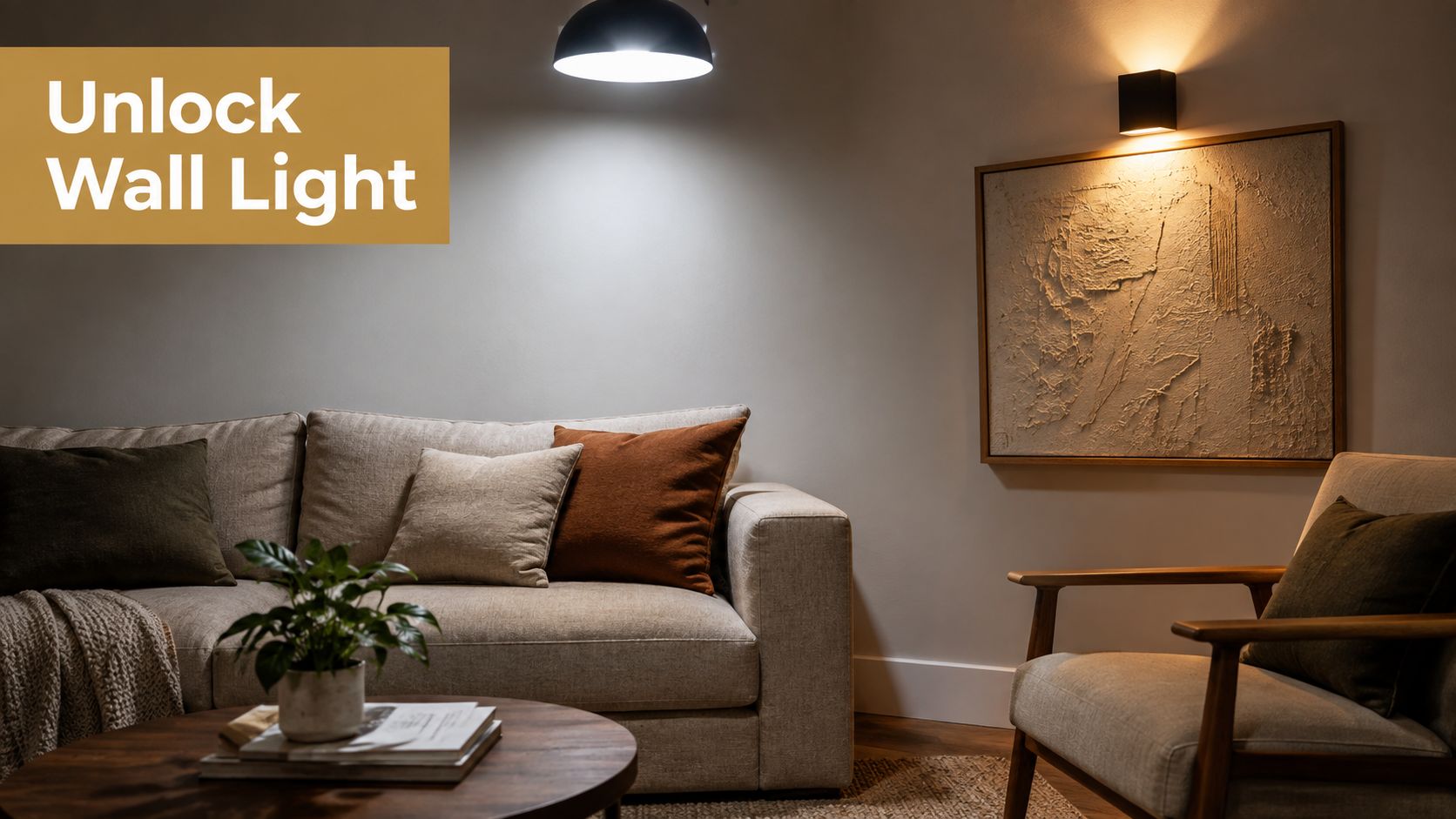
The most common mistake is relying on a single overhead fixture to do everything. That usually creates bright centers, dark edges, and harsh contrast on walls. A sconce spreads light outward across the vertical surfaces people see first, which makes a room feel more settled.
A second advantage is flexibility. Sconces can act as:
- Ambient lighting that softens a room and fills the perimeter
- Task lighting beside a bed, vanity, or reading chair
- Accent lighting that highlights art, millwork, or a fireplace wall
Practical rule: A room rarely feels balanced when all the illumination starts at the ceiling plane.
Function came first, then style
That long design history still matters. Early sconces were built to improve illumination efficiency. Later forms became part of the architecture itself. That same balance still separates good choices from disappointing ones.
The most effective wall sconce design ideas start with function, then use style to support the room. In a narrow hallway, that means clean projection and even spread. In a bedroom, it means a comfortable reading beam. In a living room, it may mean framing a focal wall while supporting a chandelier or pendant.
Walls also give decorative finishes more visual payoff. A washed plaster, panel molding, or lime-textured surface becomes more dimensional when lit from the side. Directional light and surface texture work together, and it's worth choosing the accent wall finish before locking in the fixture, not after.
Why this category keeps growing
Sconces fit modern life because they solve real layout problems. They don't occupy a nightstand, they reduce clutter in an entry, and they let a bathroom mirror work harder. They're also easier to treat as a visible design layer, whether the room leans classic, minimal, or more expressive.
That's why strong wall sconce design ideas don't begin with finish samples. They begin with where the eyes land, where the glare hits, and where the room still feels underlit.
How to Get Height Spacing and Glare Right the First Time
A sconce can be beautifully made and still feel wrong the first night you live with it. The usual problem is simple. The light source sits right in your line of sight, or the pair is mounted by ruler alone and ignores how the room is used.
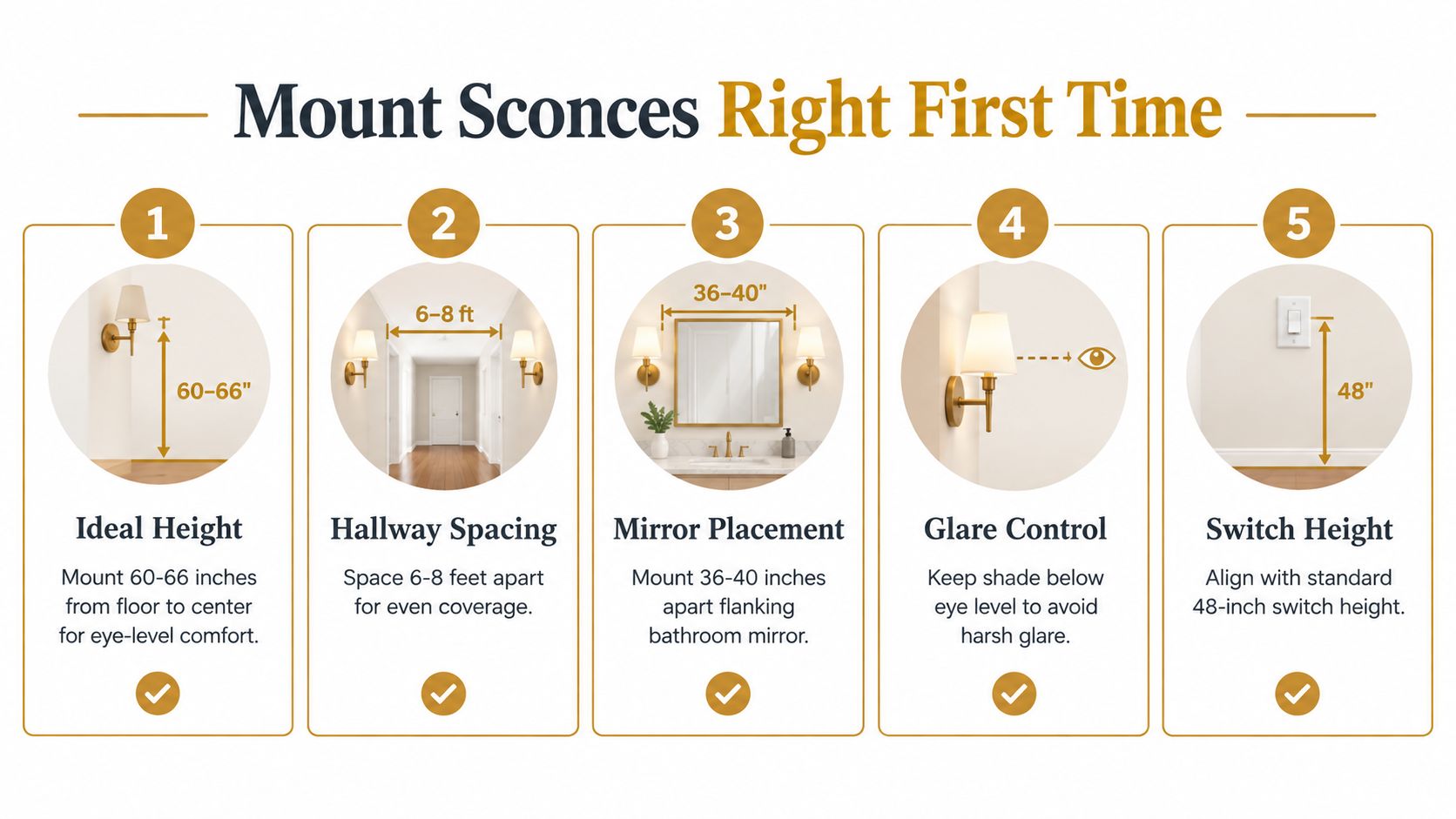
The safest starting point for general wall placement is to center the fixture about 60 to 66 inches above the finished floor, with a broader working range of 60 to 72 inches when ceiling height, fixture projection, and room function change, per Golden Lighting's sconce placement standard. That range works because it tracks with eye level in real circulation spaces, not just with what looks centered on a sketch.
Start with sightlines first
I tell homeowners and designers to stand where the room pauses them. At the front door. Beside the bed. In the chair across from the fireplace. At the vanity.
Then check one thing. Can you see the hot spot of the bulb, diode, or lens at eye level?
If the answer is yes, the fixture is too low, too open, or pointed the wrong way for that location. Good placement protects comfort before it chases symmetry. A shielded sconce with frosted glass can often sit a bit lower. An exposed lamp or open-sided metal form usually needs more height or a different fixture body altogether.
Set mounting height by the bright part of the fixture, not just by the backplate or overall silhouette.
A quick field check helps avoid expensive corrections:
- Stand where people enter or stop in the room.
- Check the seated view in bedrooms, living rooms, and reading areas.
- Raise or lower the center point until the light source drops out of direct view.
Space for overlap, not for decoration alone
In hallways, fixtures need enough distance to create rhythm without leaving dark gaps. Independent guidance commonly places sconces roughly 6 to 8 feet apart. The exact spacing shifts with lumen output, beam spread, wall color, and fixture size. Narrow beams need tighter spacing. Wider diffused light can stretch farther.
Here is the practical benchmark I use early in planning:
| Space | Practical benchmark |
|---|---|
| General walls | Center fixture around eye-level range |
| Hallways | Space fixtures so light patterns slightly overlap |
| Bedside | Mount relative to seated shoulder height |
| Vanity sides | Keep the brightest zone near face level without exposing the lamp |
If you are still narrowing down form before rough-in, this guide to different wall sconce types and where they work best is useful because fixture shape directly affects mounting flexibility.
Adjust for the job of the room
Bedside sconces need a different setup than decorative hallway sconces. Reading light should land on the page or pillow area without shining into the user's eyes. Independent guidance places bedside sconces about 24 to 27 inches above the mattress top.
Bathrooms are even less forgiving. Side-mounted vanity sconces usually work best when the brightest zone sits near face level but the lamp itself is screened from direct view. Golden Lighting's placement standard for mirror-adjacent sconces recommends mounting each fixture at roughly eye level, spaced to flank the mirror evenly, with shielding such as frosted glass or baffles to reduce harsh direct light.
One trade-off matters here. Mounting higher often improves comfort, but it can weaken task light if the beam gets too far above the work zone. Mounting lower can improve usefulness, but only if the shade, diffuser, or baffle hides the source. That is why glare control and height have to be decided together.
Pro-Tip: Lock junction-box height before drywall, then test eye-line clearance in the actual room. That step saves one of the costliest lighting fixes, relocating a sconce after tile, plaster, millwork, or wallpaper is finished.
There is no magic number that fits every wall. There is a comfortable range, a visible source, and a beam path. Get those three right first, and the styling choices start working much harder.
Choosing Direction and Diffusion for Comfort and Style
Once placement is solved, the next decision is how the light should leave the fixture. Beam direction shapes mood, usefulness, and comfort more than most buyers expect.
Comparing up-light, down-light, and diffused forms
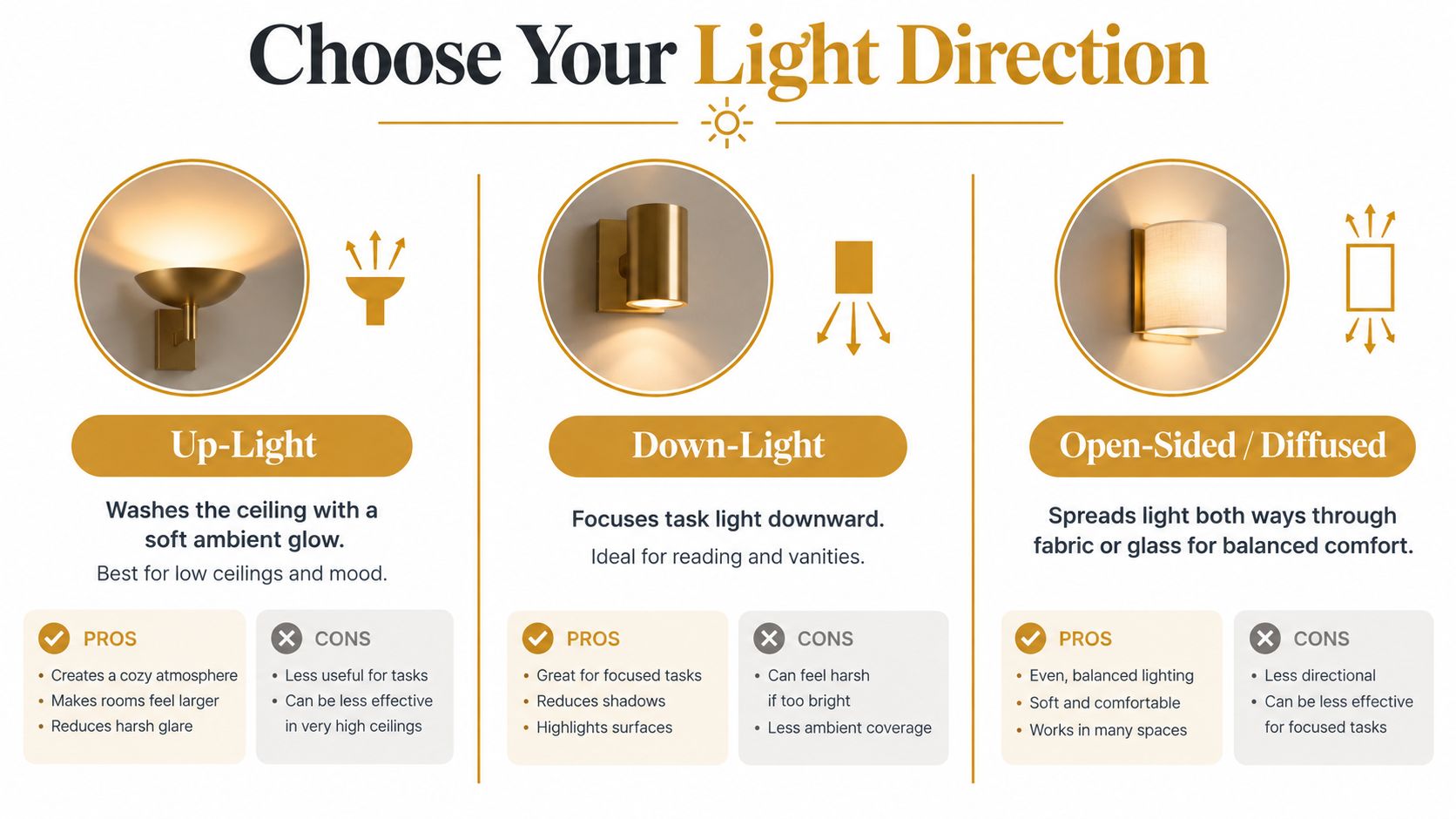
Different fixture geometries serve different jobs.
| Type | What it does well | Where it often fails |
|---|---|---|
| Up-light | Washes the wall and ceiling for a softer ambient effect | Weak for reading or face lighting |
| Down-light | Pushes illumination onto a task surface | Can glare if the source is exposed |
| Open-sided or diffused | Spreads light more evenly through shade or glass | Can lose focus if the task needs direction |
Up-light sconces are strong mood builders. They help low-contrast rooms feel calmer because the brightness bounces through the upper wall and ceiling plane.
Down-light sconces are more disciplined. Beside a bed, they can support reading. Near a stair or console, they can define a useful pool of light. But if the diode or bulb is directly visible, discomfort shows up fast.
Shielding is the difference between polished and harsh
A fixture with frosted glass, a fabric shade, a baffle, or a wall-washing design tends to feel more refined because the eye sees the effect of light before the source itself. Open bulbs can be beautiful, but they demand tighter control over height and viewing angle.
The reliable sequence for choosing and placing wall sconces stays the same across rooms: define the task zone, choose beam direction, test sightlines from seated and standing positions, then confirm clearance from mirrors, artwork, and headboards. Bare or open sources should stay out of direct line of sight, while shielded fixtures can tolerate lower mounting because the source is diffused.
What works in real rooms
A few practical pairings hold up well:
- Reading chair plus down-light head. Direct the beam onto the page, not across the room.
- Textured feature wall plus up-light or wall-wash form. Let the wall carry the drama.
- Vanity side lights plus diffused shade or glass. Even facial illumination beats decorative sparkle every time.
- Hospitality-style hallways plus shielded fixture. It keeps circulation comfortable over repeated passes.
The strongest wall sconce design ideas don't ask one fixture to do every job. They assign the light direction to the task, then choose a shape that supports the room visually.
Room by Room Wall Sconce Design Ideas That Work
Good sconce plans become obvious once they're tied to a room, a task, and a point of view. The same fixture that feels elegant in a hallway can be frustrating beside a bed. Context decides.
Entryways and hallways that feel intentional
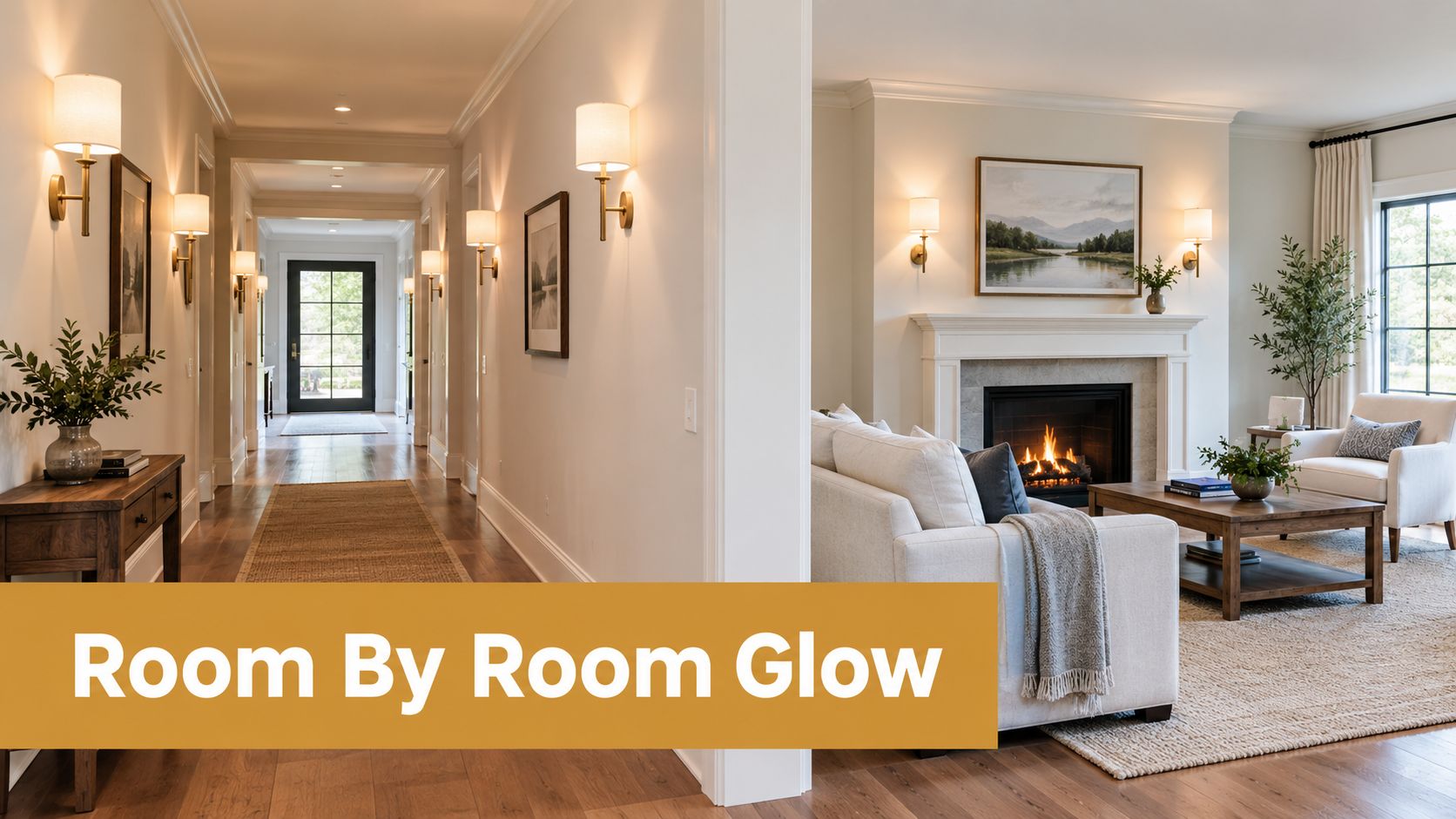
A narrow hall often gets treated as a pass-through, then ends up dim and forgettable. Wall sconces fix that because they light the perimeter without shrinking the walking path.
For classic homes, a paired lantern-style or shaded sconce can establish rhythm near a console or art grouping. For cleaner interiors, a slim form with controlled diffusion keeps the wall bright without visual clutter.
What doesn't work is random spacing or over-scaled projection. Long corridors need consistency more than drama.
- For standard ceiling heights: Keep the visual center comfortable and avoid exposed bright sources.
- For taller walls: Let the fixture breathe vertically, but keep the light behavior tied to the person moving through the space.
- If the hall includes artwork: Shift the sconce so the wall glow supports the art instead of competing with it.
For readers balancing bold decorative choices with practical performance, treating a hallway sconce as a piece of wall art in its own right can help clarify when a fixture should act as focal art and when it should stay in a supporting role.
Living rooms that need more than one layer
A living room usually asks sconces to do two jobs. They need to fill dim edges and support a central fixture. That pairing works especially well when sconces sit beside millwork, a fireplace, or a large art wall.
A practical combination is a chandelier or pendant handling broad ambient light while wall fixtures shape the perimeter. That's where layered planning matters more than matching every finish exactly.
For more fixture formats that suit this kind of layering, this guide to types of wall sconces for different spaces can help compare shapes before committing to a scheme.
A living room feels expensive when the eye reads light at multiple heights, not when one bright fixture tries to dominate the whole volume.
Bedrooms that read well at night
Bedside sconces succeed when they eliminate the reach and clutter of table lamps. They fail when they're mounted for symmetry with the headboard but not for the person sitting up in bed.
A good bedside fixture should align with the user's seated shoulder zone and direct light onto the page or pillow area without shining across the face. Adjustable heads, shaded forms, and controlled down-light styles usually perform better than exposed decorative bulbs here.
This is also where wall sconce design ideas become personal. Some people want hotel-like order with matching bedside pairs. Others want one reading light paired with one softer ambient sconce. Both can work if the beam is honest about its job.
A quick visual reference helps show how layered wall lighting changes room balance in practice.
Bathrooms that flatter instead of punish
Bathroom sconces belong at the sides of the mirror when the goal is even face lighting. Golden Lighting's placement standard for mirror-adjacent sconces recommends side sconces about 60 to 65 inches above the floor and about 28 to 36 inches apart, center to center, so the light reaches the face more evenly.
That side placement is a real performance upgrade over a lone overhead vanity bar because it reduces the shadows that form under the eyes and chin. Frosted or otherwise shielded sources are especially valuable here.
Covered porches and exterior transitions
Outdoor sconces have a different burden. They need to welcome, guide, and hold up over time. On a covered porch, a damp-rated wall light with controlled output usually gives better long-term results than an ornate fixture that throws glare toward the entry.
The mistake outdoors is overshooting brightness. Entry lighting should reveal the door hardware, threshold, and house numbers comfortably. It shouldn't feel like a floodlight at face level.
How to Mix and Match Finishes Styles and Collections
Once the placement and beam behavior are right, style becomes much easier to shape. Homeowners, creatives, and design professionals often want different things, and that's normal.
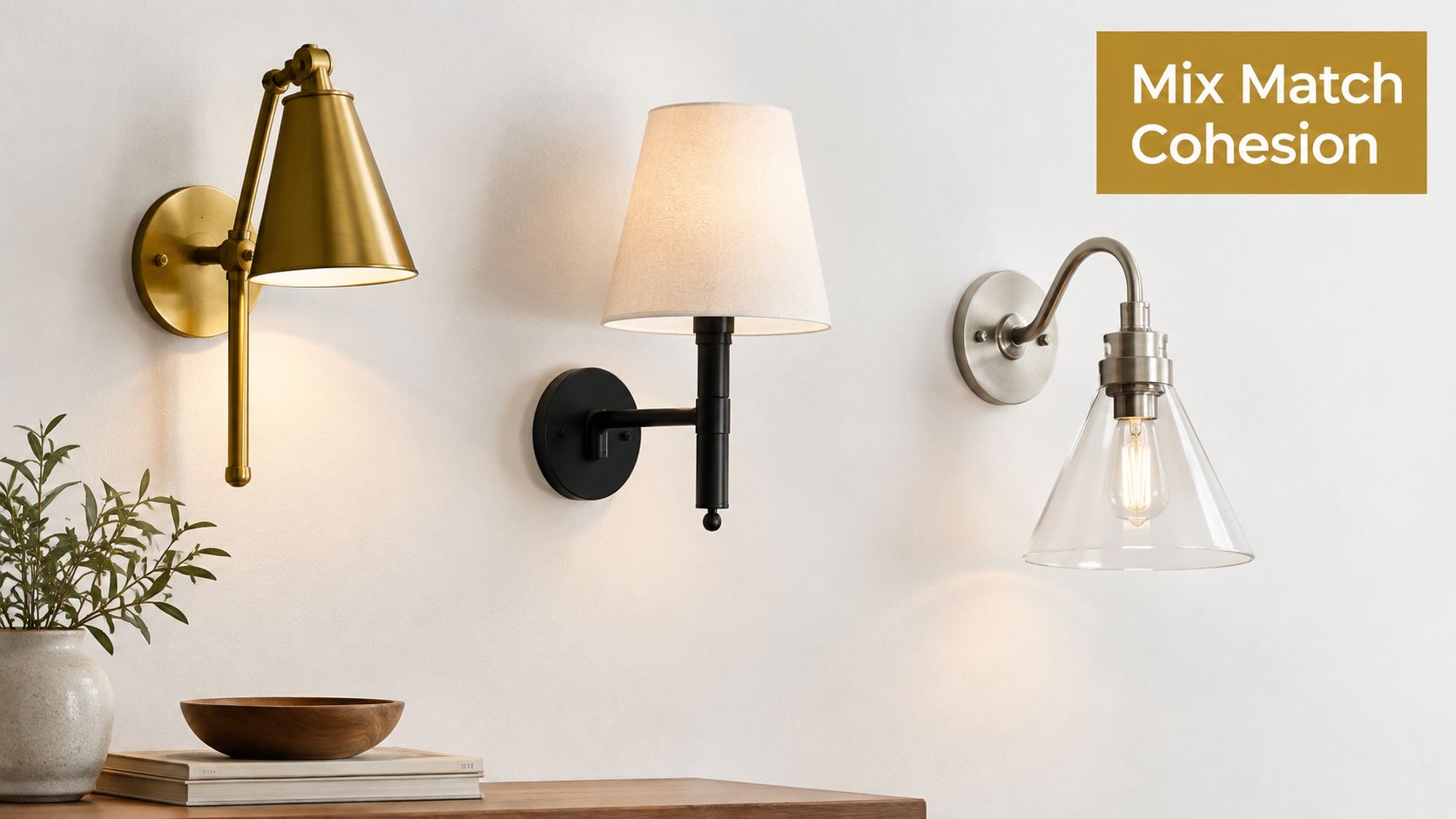
Build a palette before mixing fixtures
The cleanest approach is to choose one lead finish and one supporting finish. That keeps the home collected rather than matched.
A practical pattern looks like this:
- Aged Brass as the anchor. It warms kitchens, bedrooms, and living areas without feeling fragile.
- Matte Black as the structure. It sharpens mirrors, frames, and modern millwork.
- Glass as the bridge. Clear, opal, or textured glass helps connect fixtures across rooms without forcing the same silhouette.
A classic homeowner often wants a finish that stays easy to live with. A creative client usually wants permission to break symmetry or combine shade shapes. A professional specifying a more refined interior usually wants tighter detailing, stronger materials language, and cleaner transitions across the project.
Let one fixture speak louder than the rest
Not every sconce should be a statement. In fact, most rooms benefit when only one layer carries the most visual weight.
If the chandelier is sculptural, the wall lights should often become quieter. If the walls are simple and the furnishings are restrained, a more expressive sconce can carry the composition.
Recent trend coverage points to a split market between sculptural, asymmetric wall-jewelry forms and cleaner LED bars or flush profiles. The practical takeaway isn't trend-chasing. It's choosing whether the fixture should deliver visible personality, efficient utility, or both.
A few combinations that hold together well
The following pairings are dependable because they respect both style and function:
- Traditional room, modern edge: A Seaport 1-light Wall Sconce in Brushed Champagne Brass can sit comfortably with cleaner-lined pendants if the metal finish repeats elsewhere.
- Contemporary room, softer mood: An Ingalls 1-light Wall Sconce in Matte Black can add definition without crowding the wall.
- Creative mix-and-match spaces: YEP by Golden gives more freedom to vary shades, finishes, and glass across a home while keeping a shared language.
- Showroom or high-design projects: Ziva by Golden suits interiors where restraint, proportion, and detailing carry the luxury more than ornament does.
For anyone leaning toward glass, this guide to glass wall sconce styles and placement is a useful way to compare how transparency and diffusion shift the mood of a room.
Your Next Step to a Brighter More Layered Home
The strongest wall sconce design ideas aren't the ones that photograph best first. They're the ones that still feel comfortable after months of daily use.
That comes down to a short list of decisions that shouldn't be left to guesswork:
- Set height by eye line. The decorative body matters less than where the bright source lands.
- Choose shielding with intention. Frosted glass, shades, and baffles usually create better comfort.
- Match beam direction to the task. Reading, grooming, circulation, and mood don't want the same light behavior.
- Respect room context. A hallway, a vanity, a bedside wall, and a covered porch each ask for a different solution.
- Let style support performance. A beautiful sconce that glares isn't finished design.
What's seen across the factory floor and in real homes is straightforward. The rooms that age well are the ones where engineering, scale, and visual comfort were solved before the finish board took over.
For the next move, explore layered companions alongside your sconces. Browse Chandeliers, Pendants, and Outdoor lighting to build a whole-home plan that feels connected.
Ready to move from inspiration to a real layout? Shop the Collection, Download the 2026 Catalog, or Find a Showroom Near You.











Share:
Chandeliers for Foyer How to Choose Scale and Style