



Written by Rick Kovac, COO of Golden Lighting
The takeaway: A sculptural fixture earns its place in a room only when its scale, brightness, glare control, and mounting are solved as carefully as its silhouette — the object still has to work as a light.
Key takeaways:
- A sculptural fixture succeeds only when scale, brightness, glare control, mounting, and maintenance are all solved — presence alone isn't a lighting plan.
- Size it from the room first: add the room's length and width in feet for an approximate starting diameter in inches, then size up a step for an airy or open design.
- Match color temperature to the room's job — warm 2,700–3,000K for living and dining, stepping up toward 3,500K only where a task genuinely needs it.
- Golden's core line, YEP, and Ziva solve three different problems — speed and predictability, a custom fit, or a genuine showroom statement — not three tiers of the same thing.
A kitchen can have fresh paint, carefully chosen cabinets, and a generous island, yet still feel unfinished under a grid of flat recessed lights. A dining table can be perfectly proportioned but lack a focal point, while an entryway can read as a passage instead of an arrival. Sculptural light fixtures solve that problem only when they deliver both visual presence and useful illumination.
The right piece must earn its place through scale, light output, glare control, mounting, wiring, finish, and maintenance. A dramatic silhouette that leaves the table dim, exposes harsh LED sources, or overwhelms a low ceiling isn't a successful lighting decision. The strongest results come from treating the fixture as an engineered object that also happens to shape the room.
When the Room Needs More Than a Light
A homeowner often notices the problem after the renovation is already complete. The dining room has a new table and chairs, but the eye has nowhere to settle. The entry has attractive flooring and a console, yet it still feels narrow and anonymous. In the kitchen, recessed lights provide visibility, but the island lacks the visual weight that makes it feel intentional.
A sculptural pendant or chandelier can solve both issues. Its volume gives the room a focal point when switched off, while its distribution of light can support meals, conversation, or everyday tasks when switched on. Design coverage describes sculptural lighting as a way to bring color, texture, and expressive visual impact into an interior, with the fixture functioning as artwork in the right context — a framing Azure Magazine explores well.
That artistic role doesn't excuse weak performance. A fixture that looks striking in a showroom but creates glare across a dining table or leaves a kitchen work surface underlit has failed the practical test. The room needs a piece that provides presence without becoming an obstacle. We'd rather see a fixture sized a notch too big for a room than one that disappears into a ten-foot ceiling — visual timidity is the more common design mistake, not boldness.
The decisions that protect the result
Before ordering, the buyer should resolve:
- Scale: The fixture must relate to the room, table, island, ceiling, and surrounding sightlines.
- Brightness: Output must match the room's task rather than relying on decorative glow alone.
- Mounting: The ceiling box, suspension system, and available height must support the finished assembly.
- Finish: Metal, glass, stone, and textile choices influence the room's visual temperature.
- Care: Textured surfaces and integrated light sources require a maintenance plan.
A layered approach usually performs better than asking one object to do everything. Golden Lighting's guide to layered lighting room by room explains why ambient, task, and accent sources should work together. For supporting illumination at a console or bedside, a simple accent lamp can pick up the slack when the ceiling fixture is chosen mainly to set a mood rather than to carry the room's whole light load.
Pro-Tip: Choose the fixture from the most important viewing angle first. A piece seen from a foyer, stair, or open kitchen must look convincing from the side and below, not only in the product photograph.
What Makes a Light Fixture Sculptural
Price doesn't define sculptural lighting. A fixture becomes sculptural when its three-dimensional form, material expression, or assembly logic reads as an object before it reads as a utility product.
A recessed downlight directs attention toward a surface and largely disappears. A basic flush mount may add decoration around a light source, but its structure remains secondary. Sculptural light fixtures reverse that relationship. Their volume, rhythm, and construction remain visible, even when the light is off.
A working definition for browsing
Look for four qualities:
- Visible structure. Arms, ribs, rings, branches, panels, or layered elements create a composition that can be read from more than one angle.
- Expressive geometry. Organic curves, asymmetry, biomorphic shapes, folded planes, and irregular clusters give the fixture an individual silhouette.
- Material character. Cast glass, blown glass, metalwork, ceramic, stone, fiber, or mixed materials contribute texture and depth.
- Integrated light behavior. The source illuminates the room while also revealing the fixture's own edges, surfaces, and openings.
Pendants, chandeliers, and sconces are especially effective vessels because they project or hang into the room. Their placement gives the eye enough volume to read the piece as an object rather than as a ceiling accessory.
The broader decorative-lighting category backs that up. Grand View Research projects the global decorative lighting market to reach USD 49.4 billion by 2030, growing at roughly a 2.9% CAGR from 2025 to 2030 — a broad, established commercial category, not a narrow art-market niche.
The distinction matters during selection. A large traditional chandelier can be a statement piece because of its scale or ornament, while a smaller abstract pendant can be sculptural because of its composition. The buyer should ask, Does the form remain interesting from several angles, and does the light support that form comfortably?
Materials and Forms That Define the Look
Materials determine more than appearance. They affect weight, cleaning, heat management, finish stability, and the kind of silhouette a fixture can achieve.
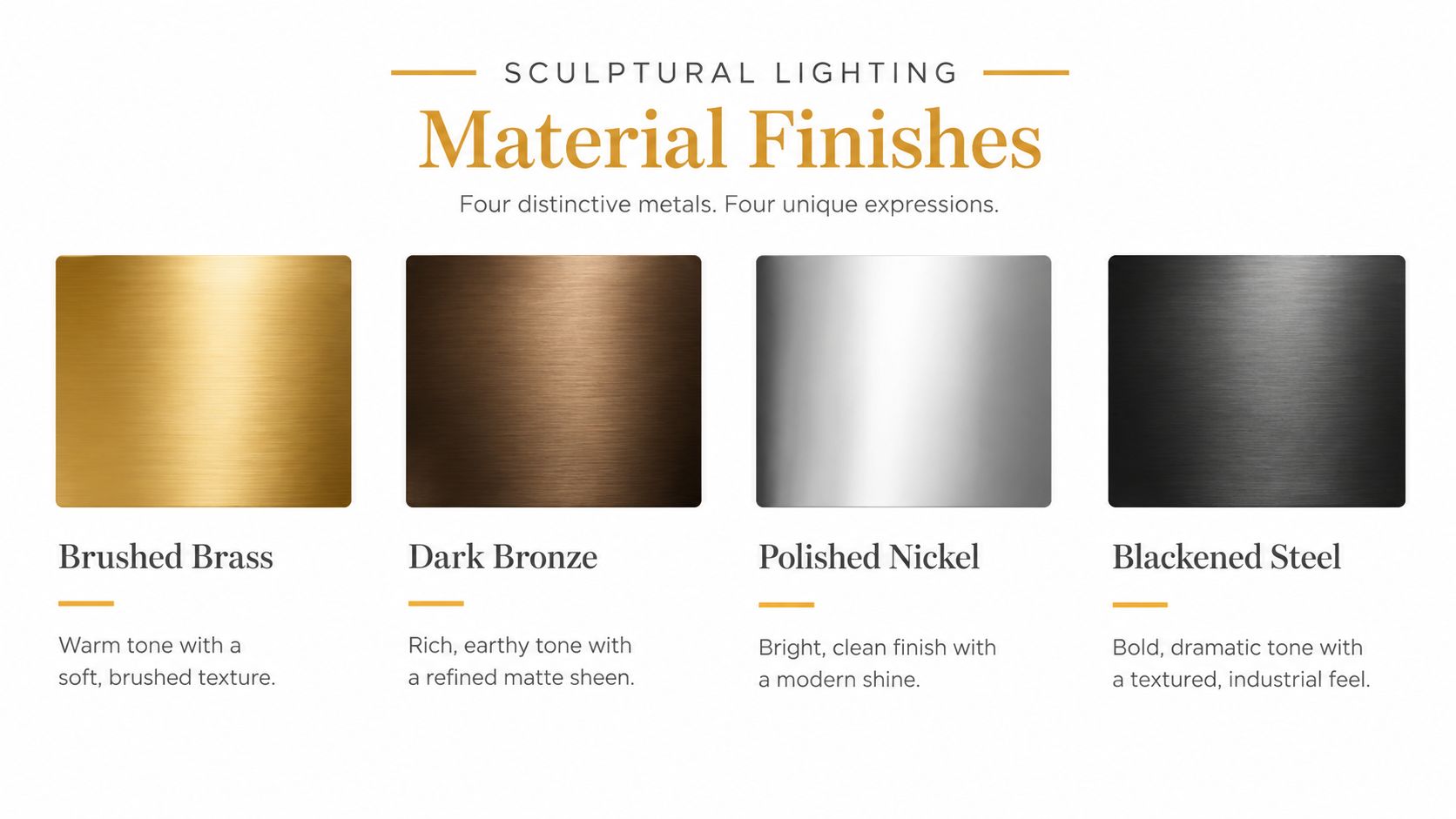
Brushed brass and other plated or treated metals suit ribbed, folded, ringed, and branched forms. Warm brass brings visual warmth before the lamp is switched on, while bronze and blackened steel create stronger contrast and tend to anchor pale rooms. Polished nickel reflects more light and feels cooler, cleaner, and more formal.
Match the material to the form
- Blown glass: Organic globes, bubbles, clusters, and softened asymmetrical shapes benefit from the way glass catches and transmits light. Smooth glass is relatively straightforward to wipe, but hand-worked or heavily textured surfaces demand more patience.
- Cast glass: Ribbed cylinders, waves, and thick panels create shadow and refraction. The texture can make dust more visible, so the fixture needs accessible surfaces.
- Alabaster and stone: Slabs and carved elements produce a quiet, diffused glow. Natural variation is part of the material, not a defect, but the additional weight makes mounting review important.
- Ceramic and porcelain: These materials support rounded, sculpted, or hand-formed elements. They can look grounded and substantial, though chipped edges are difficult to disguise.
- Woven fiber, rattan, wood, and cane: Airy globes, baskets, and open shades soften a room. They work well away from grease and steam, where dust and moisture can settle into the weave.
- Mixed media: Metal with glass, stone with brass, or textile with wood adds layered contrast. These assemblies often provide the richest visual result, but they also create more surfaces and connections to maintain.
From the COO's own build list: Golden's own COO wired the accent lighting around his koi pond by hand — stone uplighting, a backlit carved feature panel, low-profile deck lights — and the lesson traveled straight into showroom guidance: light the object first, then let the room borrow its glow. A backlit stone or alabaster panel indoors works on exactly the same principle.
In active kitchens, sealed or well-protected metal usually performs better than fabric. In a low-traffic entry, a delicate woven shade can be an appropriate choice if it remains easy to reach. For a project centered on glass, a focused hand-blown glass pendant lamp buying guide can help buyers evaluate shape, transparency, and visual weight before choosing a cluster or single pendant.
Finish coordination deserves the same attention as shape. Warm brass can reinforce wood, cream, terracotta, and warm white. Matte black gives a sharper outline and can connect to window frames or cabinet hardware. Mixing finishes is possible, but the room needs a clear hierarchy rather than a random collection of metal tones.
Sizing, Brightness, and Mounting Decisions
A sculptural fixture can be visually generous without being physically enormous. The first sizing check should use the room's length and width. For a ceiling-mounted chandelier or pendant in a general room, Golden Lighting's own Golden Scale Method adds those two dimensions in feet and uses the total as the approximate fixture diameter in inches, as a starting minimum. A 12-by-14-foot room suggests a fixture about 26 inches wide as a floor, not a ceiling — an especially airy or open design can comfortably size up a step from there.
That rule is a starting point, not a final specification. An irregular piece should be judged by its longest dimension, while a linear fixture should be compared with the island or table beneath it. Ceiling height, door swings, walk paths, and sightlines can justify a smaller or larger form.
Brightness and color need separate decisions
Decorative impact doesn't reveal whether a fixture produces enough usable light. Buyers should review the listed lumens, source type, distribution, and dimming information rather than judging output from the number of bulbs alone.
For color temperature, 2700K to 3000K generally supports warm residential living and dining environments, while up to about 3500K can make a task zone feel more alert and neutral — we'd caution against going meaningfully higher in a home, where anything past that band starts to read commercial rather than residential. Kitchen work surfaces may need additional dedicated lighting even when a sculptural pendant is specified above the island.
The light source also needs comfortable shielding. Golden Lighting's own glare standard targets a luminaire UGR of 19 or lower — the CIE 117 benchmark for discomfort glare — and a narrower beam divergence, a better cutoff angle, and darker anti-glare surfaces inside the fixture all help hit that number. That matters most in foyers and dining rooms, where the fixture often sits directly in the viewer's line of sight. Open frames with bare LED arrays can look harsh; diffusers, downlight shields, or indirect configurations usually produce a more controlled result.
Mounting and controls must be resolved early
- Rigid stems keep a piece stable and visually precise.
- Chain suspension supports a more traditional, adjustable character.
- Cable systems suit lighter, contemporary forms but require careful alignment.
- Integrated LED drivers need confirmed dimmer compatibility to prevent flicker, buzzing, or inconsistent range.
- Heavy assemblies require a verified junction box or structural support, not a visual assumption based on the canopy.
The Golden Lighting fixture sizing and placement reference offers a useful planning reference for these decisions. For complex pieces, the installer should confirm the canopy position, wire length, driver location, and final hang height before the fixture arrives.
Placing Sculptural Fixtures Room by Room
The same sculptural silhouette behaves differently over a work surface, a dining table, a stair, or an exterior seating area. Placement should follow the room's activity first, then its visual language.
| Room | Hang Height / Mounting | Sizing Rule | Lumen Range | Rating & Notes |
|---|---|---|---|---|
| Kitchen island | Hang about 30 to 36 inches above the countertop | Linear fixture or paired pieces at roughly two-thirds of island length | Use the product's listed output and supplement with dedicated task lighting | Keep the cooktop on separate task lighting; control glare over prep areas |
| Dining room | Hang about 30 to 36 inches above the table | Diameter around two-thirds of table width; offset asymmetric forms when needed | Choose comfortable ambient and table illumination, with dimming | Check sightlines across the table and shield exposed sources |
| Entryway or stair hall | Use a vertical suspension suited to the ceiling and stair volume | Relate the piece to stairwell width and visible void | Favor balanced ambient light without glare from below | Select a form readable from multiple levels; professional installation may be appropriate |
| Bath | Use a suitable ceiling or wall mount outside the tub splash zone | Keep scale subordinate to vanity and room clearances | Pair decorative light with strong vanity illumination | Choose a damp-rated fixture where required and follow local electrical rules |
| Covered outdoor room | Mount securely on taller ceilings with weather exposure in mind | Relate scale to the seating or architectural volume | Use the listed exterior-rated output | Require a wet-rated, corrosion-resistant fixture where exposure demands it |
Kitchen versus dining placement
A linear sculptural pendant often works better over a long island than a single compact cluster. Two coordinated pieces can distribute visual interest, but they should leave the cooktop and prep zones clear of shadows and glare.
Dining rooms allow more expressive central forms. A round chandelier can sit directly over the table, while an offset branch or asymmetric piece may need careful positioning so its visual center aligns with the table rather than the room's ceiling box.
Entries, baths, and exterior rooms
Vertical pieces suit stair halls because their composition can be read from the lower landing, upper landing, and side view. In a small entry, a compact semi-flush sculptural form often works better than a long drop that competes with the door swing or restricts circulation.
Baths require restraint. Decorative form should support, not replace, clear vanity lighting, and the fixture must be selected for the applicable moisture conditions. Covered outdoor rooms need fixtures designed for exterior exposure, with corrosion resistance and the correct wet or damp rating for the installation location — check the fixture's own listing before mounting anything over an uncovered seating area.
Matching Sculptural Pieces to Your Project
The right product path depends on the project's constraint. A homeowner replacing one fixture, a builder working against a schedule, and a designer developing a signature foyer don't need the same degree of customization.
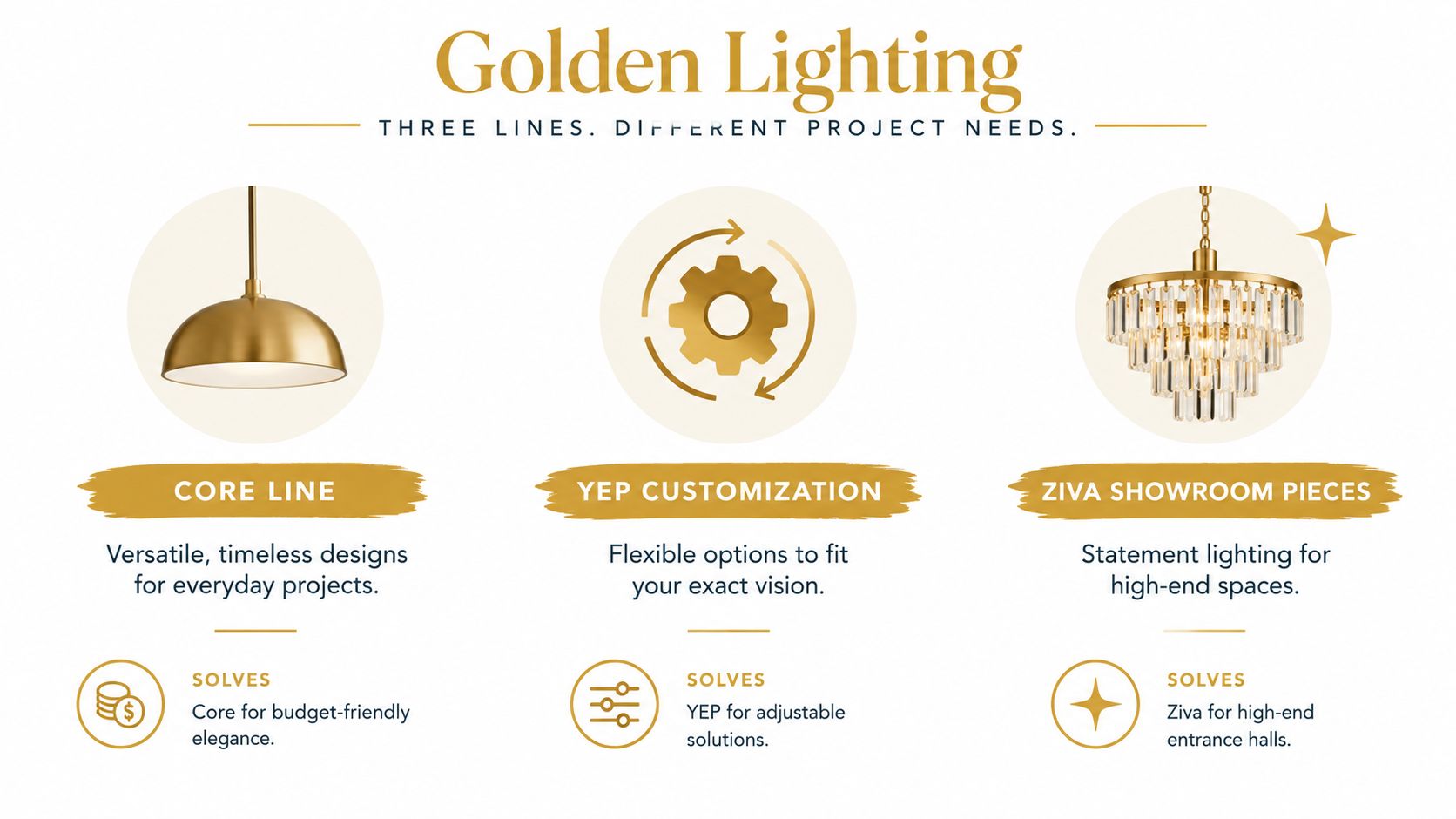
The core line suits projects that need a stocked sculptural form in a proven finish. It offers a practical route when the room's dimensions, junction-box position, and design direction are already settled, and when delivery certainty matters more than a one-off configuration.
YEP by Golden addresses the next level of specificity. It makes sense when a project needs a custom finish relationship with cabinet hardware, a different glass or shade combination, a non-standard ceiling height, or a silhouette that isn't available in a standard catalogue. The value isn't customization for its own sake. It is the ability to solve a real mismatch between the room and an off-the-shelf fixture.
Ziva belongs in projects where the light is deliberately treated as the room's focal object. Its showroom-oriented pieces are appropriate when the designer is evaluating refined materials, more dramatic forms, and the visual presence required for a grand entrance hall, hospitality setting, or bespoke interior.
Make the choice by project problem
- Need speed and predictability: Start with a stocked core fixture and verify dimensions, output, and finish before ordering.
- Need a solution: Use YEP when the ceiling, hardware, glass, shade, or mounting condition calls for adjustment.
- Need a signature installation: Consider Ziva when material quality and visual drama justify showroom review and a more deliberate specification process.
Creative buyers can also mix and match supporting pieces by repeating one material or curve rather than duplicating the hero fixture — the same principle that governs where a piece of sculpture earns its place in a room: relate it to the room's scale, viewing distance, and surrounding composition, rather than letting it compete for attention.
Before approving a custom or high-impact piece, the design team should request drawings, material samples, connection details, and a clear installation sequence. That evidence separates an appealing rendering from a fixture that can be fabricated and installed cleanly.
Keeping Sculptural Fixtures Beautiful Over Time
Maintenance starts with material identification. Blown glass, plated metal, alabaster, and woven fiber don't tolerate the same cleaning method, and a beautiful finish can be damaged by an overly aggressive shortcut.

Use a soft microfiber cloth on blown glass and a dry brush on woven or fiber shades. Mild soap can be used on appropriate metal parts, but the surface should be dried thoroughly. Clean the fixture only when it is switched off and cool, and never spray cleaner directly onto an integrated LED module, driver, socket, or connection.
Bulb-based and integrated LED pieces
For bulb-based fixtures, the replacement lamp must match the wattage and base type listed on the canopy label or product documentation. A lower-wattage LED isn't automatically a suitable substitute if the dimmer wasn't designed for that lamp, so compatibility should be confirmed before installation.
Integrated LED products require a different plan. These systems commonly carry an expected operating life of 25,000 to 50,000 hours, as stated in the supplied product guidance, but eventual driver or module service still needs to be considered. A fixture designed for serviceable components can remain useful longer than one that forces the owner to discard the complete assembly after a small electronic failure.
A maintenance rhythm that works
- Dust regularly: Keep the fixture off and cool, and use a soft tool that won't scratch or pull delicate parts.
- Inspect annually: Check canopy hardware, suspension points, and visible set screws.
- Protect tensioned glass: Retighten hardware carefully when required, without over-compressing the glass.
- Watch for moisture and grease: Kitchens, baths, and exterior areas need more frequent inspection than dry living spaces.
- Keep records: Save the product instructions, lamp specifications, driver information, and dimmer details.
Textured and asymmetrical fixtures reward regular light care. Waiting until buildup becomes obvious often makes cleaning harder and increases the chance of disturbing a small component or finish.
Your Sculptural Lighting Checklist and Next Step
A sculptural fixture should be ordered only after four practical decisions are settled. The design may be expressive, but the purchase still depends on measurements, light quality, mounting, and controls.
Confirm the room and the scale
Add the room's length and width in feet, then use that total as an approximate fixture diameter in inches for a general ceiling-mounted piece. For a dining or kitchen installation, check the relationship to the table or island and preserve about 30 to 36 inches above a countertop or 30 to 36 inches above a dining table, following the placement guidance used earlier.
Confirm usable light
Review the listed lumen output, distribution, source type, and dimming range. Warm 2700K to 3000K light generally suits living and dining rooms, while kitchens may need stronger task illumination and a separate work-lighting layer. Where accurate color matters, a product specification calling for CRI 90 or higher should be verified directly in the documentation rather than assumed.
Confirm the physical installation
Choose flush, semi-flush, or pendant mounting according to ceiling height and clearance. Verify the junction box or structural support can carry the finished fixture, especially when the design includes stone, thick glass, multiple arms, or a large canopy.
Confirm controls before delivery
A dimmer that works with one lamp may not work with another. Check integrated LED driver compatibility, bulb type, control method, and wiring requirements at the specification stage.
Once those decisions are documented, the buyer can select a stocked sculptural option from the Golden Lighting collection, request a YEP configuration for project-specific dimensions or finishes, or visit a Ziva showroom partner to assess scale and material quality in person. A showroom review is especially valuable for a tall foyer or a complex piece that will be seen from several levels.
The practical next step is to measure the room, table or island, ceiling height, and junction-box position, then compare those details with Golden Lighting's chandeliers and pendants collections. Select a fixture only after confirming its output, mounting requirements, finish, and dimmer compatibility, and contact a qualified installer before ordering any heavy or structurally complex assembly.
Find the right sculptural light fixture for the room today by measuring the space first, reviewing the product specifications, and exploring Golden Lighting's core, YEP, and Ziva options through the collection pages or a local showroom partner.
— seen a lot of light fixtures in 80+ countries. Still learning what actually works in a home.












Share:
How to Size a Light Fixture to the Furniture Underneath It
Sizing the Rug Under Your Dining Table When There's a Chandelier Above It