


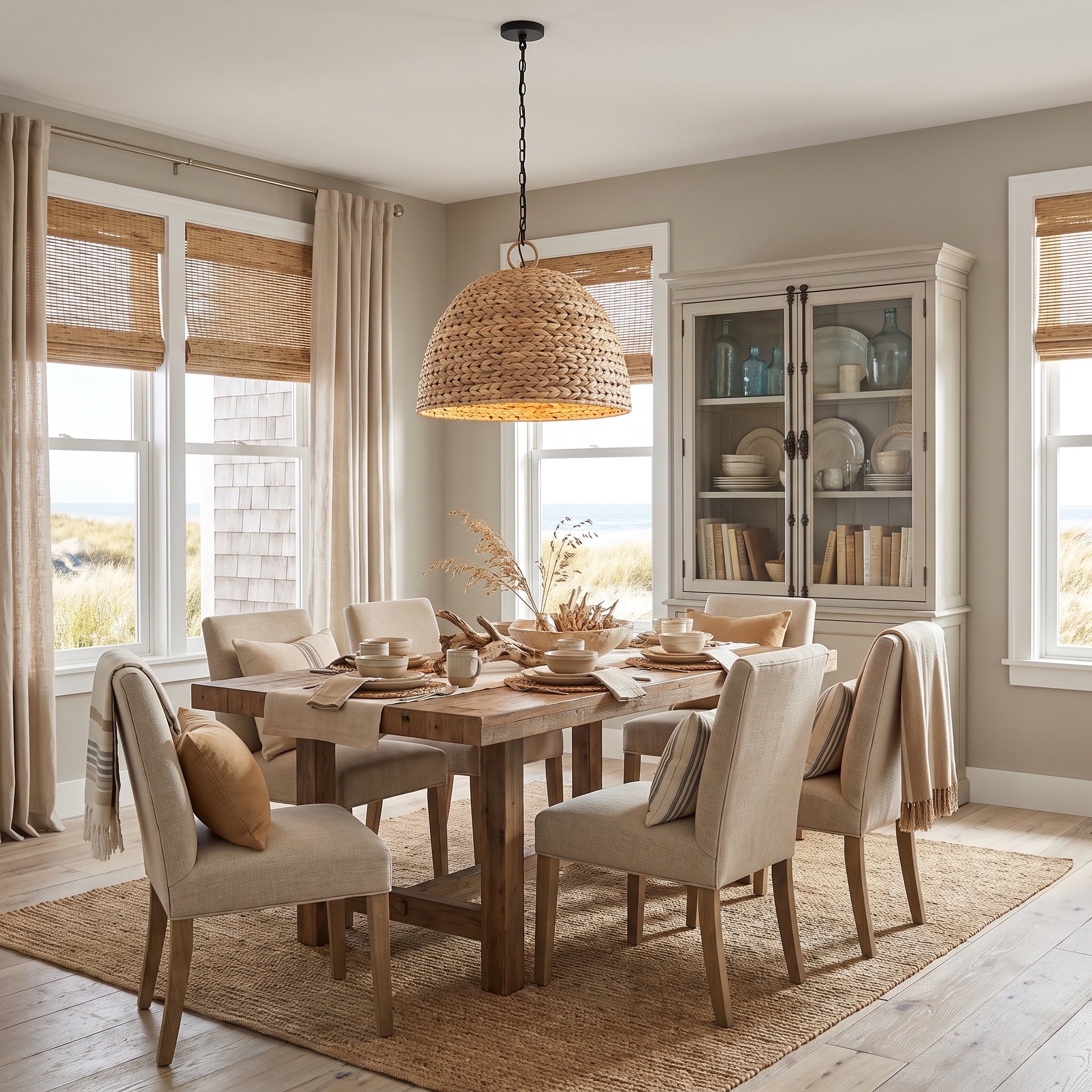
Every beautifully lit room you've ever admired is running at least three lighting systems at once. The IES residential lighting standard (ANSI/IES RP-11-26) treats layering as the foundation of good lighting: ambient light to fill the room, task light where work happens, and the decorative fixture as the jewelry that makes the room yours. A single fixture rarely carries a large room on its own — layering is what makes it work.
Here's the layered playbook, room by room.
Kitchen
The showpiece — pendants or a chandelier over the island — is the decorative layer, not the whole system. Undercabinet lighting carries counter tasks; ceiling fixtures or recessed cans supply ambient fill. Wall sconces can supplement a kitchen's lighting, playing a supporting role.
Dining room
The chandelier owns the table; a soft ambient layer (and a dimmer) owns the mood. Keep open, direct fixtures off the seats' sightlines and let the table glow brighter than the room around it.
Hallways
A pass-through space needs modest light — and the standard's advice is to light the walls, not the floor. Hallways are galleries in waiting: wall washers and picture lights make art of them, while a flush mount or small pendant adds the decorative note.
Stairs
Stair lighting is safety lighting: the point is to make every change of elevation unmistakable. Illuminate treads and landings, add light at the top and bottom of the run, and keep fixtures clear of the walking path. Code requires switches at each floor level on stairways of six or more risers — and a pendant in a tall stairwell should hang well above head height, with a shielded bottom that stays comfortable for people climbing toward it.
Home office
Light the wall behind your screen — it's counterintuitive and it works, cutting the contrast between a bright monitor and a dark background that tires eyes on long days. Put the desk perpendicular to the window for light from the side — the most comfortable angle for screens and video calls — then pair a diffuse ceiling fixture with a glare-controlled desk lamp. Bonus: soft, even light on your face is exactly what video calls want.
Bedroom
The bedroom juggles four jobs — sleep, reading, dressing, and 2 a.m. navigation — and each wants its own layer. Bedside reading calls for adjustable, well-shielded fixtures with the dimmer within arm's reach of the bed. Dressing needs ambient light with color quality good enough to tell black from navy. And a mirror check wants broad, soft light rather than a hard directional beam.
Outdoors
Every exterior light should have a job: path lights along walkways, accents on the tree worth seeing, downlights from the eaves for coverage. Aim light only where it's needed, keep it glare-controlled and dimmable, and let darkness stay part of the composition — the goal is a home that feels like a calm, private retreat after dark. Match every fixture's location rating to its exposure: damp-rated under covered porches, wet-rated where weather reaches.
The two rules under everything
Your surfaces are part of the system. Light ceilings (the standard suggests high-reflectance white) and light-to-medium walls multiply every lumen you buy; dark rooms are gorgeous but hungrier for light.
Comfort lives in gentle contrast. The brightest spot in view and its surroundings should differ by degrees, not orders of magnitude — no blown-out hot spots, no black corners. That single principle, applied with three layers of light, is most of what "professionally lit" means.
(Installing something substantial? Fixtures over 50 pounds need independent support or a ceiling box listed for the weight — check the fixture weight on every Golden Lighting product page.)
Framework and room guidance from ANSI/IES/ALA RP-11-26, the recommended practice for residential lighting; electrical requirements from the National Electrical Code (NFPA 70).
Share:
The Best Lighting for Makeup: Color Temperature, CRI, and Brightness Explained
What Size Chandelier Do I Need? The Sizing Rules Designers Actually Use