



Written by Rick Kovac, COO of Golden Lighting
The takeaway: A chandelier with Edison bulbs works when the bulb is treated as a deliberate design detail with its own sizing, dimming, and safety rules — not as a decorative afterthought bolted onto any open frame.
Key takeaways:
- Size the fixture first using room dimensions, then choose finish, then choose bulb output — in that order.
- Exposed filament is only a design asset in small, dimmed doses; large or high-output bare bulbs read as glare, not glow.
- LED filament bulbs keep the vintage look with far less heat, but a standard fixed-color LED won't shift warmer as it dims the way real incandescent does — check the bulb's own listing before promising a "candlelight" effect.
- Every socket has a maximum wattage rating and every room has a real clearance minimum — treat both as non-negotiable, not as fine print.
A dining room can have beautiful furniture and still feel flat after sunset. An entryway can look spacious by day, then seem cramped once the light disappears. In both cases, the problem often isn't the décor. It's the distribution, warmth, and scale of the ceiling fixture.
A chandelier with Edison bulbs can solve that problem by adding a visible glow and a strong architectural shape. The fixture becomes part of the room's composition, while the bulbs create atmosphere around the table, island, or foyer.
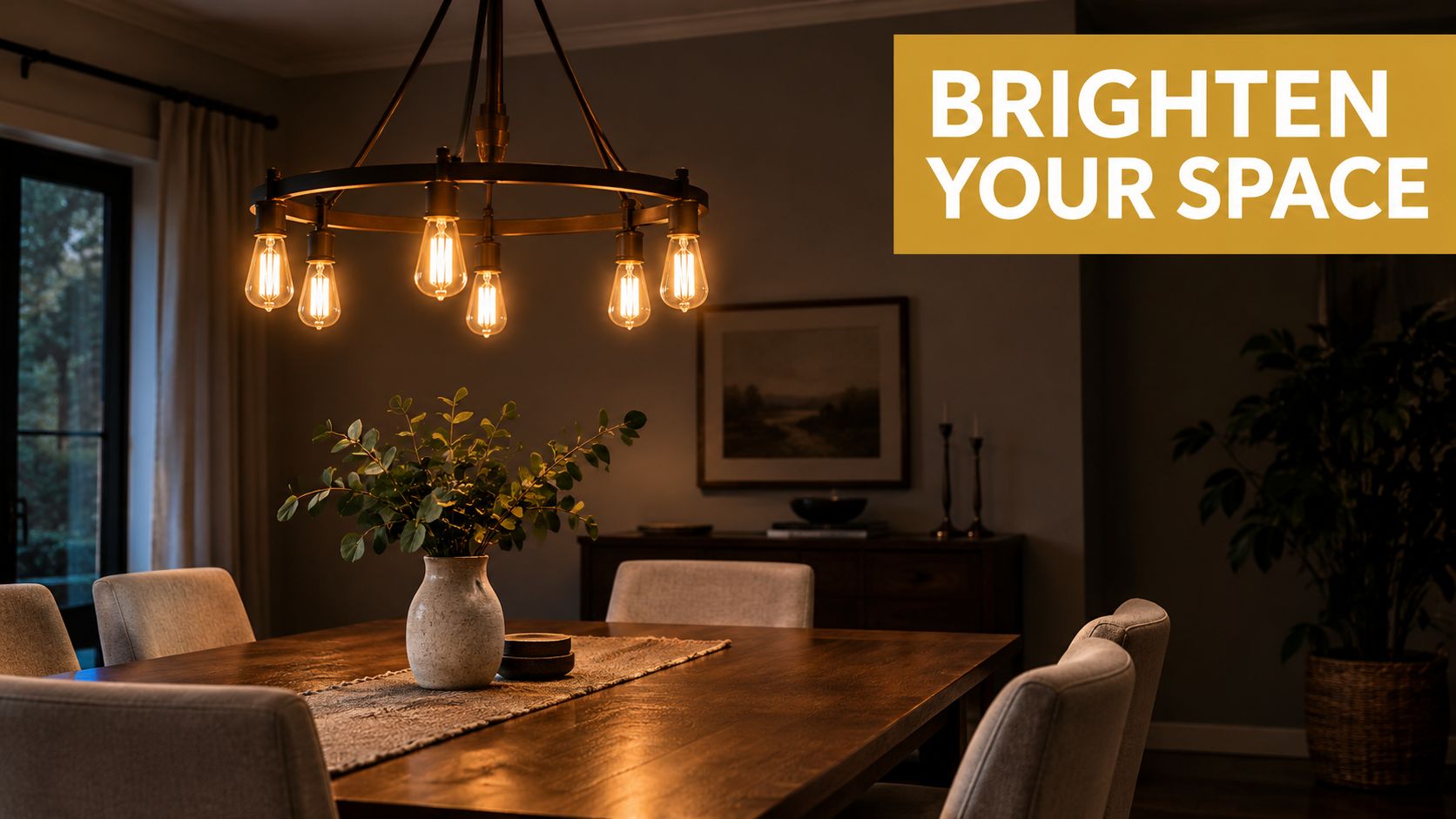
This guide helps homeowners choose a fixture that feels intentional rather than dated. It covers the Edison look, LED performance, sizing, dimming, safety, placement, and ways to personalize the result through finish and shade choices.
When Your Room Feels Dark Despite the Decor
A dining table often reveals poor lighting first. The chairs may be comfortable, the wood may have a beautiful grain, and the artwork may be carefully placed, yet the room doesn't invite people to sit down. A single ceiling fixture with weak output can leave the center dim while nearby walls remain visually disconnected.
The right chandelier changes more than brightness. A circular black frame can define the table below it, while multiple exposed bulbs distribute points of light across the room. Warm filament shapes add visual texture, so the fixture still has presence when the bulbs are dimmed for dinner.
The fixture should solve a room problem
A chandelier with Edison bulbs works particularly well when the room needs one or more of these improvements:
- A stronger focal point: The open frame gives the eye a clear center.
- Warmer evening light: Warm-white lamps soften hard architectural finishes.
- More visual connection: Repeated bulbs can echo cabinet hardware, dining chairs, or nearby metal accents.
- A flexible mood: Dimming lets the same fixture support conversation, meals, and cleanup.
The important distinction is between ambient character and task lighting. Exposed filament lamps can create a welcoming pool of light, but a kitchen work surface or reading area may still need recessed lighting, sconces, or under-cabinet sources.
Professional perspective: A chandelier should carry the room visually, but it shouldn't be asked to perform every lighting job alone.
Golden Lighting approaches this decision from the fixture down. The frame, socket arrangement, finish, and bulb visibility all affect the result. A homeowner choosing a dining fixture should first decide whether the room needs a bold centerpiece, a softer layer, or both.
What a Chandelier with Edison Bulbs Really Is
An Edison bulb is recognized by its vintage-inspired shape and visible filament. The original historical reference reaches back to October 1879, when Thomas Edison's team produced a carbonized-filament bulb that burned for about 14.5 hours — a milestone documented by the U.S. Department of Energy's history of the light bulb. The commercial follow-through came on September 4, 1882, when Edison's Pearl Street Station in Lower Manhattan began supplying electricity to an initial 82 customers, per the historical record documented by the Engineering and Technology History Wiki.
That history explains why the form still feels familiar. The chandelier doesn't use a decorative bulb. It borrows a lamp shape associated with the transition from gaslight and experimental electric lighting to practical home illumination.
The visible filament is part of the design
Traditional incandescent Edison bulbs heat a wire until it glows. Modern LED filament bulbs recreate the appearance with LED components arranged inside a clear glass envelope. The result preserves the glowing-line effect while using a more efficient light source.
For chandelier applications, the useful target is generally warm white, around 2200K to 3000K, depending on the desired mood. A lower Kelvin value appears warmer and more amber, while a higher value looks cleaner and less candlelike. Kelvins describe the light's visual tone, not its brightness.
Lumens describe brightness. Wattage describes energy use, so wattage alone isn't a reliable way to compare modern bulbs. A typical LED Edison B11 chandelier bulb runs in the neighborhood of 800 lumens at under 9 watts, with a warm 3000K color temperature and 90+ CRI — Golden Lighting's own bulb styling guide can help match shape, base, brightness, and fixture style before purchase.
Honest aside: A fixed-color-temperature LED filament bulb does not warm up the way a real incandescent does when you dim it — it just gets dimmer at the same color. If a listing promises a "candlelight glow" at low settings, that claim only holds for a bulb specifically built and labeled as warm-dim or dim-to-warm. Otherwise you're paying for a look the bulb can't actually deliver at the switch.
Why LED filament is usually the practical choice
Incandescent bulbs still have a place when the goal is low-level mood lighting. They produce more heat and generally deliver less useful brightness than an LED alternative at a comparable visual style.
LED filament lamps reduce the heat load and operating demand while keeping the exposed-bulb character. For most homes, the strongest combination is a dimmable LED filament bulb, a warm color temperature, and enough total lumens for the room's function.
Pros and Cons You Should Weigh Before You Buy
The Edison look succeeds when the bulb is treated as part of the fixture's composition. It becomes less successful when every light source in the room exposes the same filament, especially if the room already includes several industrial details.
The decorative lighting category is a large and growing one. One Grand View Research market forecast projects the global decorative lighting market will reach USD 49.42 billion by 2030, growing at a 2.9% CAGR. That's a broad, growing category rather than a narrow décor fad — though the segment-level and current-year numbers you'll see quoted elsewhere vary widely enough between forecasters that we're not repeating them here as settled fact.
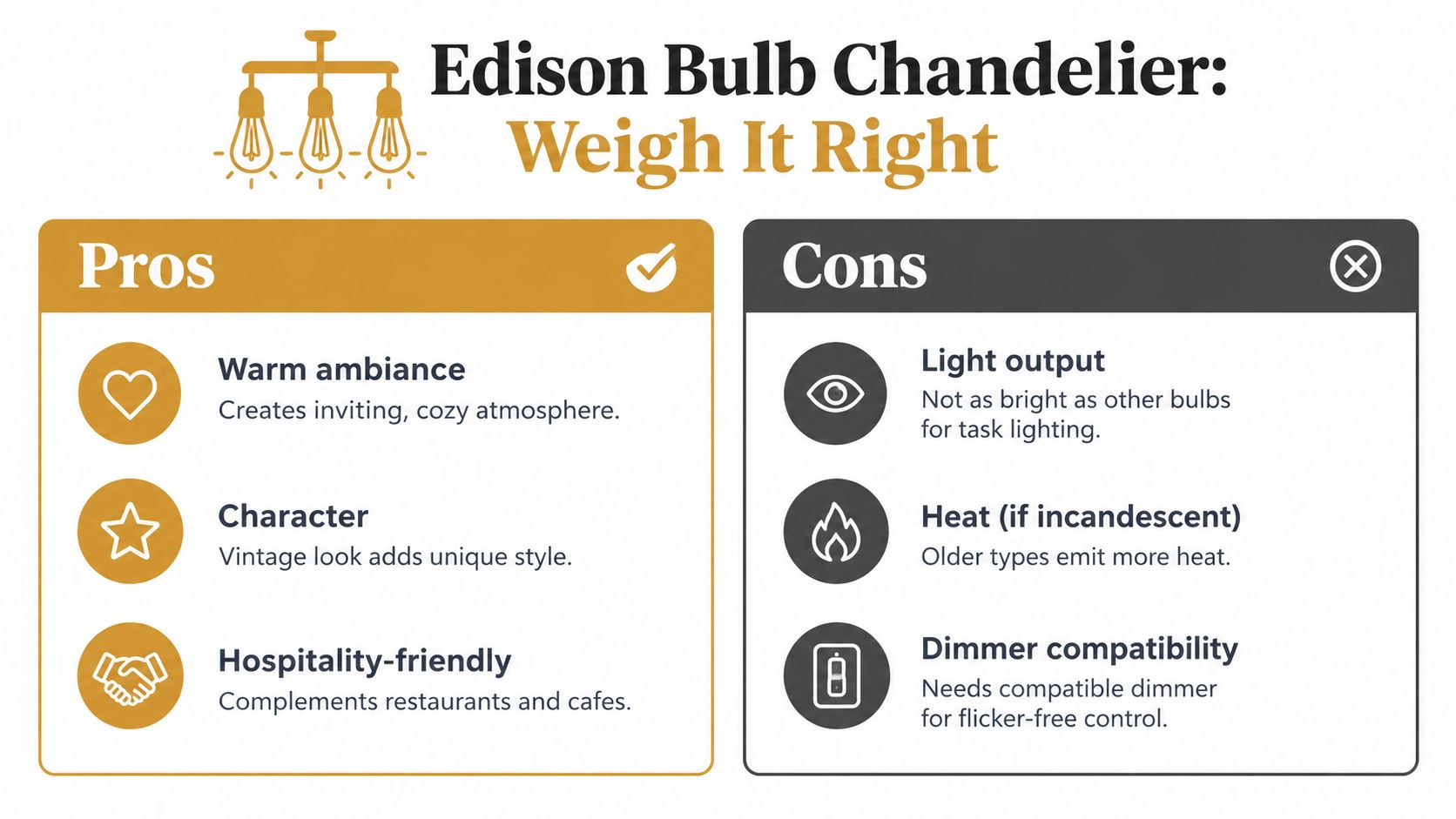
A clear trade-off for each room
| Strength | Limitation |
|---|---|
| Warm ambiance creates an inviting evening atmosphere. | Open filaments can create glare at the wrong viewing angle. |
| Visible character adds a vintage or industrial accent. | Lower-output incandescent bulbs may not support detailed tasks. |
| Hospitality appeal suits restaurants, cafés, and relaxed dining spaces. | Dimmer compatibility matters for smooth, flicker-free control. |
| LED filament options preserve the look with lower heat. | Overuse can feel cliché rather than considered. |
Golden Lighting's own design standard draws a hard line here that's worth stating plainly: a room should show at least one clearly lit vertical surface — a washed wall, lit art, a backsplash — and no bare bulb should sit exposed at eye level as the room's main light source. The one deliberate exception is small-scale, dimmed exposed filament or crystal, which reads as sparkle rather than glare. That's the real difference between an Edison chandelier that feels curated and one that just feels unfinished: scale and dimming, not the bulb style itself.
When the look stays current
The fixture feels fresh when the room gives it contrast. Pair an open cage with restrained upholstery, smooth stone, quiet cabinetry, or a refined metal finish. Add shaded sconces or concealed lighting so the Edison bulbs don't carry the entire visual and functional burden.
A rustic-industrial dining room can embrace more exposed glass. A polished foyer may benefit from a restrained frame with fewer visual details. For a professional or showroom-forward interior, Ziva by Golden offers a more refined direction than a purely utilitarian open cage.
How to Choose the Right Size Finish and Bulb for Your Space
Selection becomes easier when the decisions happen in the right order. Choose scale first, finish second, and bulb performance third. A beautiful finish can't rescue a fixture that's too small, too low, or too dim.
Start with the room and fixture dimensions
Golden Lighting sizes chandeliers with the Golden Scale Method: add the room's length and width in feet, and the sum becomes the approximate chandelier diameter in inches, as a starting point rather than a hard ceiling.
For example, a room measuring 10 feet by 12 feet points toward a fixture around 22 inches in diameter. Ceiling height also affects fixture proportion. Golden Lighting's own sizing standard calls for roughly 2.5 to 3 inches of fixture body per foot of ceiling height.
| Room size example | Suggested fixture diameter | Target total lumens | Example bulb mix |
|---|---|---|---|
| 10 by 12 feet | 22 inches | 1,800 to 2,400 lumens | Six bulbs at 300 to 400 lumens |
| 12 by 14 feet | 26 inches | 2,400 to 3,000 lumens | Six to eight bulbs at 400 lumens |
| 14 by 16 feet | 30 inches | 3,000 to 3,600 lumens | Eight bulbs at 400 to 450 lumens |
The table's lumen ranges keep a dining-room chandelier in a useful 1,800 to 3,600 lumen total ambient range — enough to be functional without making open filaments uncomfortably bright. A six-light chandelier using 400-lumen lamps produces about 2,400 lumens, which sits near the middle of that range.
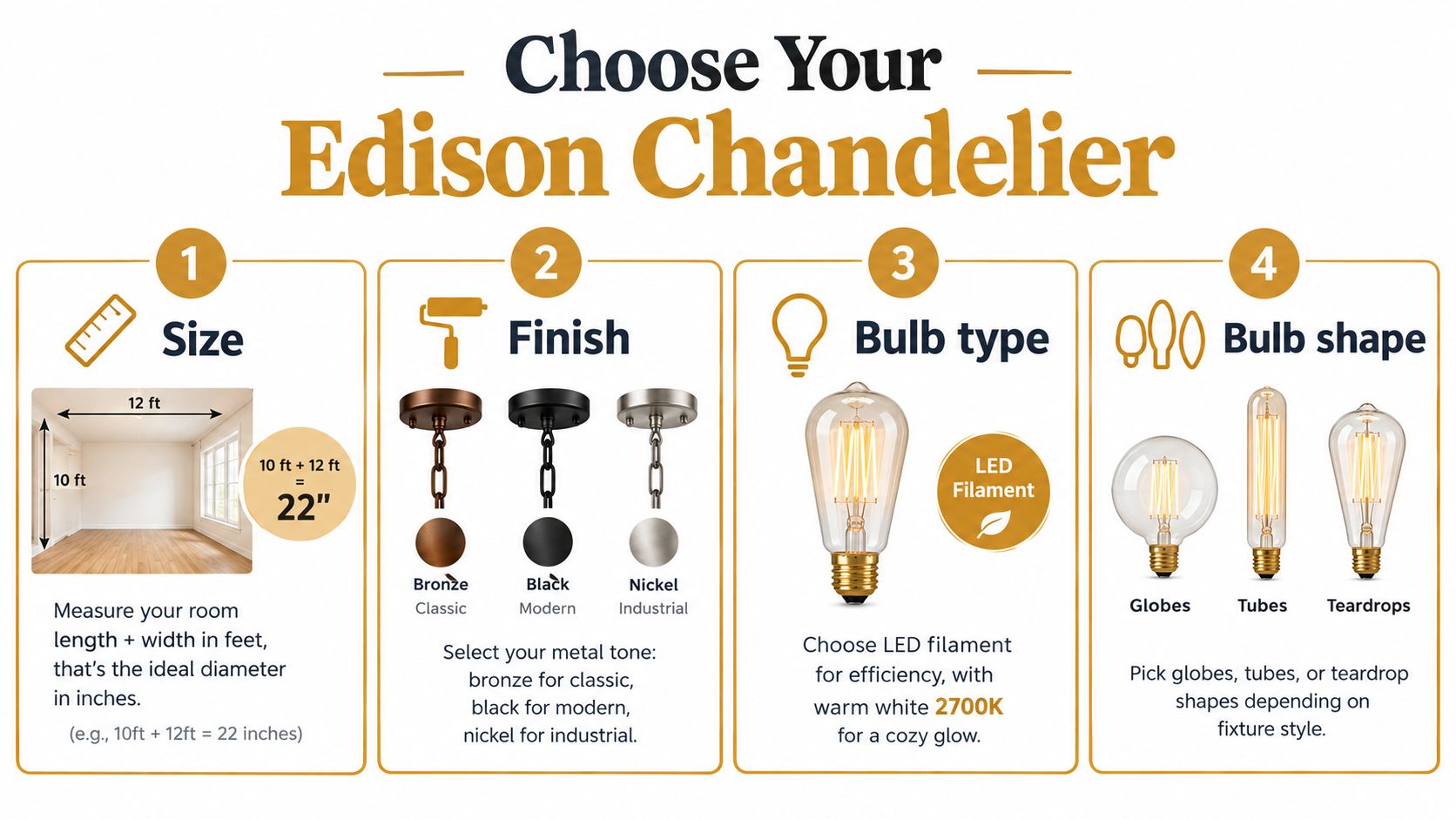
Finish and bulb shape set the personality
Black creates crisp contrast and a contemporary outline. Bronze supports a more traditional or rustic room. Nickel leans industrial and works well with cooler metal details.
For modern brass kitchen lighting, a brass chandelier can connect with cabinet pulls without forcing every nearby fixture to match exactly. YEP by Golden suits creative homeowners who want to mix and match shades, finishes, and glass rather than accept one fixed combination. Ziva by Golden is a logical consideration when the setting calls for a more refined, showroom-oriented specification.
Bulb shape should reinforce the frame. Tubes emphasize vertical cages, globes soften geometric arms, and teardrops add a more historical profile. The bulb should look selected, not randomly substituted.
Choose lumens before wattage
A useful LED Edison bulb may offer around 800 lumens at under 9 watts, but a decorative chandelier often uses lower-output lamps to control glare. Warm-white options around 2200K to 2700K usually create the coziest residential effect, while 3000K can provide a cleaner warm-white appearance.
Pro-Tip: In an open-cage chandelier, use the lowest bulb brightness that supports the room's purpose, then add a separate task layer. This protects the eye from glare and keeps the filament visible as a design feature.
Golden Lighting's bulb styling guide can help match bulb shape, base, brightness, and fixture style before purchase.
Wiring Dimming and Safety Basics Made Simple
A chandelier can look simple while still requiring careful compatibility checks. The socket rating, bulb type, dimmer, junction box, and installation method all affect safe operation.
Start with the label on the fixture. Every socket has a maximum wattage rating, and the total lamp choice must stay within the fixture's instructions. U.S. consumer safety guidance warns that decorative lighting can create shock or fire hazards when basic protections are missing, so buyers should review CPSC guidance for seasonal and decorative lighting products.
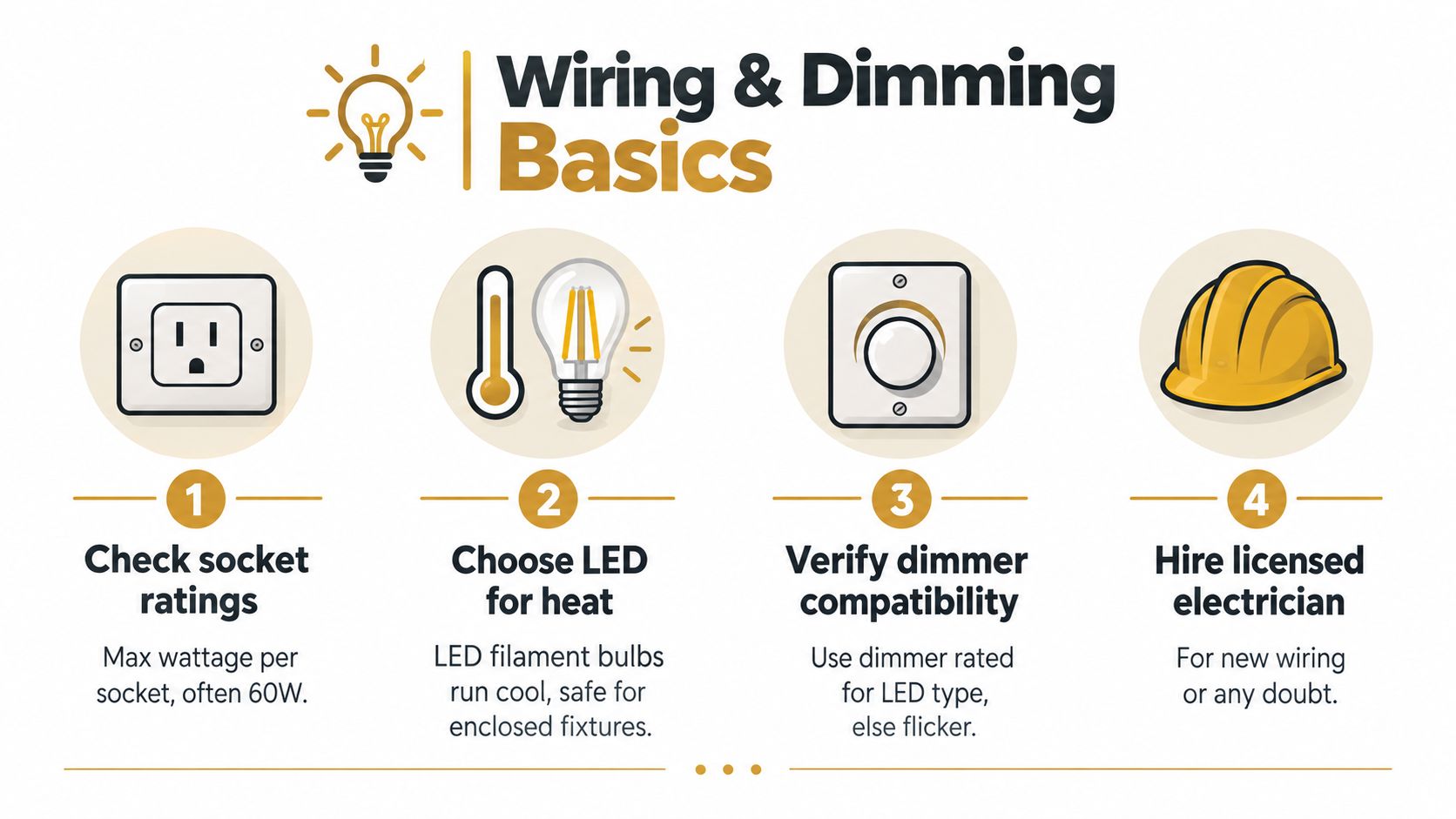
Check the parts before installation
- Read socket ratings: Stay below the maximum wattage listed for each socket and use the specified base type.
- Prefer LED filament for lower heat: LED sources preserve the vintage appearance while reducing heat compared with incandescent lamps.
- Confirm dimmer compatibility: An LED bulb and a dimmer must work together. An incompatible pairing can cause flicker, buzzing, or a restricted dimming range.
- Call a licensed electrician: New wiring, uncertain grounding, ceiling reinforcement, or unfamiliar connections should not become a casual DIY project.
A dimmer isn't a decorative extra — Golden Lighting recommends one on any dining, bedroom, or living-space fixture where mood flexibility matters. It gives an exposed-bulb chandelier a wider range of use, from brighter family meals to softer evening gatherings. The LED dimmer guidance from Golden Lighting provides a useful compatibility reference.
Future-proof the replacement plan
Interchangeable-bulb fixtures offer a practical advantage because homeowners can replace lamps as products change. For that reason, buyers should keep the fixture instructions, record the bulb base and color temperature, and choose readily replaceable dimmable LED lamps. A compatible replacement strategy protects the vintage look without locking the household into a hard-to-source lamp.
Safety first: A licensed electrician should handle any installation that involves new wiring, uncertain support, or questions about the existing circuit.
Styling and Placement Ideas for Every Room
A chandelier with Edison bulbs looks current when the room controls the visual story. The fixture can be rustic in one setting, refined in another, or nearly sculptural when the frame is open and the surrounding finishes are quiet.
Dining room
Center the chandelier over the table, not necessarily in the geometric center of the room. A long rectangular table may need a linear fixture, while a round table often benefits from a circular frame. Golden Lighting's own sizing standard keeps the fixture bottom 30 to 36 inches above the table surface — close enough to anchor the table, high enough to stay out of sightlines.
Use dimming to shift from meal preparation to dinner. Pair the exposed bulbs with wall sconces or nearby lamps that provide softer secondary light.
Kitchen island
Over an island, the chandelier must support both appearance and visibility. A black open cage can complement white cabinetry, natural wood, or stone, but the exposed lamps shouldn't sit directly in the sightline of someone working at the counter.
For a clean contemporary example, the Wesson 4-light chandelier in Black uses exposed E26 medium-base bulbs (60W max per socket) inside square tubing and geometric cages. Its generous frame suits larger open spaces, while its height works comfortably with 8 to 9 foot ceilings, per Golden Lighting's own product listing.
Entryway and foyer
A foyer can accept a more formal chandelier because the fixture often serves as the first visual statement. Choose a shape that leaves enough clearance for movement and sightlines — Golden Lighting treats 7 feet of clearance from floor to fixture bottom as a hard minimum in any walking area, with 7.5 feet preferred where the ceiling allows it, especially where the entrance is narrow.
A restrained Edison profile can soften a modern foyer without making the space feel themed. Keep nearby hardware coordinated through one repeated finish or shape rather than matching every metal exactly.
Bedroom and covered patio
A bedroom benefits from a smaller, quieter expression. A warm filament glow can support relaxation, but bedside sconces or lamps should handle reading.
A covered patio can use a fixture only when the product is specifically rated for the location. Interior decorative fixtures shouldn't be moved outdoors because their style suits the space — check the damp or wet rating on the product's own listing, not a rule of thumb.
Golden Lighting's guide to chandeliers in different shapes and sizes offers additional ways to compare silhouettes before choosing a room-specific form.
Keep It Glowing With Easy Care and Your Next Step
A chandelier keeps its appeal when the owner treats the bulbs, finish, and controls as one system. Dust on clear glass can mute the filament effect, while residue on a metal frame can make a carefully selected finish appear dull.
Turn the fixture off and let the lamps cool before cleaning. Use a soft, dry cloth for regular dusting, and follow the manufacturer's instructions for glass, plated finishes, and any removable components. Avoid spraying cleaner directly onto sockets or electrical connections.
Preserve performance over time
Check the dimmer if the bulbs begin to flicker, buzz, or respond unevenly. The cause may be a compatibility issue rather than a failing chandelier. Replacing all lamps with a consistent dimmable LED filament type can also create a more uniform glow.
Keep a record of the bulb details. Note the base, shape, brightness, color temperature, and dimmer compatibility so future replacements maintain the original appearance. This is especially useful for fixtures with several exposed lamps, where mismatched color can become immediately visible.
Designer secret: The most lasting Edison look comes from restraint. Let the chandelier provide warmth and identity, then allow other fixtures to handle task lighting.
Quality engineering matters because the fixture must support the intended bulbs, distribute light evenly, and remain compatible with normal maintenance. Golden Lighting offers dedicated collections for Chandeliers, Pendants, and Outdoor lighting, allowing a homeowner to coordinate a broader lighting plan.
The next step is practical. Measure the room, calculate the approximate diameter, choose a dimmable LED filament bulb, and compare finishes against the existing hardware. Then shop the chandelier collection or visit a showroom to see the frame, bulb visibility, and glow in person.
Choose the Golden Lighting chandelier that fits the room's scale, specify compatible LED filament bulbs, and use dimming to keep the vintage character warm rather than overpowering.
— seen a lot of light fixtures in 80+ countries. Still learning what actually works in a home.












Share:
Sizing the Rug Under Your Dining Table When There's a Chandelier Above It
How Tall Should Your Lamp Be? Sizing It to the Furniture