


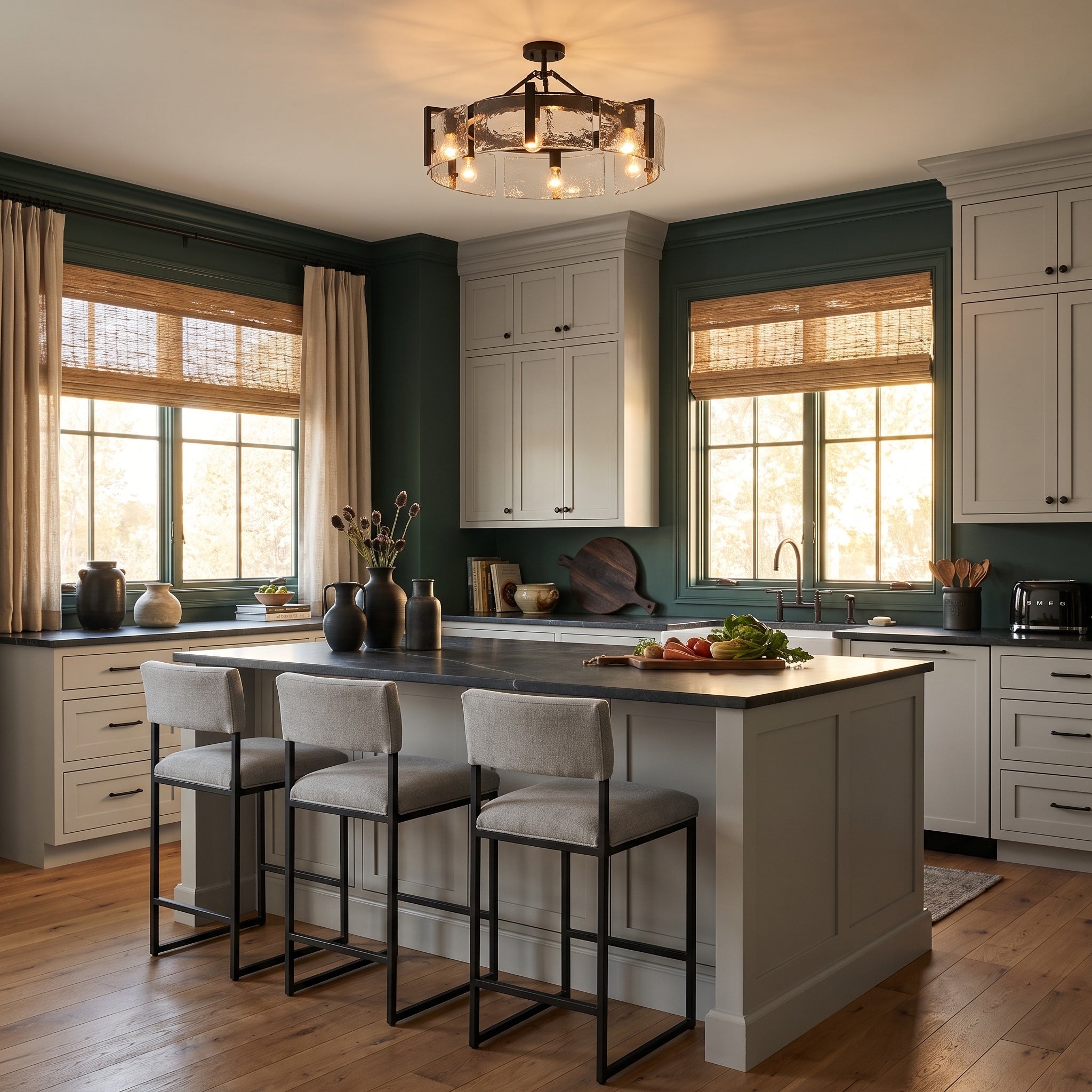
A low dining room can feel dim before dinner even starts. The ceiling presses down, the fixture looks awkward, and the whole room loses the easy warmth that a dining space should have.

That problem usually isn't the room. It's the lighting plan.

At Golden Lighting, the strongest results come from treating a low ceiling as a design condition, not a compromise. A well-chosen fixture can open sightlines, brighten the table, and make the room feel more settled. Homeowners often focus on style first. The smarter long-term investment is balancing style, clearance, and light distribution so the room works every day, not just in a showroom photo.

How to Brighten a Dining Room with Low Ceilings

A common scenario looks like this. The table is right, the chairs are right, and the paint color is close, but the room still feels boxed in. The overhead fixture either hangs too low and dominates the view, or sits too high and leaves the tabletop looking flat and underlit.

That's where dining room lighting for low ceilings changes the entire mood of the space. The right fixture doesn't just add brightness. It reshapes how the room feels when you walk in, sit down, and look across the table.

Low ceilings demand restraint in one place and confidence in another. The restraint comes from keeping visual clutter overhead under control. The confidence comes from choosing a fixture that still gives the dining area presence, instead of defaulting to something forgettable.

A few moves consistently improve the room:

  • Keep the table as the focal point: The light should support the gathering space, not fight it.
  • Use horizontal spread: Wider, shallower fixtures often make a room feel broader.
  • Avoid bulky silhouettes: Heavy shapes overhead can make the ceiling feel closer than it is.
  • Add light beyond the center fixture: Side lighting and reflected light help the room breathe.

A cramped dining room usually improves faster with better light placement than with new furniture.

Space planning matters too. Readers working through furniture layout at the same time may find this practical guide on how to make a small room feel bigger useful, especially when the goal is to support better sightlines and a more open dining zone.

The payoff is simple. A low ceiling stops feeling like the room's flaw and starts reading like part of a more intimate, intentional design.

Why Low Ceilings Demand a Different Lighting Strategy

Ceiling height changes every decision overhead. A fixture that looks balanced in one dining room can feel intrusive in another because the vertical space is tighter.

A warm, traditional dining room featuring a classic hanging pendant chandelier above a wooden table.

Sightlines matter more than style alone

The biggest mistake in a low dining room is choosing a fixture based only on silhouette or finish. In a room with limited height, the light becomes part of the eye-level experience. If it interrupts the view across the table, the room immediately feels smaller.

A useful rule of thumb is that if a fixture drops more than 8–10 inches below an 8-foot ceiling, it will typically make the space feel noticeably lower, which is why flush or semi-flush fixtures with shallow profiles are often the better choice for preserving clean sightlines and a more open feel, as noted in this low-ceiling lighting guideline.

That doesn't mean decorative lighting is off the table. It means the fixture has to earn its place by solving the room, not just decorating it.

The room feels smaller when the ceiling plane gets busy

Low ceilings create a psychological effect as much as a physical one. When too much mass hangs down, the eye reads the room as compressed. When the ceiling plane stays clean, the room feels calmer and wider.

That's why the best dining room lighting for low ceilings usually does one of two things:

  • It stays close to the ceiling: Ideal when traffic flows through the room.
  • It concentrates drop directly over the table: Ideal when the fixture doesn't interfere with movement.

Practical rule: In low rooms, protect the visual path first. Decorative impact comes second.

For homeowners comparing layouts or planning a renovation, a broader guide to Australian new build ceiling heights can help frame what β€œlow” or β€œstandard” really means in residential construction. That context matters when selecting proportions that won't feel forced.

What works better than oversized drama

Rooms like this respond well to fixtures that spread light outward rather than downward in a heavy column. Open frames, shallow drums, diffused glass, and close-to-ceiling forms tend to perform better than deep, tiered designs.

The goal isn't to make the light disappear. The goal is to keep the room from feeling interrupted.

The Best Fixture Styles for Vertically Challenged Spaces

Different low-ceiling rooms need different answers. A compact dining nook, an open-plan dining area, and a formal room with a centered table won't all benefit from the same fixture type.

An infographic illustrating four types of lighting fixtures suitable for rooms with low ceilings.

Flush mounts for maximum openness

Flush mounts are the cleanest answer when every inch matters. They keep the ceiling line intact and work especially well in dining spaces that double as circulation zones.

They also suit homeowners who want classic styling without a heavy visual footprint. If a room already has strong furniture, art, or millwork, a flush mount often keeps the composition balanced. Golden Lighting's own educational breakdown of what flush mount lighting is is a useful reference if the distinction between flush and semi-flush still feels blurry.

Semi-flush mounts when you want more presence

Semi-flush mounts add shape and character while staying disciplined overhead. That small drop can make the room feel more designed, especially above a centered table where the fixture has a clear visual role.

For a natural-texture direction, Golden Lighting Everly 6-light Semi-Flush Mount in Matte Black and Natural Rattan shade combines a wicker shade made from natural Raphia Rope with a Matte Black frame. Its convertible construction allows flexible installation for low or high ceilings, and its listed dimensions are 27.13"W x 13.25"H x 27.13"D.

That kind of fixture works well when the room needs warmth and texture, not just overhead brightness.

Shallow pendants for targeted table lighting

A shallow pendant can be the right move when the dining area is clearly defined and the light hangs only above the table, not over a walking path. This is often the answer for homeowners who want a focal point but don't want a bulky chandelier form.

Creative clients also tend to like this category because it leaves more room to personalize the rest of the space. Material contrast, finish mixing, and shade choices become more expressive when the profile stays controlled. That's where mix-and-match thinking, including the flexibility associated with YEP by Golden, can support a more personal result.

Wall sconces and side lighting as supporting players

Some rooms shouldn't rely on one central fixture. Wall sconces, buffet lamps, or directional lighting can reduce the burden on the ceiling fixture and make the room feel wider.

A useful way to think about the options is this:

Fixture type Best use in a low dining room Main trade-off
Flush mount Open rooms and traffic-heavy layouts Less decorative drama
Semi-flush mount Centered tables that need style Slightly more visual weight
Shallow pendant Defined dining zones Needs disciplined placement
Wall sconces Layering and widening the room visually Doesn't replace central task light alone

Perfect Placement and Sizing for Low-Profile Lighting

A good fixture can still fail if it's hung at the wrong height or scaled without reference to the table. Placement is where polished design turns into daily comfort.

An infographic showing four essential tips for choosing dining room lighting for low ceilings, including height and diameter.

Hang to the table, not to the room

For low dining rooms, the most important reference point is the tabletop. For 7 to 8-foot ceilings, the most effective guideline is to place the bottom of a pendant or chandelier 26–34 inches above the tabletop, and in very low rooms within that range, 26–28 inches is a practical adjustment for comfort and light spread, based on this low-ceiling dining room hanging guide.

That measurement works because the fixture serves the dining surface first. It lights the table while keeping views across the room more open.

If the fixture hangs over a space where people walk, clearance becomes a separate issue. In those rooms, low-profile ceiling-mounted options usually make more sense than anything suspended.

Size for balance, not for bravado

Diameter matters just as much as drop. A fixture that's too small can look apologetic. One that's too wide can crowd the room even if the height is technically fine.

A practical selection process should include:

  • Measure the table first: The fixture should relate to the table, not float without connection.
  • Check visual mass: Open frames read lighter than dense shades, even at the same width.
  • Consider chair count and room edges: A compact room needs breathing room around the light.
  • Review installation details before ordering: Canopy shape, stem options, and adjustability affect the final fit.

For readers comparing proportions and layout decisions, Golden Lighting's guide on how to size and place your light fixture is a strong planning tool.

Pro-Tip: Mock up the fixture with a balloon, paper circle, or painter's tape before purchase. It's one of the fastest ways to test visual width and hanging depth from normal seated and standing viewpoints.

Don't ignore the floor clearance check

In rooms with very low ceilings, the total drop still has to respect safe movement. The tabletop measurement may work beautifully, but only if the fixture's body and hardware don't create a hazard outside the dining zone.

That's where engineering details matter. A fixture should look right from every angle, but it also has to install cleanly within the room's real constraints.

Layering Light to Add Depth and Ambiance

The most inviting dining rooms rarely depend on a single source of light. They feel complete because the lighting comes from more than one direction and serves more than one purpose.

A warm and inviting dining room featuring layered lighting with a dark wood table, upholstered chairs, and ambient lamps.

Build the room in layers

A strong low-ceiling plan usually combines ambient light, focused light over the table, and softer accent lighting around the perimeter. This matters even more when the central fixture has to stay shallow.

An emerging approach is layered perimeter lighting, using LED tape lights or pinspots along walls as the ambient foundation instead of relying on a dropped center fixture. That setup can deliver 3,000–6,000 lumens and is described as a growing high-design option for 2025–2026 in this discussion of low-ceiling perimeter lighting ideas.

That trend makes sense from both a design and engineering standpoint. It frees the ceiling plane while still giving the room enough usable light.

Warmth matters as much as brightness

A dining room should feel flattering at dinner and functional during cleanup. That's why dimmer control is so important. It gives one room more than one setting without changing fixtures.

A layered plan often includes:

  • Ambient light: General room illumination from a flush mount, semi-flush mount, or perimeter lighting
  • Table-focused light: The main source that gives the dining surface definition
  • Accent light: Sconces, buffet lamps, or directional lighting that adds depth and softness

Side lighting often does more for atmosphere than a larger ceiling fixture ever could.

Material choices elsewhere in the room help too. Upholstery, wood tone, and wall color all affect how light is absorbed and reflected. For anyone refining the full dining environment, this look at custom sofas for Sandy Springs is a useful reminder that furniture texture and lighting should support each other, not compete.

For a broader planning framework, Golden Lighting's article on how to layer lighting is worth keeping open during the selection process.

Design Scenarios and Styling Inspiration

Some of the best solutions become clear only when the room is viewed as a lived space, not a product category.

A modern dining room with a drum pendant light, wooden table, black chairs, and neutral decor.

A square room that feels boxed in

The problem is common. A square dining room with a low ceiling often feels static, especially if the fixture is small and visually dense.

The better fix is usually a wide, shallow semi-flush or drum-style piece that spreads attention outward. That change can make the ceiling feel calmer because the eye reads width before drop.

An open-plan dining area with traffic nearby

When people move through the dining zone, the wrong pendant becomes an obstacle. In that layout, a close-to-ceiling fixture paired with wall lighting or side lamps usually performs better than a decorative hanging piece.

That's also where modern low-profile forms shine. A restrained silhouette keeps the room from feeling interrupted every time someone passes through.

A short visual walkthrough can help clarify how different fixture forms change a room:

The contrarian answer on chandeliers

A chandelier isn't automatically wrong in a low dining room. It's wrong only when scale, drop, and placement are ignored.

A notable design tip states that a chandelier with a total drop of 14cm or less can be centered directly over a dining table, using the dining-surface clearance rather than full-floor clearance as the governing principle. That makes low-profile, height-adjustable chandeliers a viable option in rooms where many homeowners would rule them out entirely, according to this design video on chandelier use in low ceilings.

That's an important distinction. The table creates a protected visual zone. If no one walks under the fixture outside the dining area, a carefully chosen chandelier can still belong there.

Installation Checks and Essential FAQs

Before installation, a few checks prevent expensive frustration later.

  • Confirm junction box support: The ceiling box should be suitable for the fixture being installed.
  • Review door and cabinet swing: Nearby doors, hutches, and tall storage can create conflicts.
  • Test seated sightlines: Sit at the table before finalizing height.
  • Check bulb access: Low-profile fixtures still need practical maintenance.

Common questions

Can a low-ceiling dining fixture go on a dimmer?
Usually, yes, if the fixture and bulbs are compatible with the dimmer being used.

What about a sloped ceiling?
Choose fixtures with hardware that accommodates the slope cleanly. Adjustable or convertible designs help.

Are recessed lights enough on their own?
Sometimes, but many dining rooms feel better with another layer for warmth and focus.

How should a flush mount be cleaned?
Turn power off, let bulbs cool, and clean the fixture according to its material and glass details.


Ready to refine your dining room lighting for low ceilings with more confidence? Shop the Collection or Find a Showroom Near You.

Our latest lighting stories, trend forecasts, and design inspirationβ€”curated just for you.

Fresh from The Edit

View all

Chandelier Over Kitchen Table
  • by Rick Kovac

Chandelier Over Kitchen Table

Read moreabout Chandelier Over Kitchen Table

Dining Room Lighting for Low Ceilings: Brighten Your Space

Read moreabout Dining Room Lighting for Low Ceilings: Brighten Your Space

Pendant Lighting for Bathroom Vanity: Expert Guide 2026

Read moreabout Pendant Lighting for Bathroom Vanity: Expert Guide 2026

Recessed Wall Lights: Illuminate Your Home with Style

Read moreabout Recessed Wall Lights: Illuminate Your Home with Style

What Is Flush Mount Lighting? Your 2026 Guide to Style &

Read moreabout What Is Flush Mount Lighting? Your 2026 Guide to Style &

Contemporary Island Lighting Your Definitive Design Guide

Read moreabout Contemporary Island Lighting Your Definitive Design Guide

Sconce Light Wall Guide: Illuminate Your Home with Style

Read moreabout Sconce Light Wall Guide: Illuminate Your Home with Style

Lights Over Mirror: Your 2026 Guide to Perfect Vanity

Read moreabout Lights Over Mirror: Your 2026 Guide to Perfect Vanity

Your Guide to a Flush Mount Ceiling Light Pull Chain

Read moreabout Your Guide to a Flush Mount Ceiling Light Pull Chain

Lighting Fixtures for Kitchen: Your Ultimate Planning Guide

Read moreabout Lighting Fixtures for Kitchen: Your Ultimate Planning Guide

Swing Arm Sconce Guide: Placement, Wiring & Style Tips

Read moreabout Swing Arm Sconce Guide: Placement, Wiring & Style Tips

Outdoor Lighting Maintenance: A Pro's Guide for 2026

Read moreabout Outdoor Lighting Maintenance: A Pro's Guide for 2026