


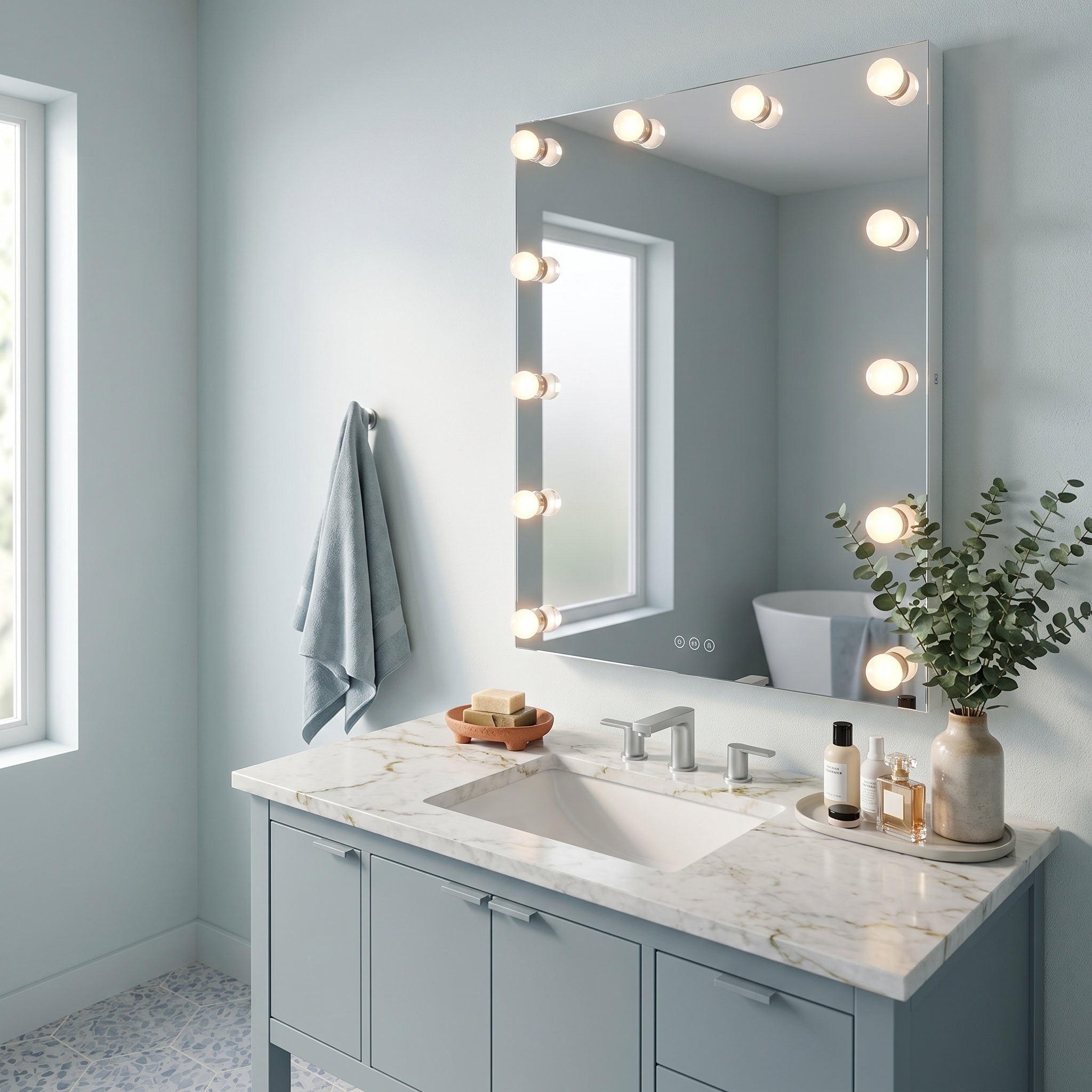
A lighted mirror is the one fixture you look into every day, which makes sizing mistakes impossible to ignore. Too small reads like an afterthought floating on the wall; too wide fights the faucet and crowds the sconces. The good news: mirror sizing comes down to two measurements you already have — your vanity's width and your own eye level.
The width rule
Our design team sizes bathroom mirrors to 70–90% of the vanity's width. That proportion keeps the mirror clearly anchored to the vanity below it — wide enough to feel generous, narrow enough to leave breathing room at the edges.
In practice, against common vanity widths:
A 24-inch mirror suits vanities from roughly 26 to 34 inches — powder rooms, compact baths, tight layouts. A 30-inch mirror is the workhorse for the most common single-sink vanities, 34 to 42 inches. A 48-inch mirror belongs on a large single-sink vanity, roughly 48 to 60 inches wide — and this is the one people get wrong in both directions. 48 inches is not big enough to serve a true double-sink vanity: centered between two sinks, it leaves both users looking at the mirror's edge. Double vanities (60 inches and up, two sinks) are better served by two individual mirrors, one centered over each sink, than by one mirror that splits the difference.
So the quick test: measure the vanity, multiply by 0.7 and 0.9, and shop inside that range. One sink gets one centered mirror; two sinks get two.
Mounting height: one question before any numbers
Will you mostly stand at this mirror, or sit? That single answer drives the height more than any formula, because seated eye level runs roughly a foot below standing eye level. The governing idea stays the same either way — your eyes should land comfortably in the middle third of the glass — but where that middle third belongs depends on the posture.
Standing use (the typical bathroom vanity, ~36-inch counter): set the bottom edge 5 to 10 inches above the countertop — high enough to clear the faucet and backsplash — and standing eye level falls naturally into the glass.
Seated use (a makeup table at desk height, a rolling stool, or an accessibility-first bath): mount lower. Keep the bottom edge close to the counter — the low end of the range or tighter — so seated eye level still lands mid-glass. This is also where lighting placement matters most: a seated face sits further below the fixtures, so mirror-integrated light earns its keep.
Mixed use — the common reality: most mirrors serve both postures — standing for the morning routine, seated for makeup or detail work. Two rules make one mirror do both jobs. First, favor the seated user: someone standing can comfortably glance down into a lower mirror, but someone seated cannot stretch into a high one. Second, let the glass absorb the difference — this is where a tall mirror earns its height. Run the numbers on a standard 36-inch counter: mount a 36-inch-tall mirror with its bottom edge about 4 inches above the counter and the glass spans roughly 40 to 76 inches off the floor — seated eye level (about 44–50 inches) lands in the lower half, standing eye level (about 60–65 inches) in the upper middle, both comfortably inside the reflection. One mounting height, both postures served — which is exactly why our Starlight line runs 36 inches tall across all three widths.
Separate from how you plan to use the mirror, there's a compliance layer: ADA standards set specific mounting requirements (including a lower bottom edge for the reflective surface) for covered projects — commercial spaces, hospitality, rental units, and homes built to accessibility code. If your project falls under those rules, the mirror itself must be rated for it — all three Starlight sizes are ADA compliant.
Round or rectangular?
Rectangular mirrors maximize usable reflection per inch of wall and pair naturally with the strong horizontal line of a vanity. Round mirrors soften a bathroom full of hard edges and suit powder rooms, where the mirror works as a decorative statement rather than a daily grooming station. The sizing rule holds either way — a round mirror's diameter plays by the same 70–90% logic, though rounds usually land at the lower end since their corners don't reach.
Don't forget the light itself
Size and height place the glass; the light finishes the job. The residential lighting standard's core principle for grooming is that light should fall on the face — from the mirror's direction, not just from a ceiling fixture that throws brow and chin shadows exactly where you're working (ANSI/IES RP-11-26). A lighted mirror sized correctly does both jobs at once: right proportion for the wall, and face-on illumination built into the glass. Pair it with a dimmer-controlled ambient layer and the bathroom works at 6 a.m. and at midnight.
Quick tips for sizing your mirror
- Width: 70–90% of your vanity’s width
- Count: one sink, one mirror — centered on the sink; two sinks, two mirrors
- Standing use: bottom edge 5–10″ above the counter
- Seated or mixed use: mount lower, and favor the seated user — eyes should land in the middle third of the glass
- 48″ mirrors fit large single vanities (48–60″), not doubles
- ADA-covered project? The mirror itself must be rated for it (every Starlight is)
See all three sizes side by side — 24", 30", and 48", each in three diffuser styles — in the Starlight LED mirror collection.
Share:
The Best Lighting for Makeup: Color Temperature, CRI, and Brightness Explained
Exterior Home Lighting: A Guide to Perfect Illumination