


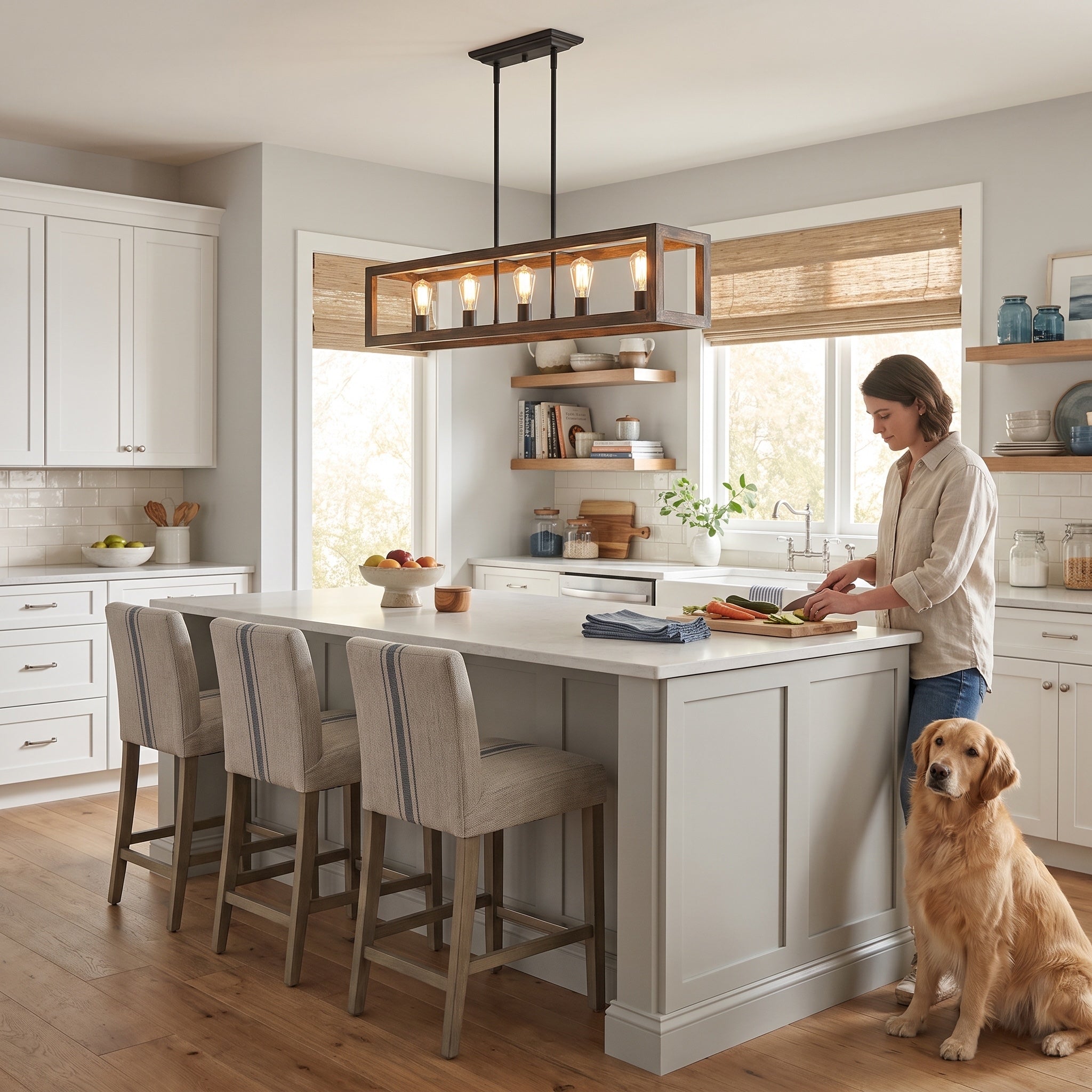
The island is the hardest-working surface in your home — prep station, breakfast bar, homework desk, party headquarters. Its lighting has to work just as hard, and there's a reliable playbook for getting it right.
Islands need real task lighting
An island calls for real task light: either pendants installed in multiples or one high-output statement fixture — a large linear pendant or a generously lamped chandelier that can flood the whole work surface. As a rule of thumb from our design team: three small pendants, two medium pendants, or one oversized fixture. The goal is even task light across the entire counter, with consistent coverage from end to end.
Size each pendant to the island
A well-proportioned pendant is about one-third the width of the island it hangs over. Pendants that pass this check look inevitable; pendants that fail it look like an afterthought. For linear fixtures, switch to length: about half the island's length, with one-third to two-thirds as the acceptable range.
Worth knowing if you're sizing fixtures for more than just the island: the dining table follows a related but different rule — a table's fixture runs 1/2 to 2/3 of the table's width, not 1/3. Our white paper, The Golden Scale Method: A Proportion System for Sizing Light Fixtures, covers the table-specific version in depth, including what to do when it conflicts with the room's own size.
Placement: the centerline is everything
Pendants belong on the island's long centerline, evenly spaced — positioned the way an electrician would actually install them, centered as a group over the island. A row that drifts off the centerline, or spacing that bunches toward one end, is the single most common thing that makes an otherwise beautiful kitchen photo look off. Hang them 30 to 36 inches above the countertop.
Two placement rules our designers treat as absolute: keep pendants clear of the range hood entirely, and if your island has a cooktop, put the seating on the opposite side.
What about flush mounts in kitchens?
Flush and semi-flush ceiling lights have a real place in kitchens — the right kitchens. They shine in smaller kitchens, and in galley kitchens a row of two or three along the ceiling gives beautifully even light. Over an island, they play a supporting role — the pendants carry the real task light. In larger kitchens, flush mounts support the island fixtures the same way.
Layer the rest of the room
The IES residential lighting standard (ANSI/IES RP-11-26) treats layering as fundamental: ambient light for the room, task light where work happens, and the decorative fixture as the jewelry. In practice that means your island pendants get help — undercabinet strips for the counters, recessed or ceiling fixtures for general light. Wall sconces can join a kitchen too, as a supplement to the main event.
One glare note worth knowing from the same standard: open-bottom pendants are meant to hang at or below eye level over a surface. Mounted higher — in an entry or a stairwell — they need bottom shielding so you're not staring at a bare bulb.
Finishing touches (current style notes)
Two styling conventions we follow right now, offered as trend guidance rather than timeless law: kitchen windows look best in roller shades, Roman shades, or blinds rather than full curtains — cleaner near cooking zones and better for light. And cabinet hardware, faucets, and fixture finishes read most intentional when they match or share a color family (blacks together, brass and gold together, nickels and chromes together).
Recommendations from Golden Lighting's design rulebook: professional designer consensus, corroborated where noted by the IES/ALA recommended practice for residential lighting (ANSI/IES RP-11-26). Style notes are current-trend guidance, dated 2026.
Share:
The Best Lighting for Makeup: Color Temperature, CRI, and Brightness Explained
What Size Chandelier Do I Need? The Sizing Rules Designers Actually Use