


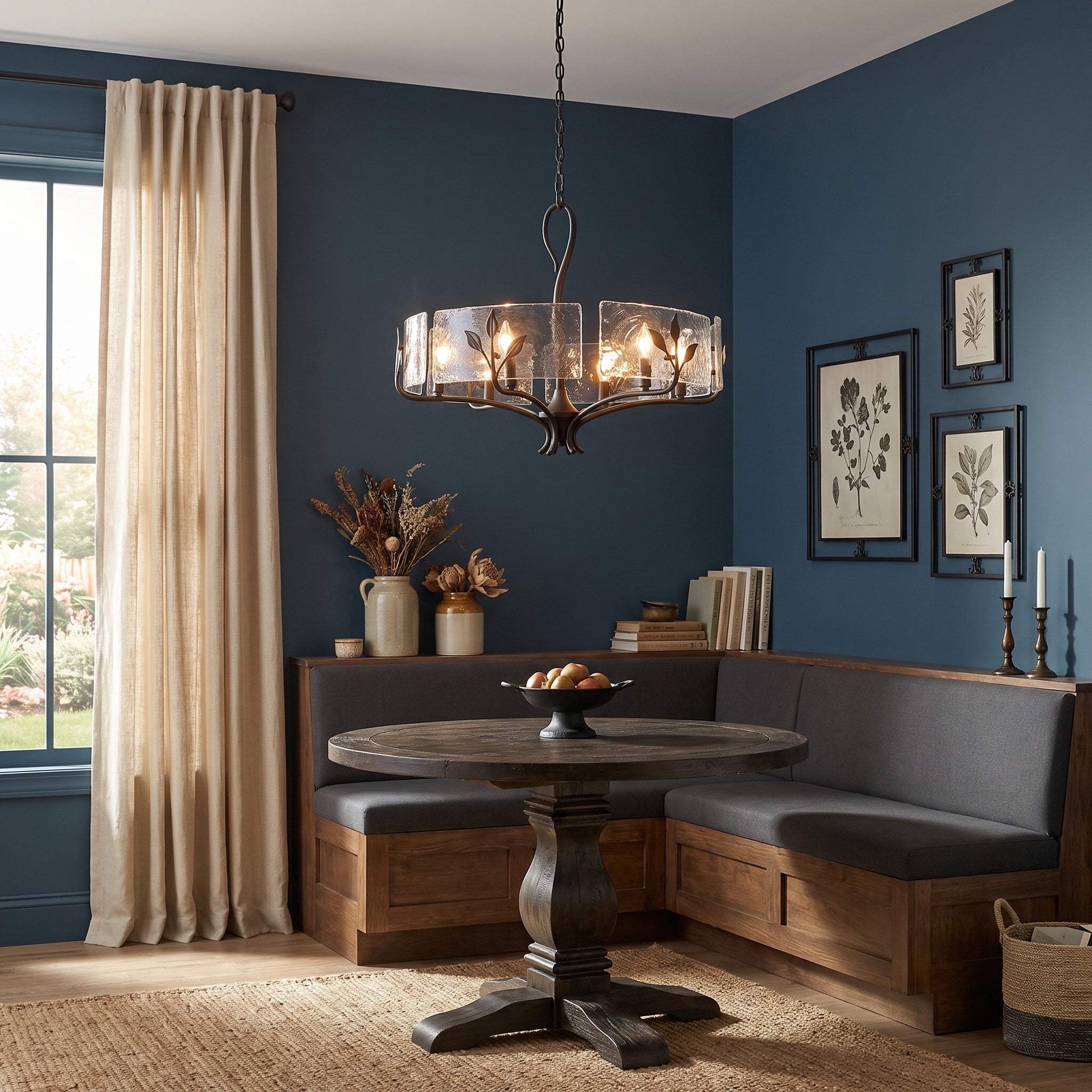
Is a dark kitchen making meal prep a chore? Does your entryway feel cramped and uninviting? You can walk into a room and know, almost instantly, when something feels off. More often than not, we find the culprit is the lighting—specifically, a chandelier that’s too small, too big, or hung at the wrong height.
It’s a design pain point that can undermine an otherwise beautiful space. That’s why we’re here to guide you through the simple math designers use, turning a tricky decision into a confident choice with our easy-to-use chandelier size calculator.
How to Unlock Flawless Lighting Design

In my years in this business, I've learned that getting the scale right is the single most important factor in achieving a balanced, beautifully illuminated room. Lighting is about so much more than just function; it's the element that creates atmosphere and pulls your entire design together.
When the scale of a central fixture is an afterthought, the whole design can fall flat. A properly scaled chandelier will always put your living room in the best light.
Why Getting the Scale Right Matters
A perfectly sized chandelier feels intentional. It’s the key to unlocking a polished, professional look in any room. Here’s the value it brings:
- Creates Visual Balance: It anchors the room without overwhelming it, feeling like a natural and necessary part of your space.
- Enhances Ambiance: The right size and height distribute light effectively, casting a warm and inviting glow that sets the mood.
- Defines Your Space: In open-concept homes, a chandelier can create a distinct zone, clearly marking a dining area or a cozy sitting room.
We’ll give you the formulas and confidence to select a fixture that doesn't just light your space—it completes it. With these tools, you can browse our Chandeliers collection with the discerning eye of a seasoned designer.
Pro-Tip: When In Doubt, Go Bigger In my years in this business, the most common sizing mistake I see is choosing a fixture that's too small. If your calculations place you between two sizes, my experience shows that opting for the larger one almost always creates a more impactful and professional look, especially in rooms with high ceilings.
The Golden Rules of Chandelier Sizing
Choosing the right chandelier can feel like a high-stakes decision. Go too small, and the fixture gets lost. Go too big, and it completely overwhelms the room. After years of guiding homeowners and designers, I’ve found that a couple of simple rules of thumb make all the difference.
These aren't rigid laws but rather time-tested guidelines that give you a reliable starting point. Think of them as the foundation for getting the scale just right, so you can browse our Chandelier collections with confidence.
For Open Spaces Like Living Rooms And Bedrooms
In an open area like a living room, great room, or primary bedroom, the chandelier acts as a central focal point. Its size needs to relate to the entire room to feel balanced and intentional.
The go-to formula is surprisingly straightforward:
Room Length (in feet) + Room Width (in feet) = Ideal Chandelier Diameter (in inches)
So, if you have a living room that’s 14 feet wide by 18 feet long, you’d add those two numbers together (14 + 18 = 32). This means a chandelier with a diameter right around 32 inches will anchor the space beautifully without feeling imposing.
For Dining Rooms And Kitchen Nooks
When you're hanging a light over a specific surface—like a dining table or kitchen island—the perspective shifts. The chandelier's relationship is now with the furniture beneath it, not the overall room dimensions.
Here, the sizing is all about proportion to the tabletop:
Chandelier Diameter = 1/2 to 3/4 of the Dining Table's Width
Let’s say your dining table is 48 inches wide. You’ll want to look for a fixture that measures between 24 and 36 inches in diameter. This range gives you creative flexibility. A visually light, airy design from our YEP by Golden collection might look stunning at the 36-inch mark, while a more substantial, traditional piece could feel perfect at 24 inches.
Getting this wrong is one of the most common design mistakes. With the lighting fixtures market projected to surge to an incredible $221.39 billion by 2034, it’s clear that lighting is a critical investment for homeowners. A simple sizing error can throw off a room’s entire harmony. It’s no wonder that over 60% of interior designers rely on tools like a chandelier size calculator to eliminate the guesswork that plagues up to 35% of DIY projects.
Using Our Interactive Chandelier Size Calculator
To take the pressure off, we built our own interactive Chandelier Size Calculator. It handles all the math for you.
Just plug in your room dimensions or your table width, and it instantly gives you the perfect diameter range for your new fixture. It’s the same first step our own design team takes.
This gives you a solid, reliable number to work with, letting you focus on the fun part: finding a style you love. Whether you’re drawn to the sophisticated presence of a Ziva by Golden fixture for a formal dining space or need a versatile piece for your living room, our calculator ensures you start the search with absolute certainty.
Calculating The Perfect Chandelier Hanging Height
Once you've landed on the perfect diameter, it's time to talk about height. I’ve seen it time and time again—getting the hanging height wrong by just a few inches can throw off a room's entire feel. Diameter gives you scale, but it's the height that truly brings your design to life.
Hang a chandelier too high, and it gets lost, looking disconnected and out of place. Hang it too low, and you're blocking sightlines or creating a hazard in high-traffic areas. It's a delicate balance, but we'll get it just right.
The Guideline For Dining Rooms
Over a dining table, the rule is refreshingly simple. The goal here is to illuminate your meals and create an intimate setting without blocking the view of your dinner guests across the table.
For the best effect, the bottom of your chandelier should hang between 30 and 36 inches above the surface of your dining table. This positioning creates a warm pool of light, making the fixture a stunning centerpiece for conversation and dining.
This simple diagram shows how the sizing process shifts from a general living space to a specific dining area where the table becomes the anchor.

The key takeaway is that context is everything. The fixture has to relate beautifully to either the room's total size or the furniture directly beneath it.
Hanging Height For Foyers And Living Areas
In open spaces like living rooms, foyers, and bedrooms, the calculation is all about safe clearance and vertical scale. Here, we measure from the floor up, and the main factor is your ceiling height.
The standard starting point is to leave at least 7 feet of clearance between the floor and the bottom of the fixture. This is the sweet spot for a standard 8-foot ceiling.
But what about taller ceilings? For every foot of ceiling height you have above 8 feet, you'll want to raise the chandelier by 3 inches. It's a simple rule that makes a world of difference.
For every foot of ceiling height above 8 feet, add 3 inches to the hanging height.
Let's walk through an example. Imagine a grand entryway with a 16-foot ceiling. That’s 8 feet taller than the standard. So, we multiply 8 feet x 3 inches, which gives us an additional 24 inches of height.
Add that to your baseline clearance (7 feet + 24 inches), and you'll find the bottom of your chandelier should hang about 9 feet from the floor. This ensures the fixture commands the upper volume of the space without feeling disconnected.
Pro-Tip: Consider The Visual Weight A dense, crystal-laden chandelier has more "visual weight" than a light, airy one. If you've chosen a heavier-style fixture, you might want to hang it an inch or two higher within its recommended range to keep the room feeling open and balanced.
Chandelier Hanging Height By Ceiling Height
To make things even easier, here’s a quick-reference table for the most common ceiling heights. Use this to find the perfect hanging height and ensure your fixture is both a functional and beautiful focal point.
| Ceiling Height | Recommended Height from Floor (to bottom of fixture) |
|---|---|
| 8 ft | 7 ft (84 inches) |
| 9 ft | 7 ft, 3 inches (87 inches) |
| 10 ft | 7 ft, 6 inches (90 inches) |
| 12 ft | 8 ft (96 inches) |
| 14 ft | 8 ft, 6 inches (102 inches) |
Following this guidance will help you achieve a polished, professionally designed look. Of course, beyond just the height, proper lighting placement is also key to creating the best possible ambiance.
Getting these details right is what separates a good room from a great one. For more specific advice, you can also explore our comprehensive guide on how to size and place your light fixture.
A Room By Room Sizing Masterclass

The formulas give you the numbers, but a truly great lighting plan comes from understanding the room itself. A home isn't a set of empty boxes; every space has its own flow and feel. I've learned that the best results come from adapting the sizing rules to the room's specific purpose.
So, let's move from pure calculation to curation. We'll walk through a few key areas of the home, applying these principles to make sure every fixture feels like it was made for the space.
The Grand Statement in a Two-Story Foyer
A soaring, two-story foyer is your home's first impression, and it demands a fixture with real vertical presence. This is no place for a timid little light. Here, the sheer volume of the space is just as critical as the floor's square footage.
Your goal is to fill that vertical void and draw the eye upward, making the grand ceiling height feel intentional. In my experience, a multi-tiered chandelier is almost always the perfect solution.
When sizing for a two-story entryway, start with the standard formula (Length + Width = Diameter), but don’t be afraid to lean toward the larger end of the suggested range. Trust me, a fixture that looks massive in the box often feels just right once it’s suspended in that vast, open air.
Creating a Serene Focal Point in the Bedroom
The primary bedroom should be a sanctuary, and your lighting needs to reflect that. You want a soft, inviting focal point that doesn't feel overbearing. The room dimension formula is still your best starting point for getting the diameter right.
From there, think about visual weight. A light and airy piece, maybe with customizable options, can add a personal touch without dominating the room. I've found that a chandelier that is visually lighter—with delicate arms or fine details—can often be sized up slightly to create a more luxurious, boutique-hotel feel without overwhelming the space.
A Room's Vibe is Everything Getting the chandelier size right can make or break your room's vibe. Think back to the Art Deco era of the 1920s, when grand chandeliers in places like New York’s Waldorf Astoria became symbols of opulence. Fixtures often spanned 10-15 feet to match soaring 20-foot ceilings—a sizing principle that still holds true. Today, the global chandeliers market, valued at USD 8.20 billion in 2024, is still driven by this, with North America holding a 31.0% revenue share because homeowners know perfect scaling is a luxury. You can find more market insights from Grand View Research.
A Touch of Luxury in the Bathroom
Bringing a chandelier into a primary bathroom is a brilliant way to add unexpected elegance. Given that most bathrooms are smaller scale, mini-chandeliers or even small pendants are usually the way to go. A single, small chandelier centered in the room can instantly elevate the entire design.
For a more polished look over double vanities, consider hanging two matching mini-chandeliers for perfect symmetry. But here, safety is absolutely paramount.
- Damp Rating: Always choose a fixture that is "damp-rated," which means it's built to handle moisture in the air.
- Clearance: The fixture must hang at least 3 feet away from the edge of a tub or shower and at least 8 feet above it.
Following these rules ensures you get all the style without any of the safety risks.
Tackling Vaulted Ceilings and Open-Concept Areas
Challenging layouts just require a bit more strategy. For rooms with vaulted or sloped ceilings, you'll need to measure the ceiling height right at the point where the fixture will hang to get the chain length right. You'll also need a canopy with a swivel adapter so the chandelier hangs straight.
In a large, open-concept area, use lighting to define the different "zones." A professional might specify a grand fixture for the main seating area to create a powerful anchor for the whole space.
From there, you can layer in complementary lighting. Using coordinating fixtures over a kitchen island or in an adjacent dining nook creates a cohesive design language that ties the open-concept room together. For a deeper look at these spaces, our guide on how to determine the right size light fixture for your kitchen or dining room is a great resource. This is exactly where our chandelier size calculator becomes an invaluable tool for planning a beautiful, multi-zone layout.
Pro Tips For Sizing Beyond The Math
After years in lighting design, I can tell you that while our formulas and the chandelier size calculator provide a fantastic starting point, the most stunning results come from trusting your eye. What I’m seeing on the factory floor and in the most inspiring homes is a clear trend: a move toward confident, even daring, choices. Don't let the math become a rigid boundary.
Think of the calculation as your foundation, then layer your personal style and intuition on top. The formulas give you the “correct” answer, but your gut will tell you what feels right for the room.
Go Bigger For A High-End Look
Clients often worry about choosing a chandelier that’s “too big.” But in my experience, a slightly undersized fixture is a far more common design misstep. If you find yourself on the fence between two sizes, I almost always advise going with the larger option.
A more substantial fixture creates a dramatic, high-end focal point that truly commands attention. This is especially true in minimalist spaces, where the chandelier stands out as the primary decorative element. A larger, well-chosen fixture can make an entire room feel more luxurious and thoughtfully designed.
Consider Visual Weight, Not Just Diameter
The numbers from a chandelier calculator give you a diameter, but not all fixtures with the same measurement look the same. The real key is to consider a fixture's visual weight—how heavy or light it appears in the space.
-
Light & Airy Designs: A fixture with thin arms, an open-frame structure, or clear glass elements has low visual weight. You can often size up with these styles to fill a space without it feeling crowded.
-
Dense & Ornate Fixtures: A chandelier with heavy crystal elements, solid metal, or fabric shades has high visual weight. For these designs, it’s often best to stick to the conservative end of your calculated size range to avoid overwhelming the room.
Pro-Tip From The Factory Floor On the factory floor, we handle thousands of fixtures, and you develop a real sense for how a design will feel in a space. In my experience, the best approach for a challenging room, like one with low ceilings, is to choose a fixture with less vertical height and a wider, more open design. This creates a sense of scale without sacrificing precious headroom.
Think In Multiples
Sometimes, the perfect solution isn’t one large chandelier but a curated grouping of smaller lights. A cluster of stylish Pendants can be a fantastic and creative alternative to a single chandelier, especially over a long dining table or a spacious kitchen island.
This approach delivers excellent task lighting and creates a custom, high-design look. It’s also an ideal solution for rooms with lower ceilings. If you're struggling to find the right single fixture, our guide to finding lighting for low ceilings can offer some great alternatives.
Time to Shop: Putting Your Numbers to Work
You’ve done the math and you have your ideal dimensions, thanks to our chandelier size calculator. Now for the fun part—finding the perfect fixture that brings your entire vision to life.
This is where the numbers on the page become a stunning focal point in your home. Armed with your measurements, you can browse with total confidence, knowing exactly what will fit and flatter your space.
From Calculation to Curation
The real magic of the calculator is how it cuts through the noise. Instead of getting lost in a sea of options, you now have a focused, curated list of possibilities. You can immediately filter our collections by the diameter and height you know will work.
As you explore, keep those ideal dimensions in mind. Every product page lists the fixture's exact size, letting you compare the specs to your calculations. This is where you get to balance the science of sizing with the art of your personal style.
-
For Homeowners: Explore the enduring, classic designs in our main Golden Lighting collections. These are pieces built for timeless appeal, and now you know exactly which sizes to look for.
-
For Creatives: Think of your calculated size as the canvas. Dive into the YEP by Golden collection and start designing. You can mix and match shades and finishes on a perfectly sized frame for a look that's 100% you.
-
For Professionals: When you're specifying for a client, your calculations are your best friend. A show-stopping piece from the Ziva by Golden collection, selected with precise sizing, instantly anchors a high-end design and proves your expertise.
Pro-Tip: Download and Dream In my experience, the best designs come from seeing the full breadth of what's possible. Before you decide, download our 2026 catalog. It's a fantastic way to see what's next in lighting and helps you envision how a piece will fit into a larger design story.
The hardest part is over. You've measured and calculated like a pro. Now, enjoy the rewarding process of choosing a beautiful fixture that will completely transform your room.
Start exploring our Chandeliers collection today and bring that perfectly illuminated vision home.
Answering Your Toughest Chandelier Questions
We've gone over the formulas and the chandelier size calculator, but I've been in the lighting business long enough to know that real-world homes rarely follow a simple template. Every space has its quirks.
Here are the answers to a few of the most common questions that come up when you're dealing with a room that’s a little outside the box.
What If My Room Has A Sloped Or Vaulted Ceiling?
Vaulted ceilings add incredible drama to a room, but they do require a bit of planning to light correctly. The goal is always to have the chandelier hang perfectly level, regardless of the ceiling's angle.
The secret is a small piece of hardware called a swivel adapter. When you're shopping, look for fixtures that include one at the canopy. This allows the chain to pivot and compensate for the slope. You'll also need to measure from the floor to the highest point of the ceiling where the fixture will be installed to make sure you have enough chain for the proper hanging height.
Can I Use A Rectangular Chandelier Over A Round Table?
Honestly, my best advice is to match the shape of your fixture to the shape of your table. It creates a sense of visual harmony that just works. A round chandelier over a round table feels balanced, and a linear fixture over a rectangular table feels intentional.
Mixing those shapes can throw off that natural flow. If you’re really drawn to an elongated look over a round table, consider a cluster of stylish Pendants instead. This gives you a similar linear feel without disrupting the room's composition.
A Pro Design Secret When defining zones in an open-concept space, don't just stop at the fixtures. Use area rugs to visually anchor each zone on the floor. A large rug under your living room seating and another under the dining table creates "rooms without walls," making your lighting choices feel even more intentional.
How Do I Choose A Chandelier For An Open Concept Space?
In an open-concept home, you need to think like a designer creating distinct "zones" with light. Start with your main living area and use the room dimension formula (Length + Width) to size its chandelier. This fixture is your anchor piece.
From there, you’ll want to select complementary fixtures for the other zones, like the dining area or kitchen island. The best way to create a seamless, high-end look is to choose pieces from the same collection. For example, a designer might specify a large, dramatic Ziva by Golden chandelier in the great room, then pull in the coordinating Ziva pendants to hang over the kitchen island. It tells a unified and sophisticated design story.
Ready to find your perfect fixture? Golden Lighting has a curated collection for every room and style.


Share:
How to Install a Vanity Light Fixture: A Pro Guide
Master Sconce Height in the Bathroom: A Guide to Perfect Vanity Lighting